HelloGrowthCRM software
Built for real small-business sales teams
HelloGrowthCRM helps reps qualify faster, follow up on time, and close more deals—with practical automation in one place.
- AI lead scoring and pipeline visibility
- Built-in dialer, WhatsApp, and email automation
- Sales forecasting and RevOps-ready reporting
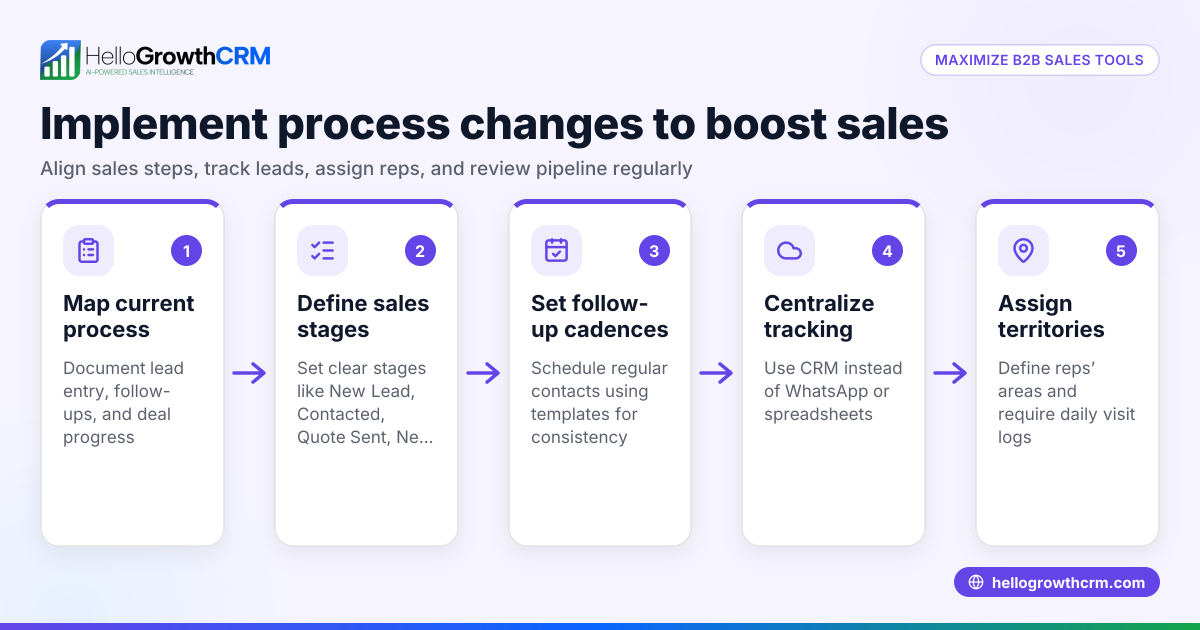
To get the most value from B2B sales tools, especially in small and mid-sized Canadian businesses, process changes are essential. These changes include standardizing how leads are captured, tracked, and followed up on, and integrating communication channels like WhatsApp and email into the sales workflow. This article explains why these changes come up, guides you step-by-step, provides a worked example, highlights common mistakes, and shows how HelloGrowthCRM can help.
Why this comes up / what goes wrong
Many small businesses start with informal sales processes: tracking leads on spreadsheets, texting customers, or emailing without a clear system. As sales volume grows, leads get lost or forgotten, follow-up is inconsistent, and the team lacks visibility into pipeline health. When adopting new B2B sales tools, owners often assume the software alone will fix these issues. However, without changing how the team captures leads, updates deal stages, and schedules follow-ups, the tools underperform.
Common challenges include:
- Leads scattered across email, text messages, and spreadsheets
- No clear ownership or responsibility for follow-up tasks
- Lack of standardized stages for deals and unclear next steps
- Sales reps not using the tools consistently or entering incomplete data
Addressing these requires process changes that fit the tool’s design and the team’s workflow.
Step-by-step
- Map your current sales process. Write down every step from lead capture to closing, noting where leads come from and how information flows.
- Standardize lead capture. Use web forms or integrations to automatically bring leads into your CRM or sales tool. Avoid manual entry to reduce errors.
- Define clear deal stages. Agree on stages such as "New Lead," "Contacted," "Quote Sent," "Negotiation," and "Closed Won/Lost." This helps track progress and forecast sales.
- Set follow-up rules. Decide how often and by what method (email, WhatsApp, phone) reps should follow up at each stage. Use templates and sequences to save time.
- Assign ownership. Make sure each lead and deal has a responsible person who updates the status and next steps.
- Train the team on tools and processes. Ensure everyone understands how to use the sales tools and why consistent data entry matters.
- Monitor pipeline and tasks daily. Use dashboards or task boards to see deals needing attention and upcoming follow-ups.
- Review and adjust monthly. Analyze sales data, identify bottlenecks, and refine processes and tool usage.
- Use free sales tools and templates. Download follow-up cadence or pipeline templates to help structure your process without extra cost (free sales tools and calculators).
- Integrate communication channels. Use tools that support WhatsApp, SMS, and email sequences to keep all communication in one place (WhatsApp and SMS CRM).
Example (fictional figures)
An HVAC company in Surrey, British Columbia, decides to improve its sales process starting 2024-05-01. They currently lose leads due to inconsistent follow-up.
- Monthly leads: 100
- Current conversion rate: 10% (10 sales)
- Average sale value: C$8,000
- Goal: Increase conversion to 15% by improving follow-up
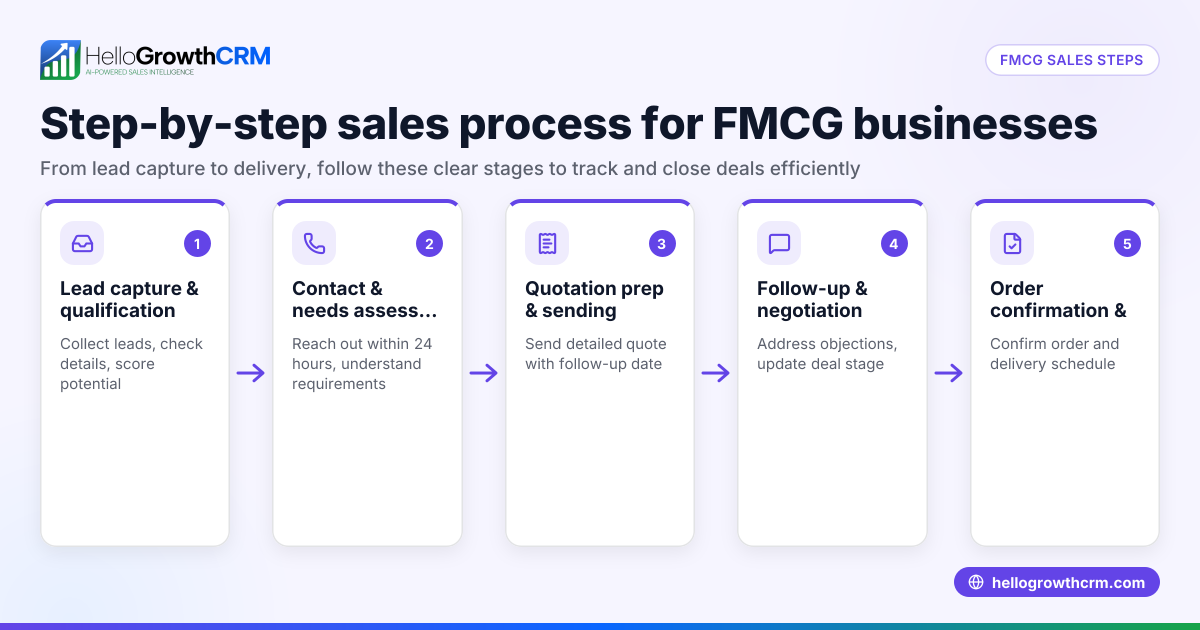
Step 1: They implement a standardized pipeline with stages: New Lead, Contacted, Quote Sent, Closed.
Step 2: They set follow-up cadence: contact within 24 hours, follow-up every 3 days until quote sent, then weekly after.
Step 3: They assign ownership so each lead is tracked by one sales rep.
Step 4: They use a free pipeline template from HelloGrowthCRM to track deals (free sales tools and calculators).
Calculation of increased revenue:
100 leads × 15% conversion = 15 sales
15 sales × C$8,000 = C$120,000
Previous revenue:
100 leads × 10% conversion = 10 sales
10 sales × C$8,000 = C$80,000
Increase in revenue:
C$120,000 - C$80,000 = C$40,000
By improving process and tool use, the company potentially increases monthly revenue by C$40,000.
Common mistakes
- Not standardizing data entry: Leads entered inconsistently cause confusion. Prevent by using web forms and mandatory fields.
- Ignoring follow-up schedules: Sales reps skip or delay follow-ups. Prevent by setting reminders and sequences.
- Lack of ownership: Leads fall through cracks without a responsible person. Prevent by assigning each lead/deal to one rep.
- Using too many tools separately: Leads and communications spread across platforms. Prevent by choosing integrated tools supporting WhatsApp, SMS, and email.
- No regular review: Processes stagnate without adjustments. Prevent by scheduling monthly pipeline reviews.
- Skipping training: Team resists or misuses tools. Prevent by providing clear training and support.
Doing this in HelloGrowthCRM
HelloGrowthCRM offers several features that support these process changes. You can download free sales tools, templates, and calculators without signing up, including follow-up cadences and pipeline templates (free sales tools and calculators). Its Deals (pipeline) feature tracks opportunities from first contact through close, showing quotations at the "quote sent" stage with follow-up dates so no deal is forgotten (WhatsApp and SMS CRM). For businesses with field sales, territories and field operations tools allow reps to log visits via mobile, with managers able to monitor daily activity (HelloGrowthCRM for Canada). These features help enforce process discipline and improve sales outcomes.
Frequently asked questions
What process changes improve B2B sales tool adoption? Standardizing lead capture, defining clear deal stages, setting follow-up routines, and assigning ownership improve adoption by making the tools easier and more useful for the team.
How often should sales reps follow up with leads? Follow-up frequency depends on the sales cycle but generally starts with contact within 24 hours of lead capture, then every 2-3 days until a quote is sent, and weekly thereafter until closure or loss.
Can I use free sales templates to improve my process? Yes, HelloGrowthCRM offers free sales tools, templates, and calculators that you can download without creating an account to help structure your sales process (free sales tools and calculators).
How do I keep track of deals after sending a quote? Using a CRM with a deals pipeline feature helps track deals at the "quote sent" stage with follow-up dates, ensuring no opportunity is missed (WhatsApp and SMS CRM).
What if my sales team works in the field? HelloGrowthCRM supports territory management and field operations, enabling reps to log visits from their phones and managers to monitor activity (HelloGrowthCRM for Canada).
Key takeaways
- Align your sales process with your tools by standardizing lead capture and deal stages.
- Set clear follow-up schedules and assign ownership to avoid lost leads.
- Use templates and free tools to structure your sales cadence and pipeline.
- Monitor your pipeline daily and review processes monthly for continuous improvement.
- Integrate communication channels like WhatsApp and SMS into your CRM.
- Avoid common mistakes by training your team and consolidating tools.
Start improving your B2B sales process today with HelloGrowthCRM’s free tools and pipeline features. Start on the Free Forever plan (200 leads, no credit card).
Ready to put this into practice?
Set up your pipeline, WhatsApp follow-ups, and AI lead scoring in minutes — free, no credit card.
Try HelloGrowthCRM freeGet CRM tips in your inbox
Join thousands of sales professionals who get weekly insights on CRM strategy, AI automation, and pipeline optimization.

The HelloGrowthCRM team publishes guides on CRM strategy, AI sales tools, and revenue operations for small business sales teams.