HelloGrowthCRM software
Built for real small-business sales teams
HelloGrowthCRM helps reps qualify faster, follow up on time, and close more deals—with practical automation in one place.
- AI lead scoring and pipeline visibility
- Built-in dialer, WhatsApp, and email automation
- Sales forecasting and RevOps-ready reporting
A restaurant CRM is a customer relationship management system tailored to help restaurants manage leads, bookings, orders, and customer interactions efficiently. It centralises communication, tracks customer preferences, and automates follow-ups to improve sales and customer loyalty. This article covers why restaurant CRMs are important, the steps to choose one, a Singapore-based example, common mistakes, and how HelloGrowthCRM supports restaurant sales teams.
Why this comes up / what goes wrong
Restaurant owners and accountants in Singapore often struggle with managing customer information scattered across WhatsApp chats, emails, and spreadsheets. This fragmented approach delays follow-ups, loses leads, and makes it hard to track repeat customers or promotions. Restaurants, cafes, and cloud kitchens need a CRM that fits their fast-paced, conversational sales style and integrates with WhatsApp, the most popular messaging channel in Singapore. Without a CRM designed for these needs, teams waste time juggling tools and miss out on sales opportunities.
Step-by-step
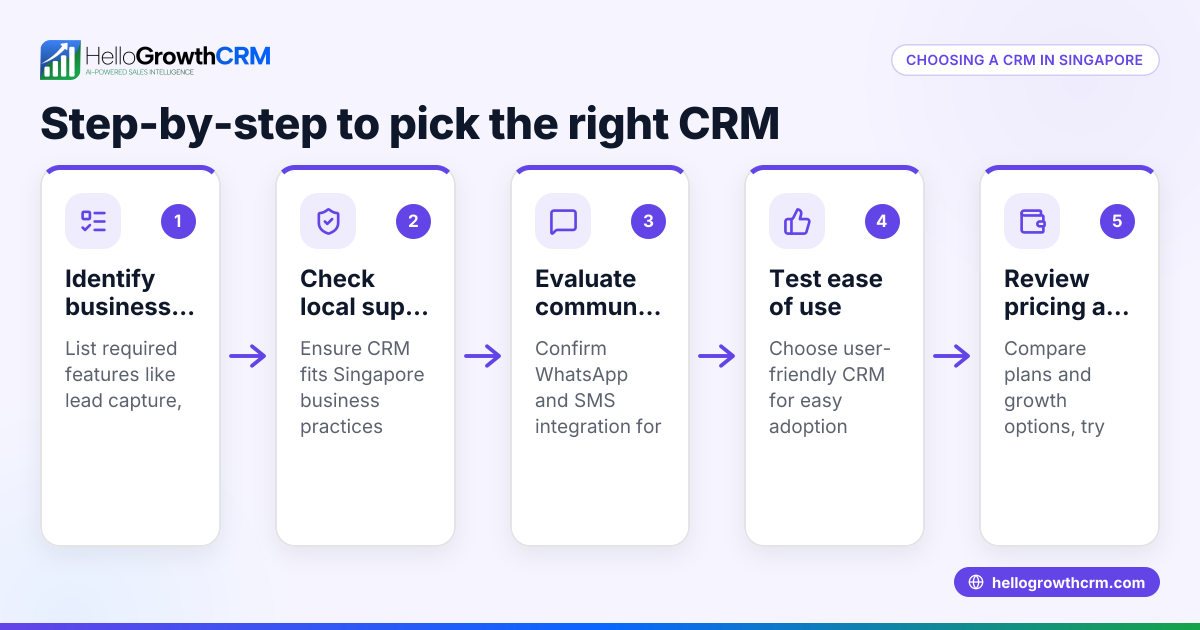
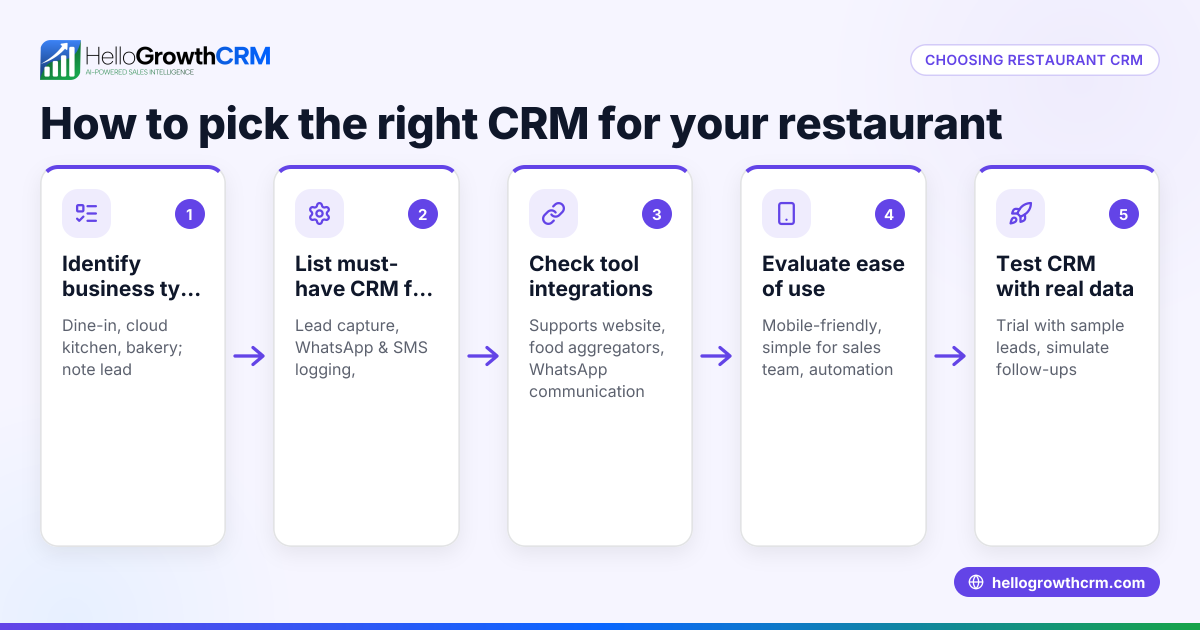
- Identify your restaurant’s CRM needs: List what your team must manage—reservations, customer preferences, promotions, delivery orders, or event bookings. Check if you need WhatsApp messaging integration since many Singapore customers prefer it.
- Check for easy lead capture: Ensure the CRM can capture leads automatically from your website forms or social media pages to avoid manual entry errors.
- Look for messaging channels support: Confirm the CRM supports WhatsApp and SMS for quick, logged communication with customers, as these are essential channels in Singapore.
- Evaluate pipeline and task management: The CRM should let your team track sales stages or booking statuses visually with pipelines or task boards.
- Consider AI features for follow-ups: Some CRMs offer AI agents that draft follow-up messages after calls, saving time and ensuring consistent communication.
- Assess pricing and scalability: Choose a CRM that fits your current team size and can scale as your restaurant grows, ideally with a free plan to start.
- Test user experience: Ensure your sales or reservation team finds the CRM intuitive and will actually use it daily.
- Review integrations: Check if the CRM integrates with your existing tools like email, web forms, or payment systems.
- Ask about local support and compliance: Verify if the CRM provider understands Singapore’s business environment and data privacy requirements.
For restaurants, cafes and cloud kitchens, these steps ensure you pick a CRM that fits your unique needs and customer communication style. Learn more about Restaurants, cafes and cloud kitchens.
Example (fictional figures)
A Singapore cloud kitchen in Jurong wants to improve its customer follow-up and booking management. It currently handles 150 leads monthly through WhatsApp and email.
- Monthly leads: 150
- Average order value: S$50
- Conversion rate without CRM: 20% (30 orders)
- Conversion rate with CRM and follow-ups: 30% (45 orders)
Without CRM: S$50 × 30 orders = S$1,500 monthly revenue
With CRM: S$50 × 45 orders = S$2,250 monthly revenue
Increased revenue: S$2,250 - S$1,500 = S$750 additional monthly revenue
The cloud kitchen invests in a CRM that supports WhatsApp messaging and AI follow-ups to improve conversion rates by ensuring timely responses and personalised offers.
Common mistakes
- Choosing a CRM without WhatsApp support: Since WhatsApp is vital for Singapore restaurants, avoid CRMs that don’t log WhatsApp chats or send follow-ups there. Prevent this by verifying messaging channels support.
- Ignoring team adoption: A CRM that’s too complex will not be used. Prevent this by involving your sales team in demos and choosing user-friendly software.
- Overlooking lead capture automation: Manual entry causes lost or delayed leads. Prevent this by selecting CRMs with automatic lead capture from web forms.
- Neglecting follow-up automation: Slow follow-ups lose customers. Prevent this by using CRMs with AI agents or message sequences.
- Not planning for growth: Picking a CRM that doesn’t scale can cause costly migrations. Prevent this by choosing one with flexible plans and features.
- Failing to check local support and compliance: This can cause delays or legal issues. Prevent by selecting CRM providers familiar with Singapore’s market.
Learn how HelloGrowthCRM addresses these in HelloGrowthCRM for Singapore.
Doing this in HelloGrowthCRM
HelloGrowthCRM supports WhatsApp and SMS messaging where conversations with leads are logged on their records, and follow-ups can be sent as messages. Its AI agents (currently in Beta) draft follow-up messages after calls, letting your team review and send quickly. The Free Forever plan allows a two-person team to manage their pipeline at no cost until they need calling or WhatsApp automation. Explore more about WhatsApp and SMS CRM.
Frequently asked questions
What features should a restaurant CRM have? A restaurant CRM should support easy lead capture, WhatsApp and SMS messaging, pipeline management, and follow-up automation. These features help manage bookings, customer preferences, and promotions efficiently.
Can I use WhatsApp for sales and customer follow-ups in Singapore? Yes, WhatsApp is widely used in Singapore. A CRM that logs WhatsApp conversations and automates follow-ups helps maintain quick, personalised communication.
Is there a free CRM suitable for small restaurant teams? Some CRMs, including HelloGrowthCRM, offer free plans allowing small teams to manage leads and pipelines without cost until they need advanced features like calling or automation.
How does AI help in a restaurant CRM? AI agents can draft follow-up messages after calls or interactions, saving time and ensuring consistent communication with customers.
What should I check before choosing a CRM for my restaurant? Check if it supports your main communication channels (like WhatsApp), integrates with your existing tools, is easy for your team to use, and offers scalability.
Key takeaways
- A restaurant CRM centralises customer data, bookings, and communications to improve sales and customer loyalty.
- WhatsApp and SMS messaging support is essential for Singapore restaurants to engage customers effectively.
- Automating lead capture and follow-ups saves time and reduces lost sales opportunities.
- Choose a CRM that your team will use daily and that can scale with your business.
- HelloGrowthCRM offers WhatsApp and SMS logging, AI follow-ups, and a Free Forever plan for small teams.
Start managing your restaurant leads and customer relationships better today. Start on the Free Forever plan (200 leads, no credit card).
Ready to put this into practice?
Set up your pipeline, WhatsApp follow-ups, and AI lead scoring in minutes — free, no credit card.
Try HelloGrowthCRM freeGet CRM tips in your inbox
Join thousands of sales professionals who get weekly insights on CRM strategy, AI automation, and pipeline optimization.

The HelloGrowthCRM team publishes guides on CRM strategy, AI sales tools, and revenue operations for small business sales teams.