HelloGrowthCRM software
Built for real small-business sales teams
HelloGrowthCRM helps reps qualify faster, follow up on time, and close more deals—with practical automation in one place.
- AI lead scoring and pipeline visibility
- Built-in dialer, WhatsApp, and email automation
- Sales forecasting and RevOps-ready reporting
Sales contracts are the foundation of any business transaction where goods or services are sold. They serve as a written agreement that clarifies expectations and protects both the seller and buyer by defining the terms of the sale. For small-business owners, having a clear sales contract helps avoid misunderstandings, ensures timely payment, and provides a reference if disputes arise.
Why this comes up / what goes wrong
Small-business owners often find themselves in situations where verbal agreements or informal emails lead to confusion or lost revenue. For example, a plumbing company might agree to fix a leak for a certain price but later face disputes about the scope of work or payment timing. Without a formal sales contract, it’s harder to enforce terms or collect payment. Slow follow-up on quotes or lost paperwork can also cause missed sales opportunities. Managing multiple leads and contracts on text messages, emails, or spreadsheets increases the risk of errors and forgotten deals.
Step-by-step
- Identify the parties involved: Clearly state the full legal names and contact information of the seller and buyer.
- Describe the products or services: Specify what is being sold, including quantities, specifications, or service details.
- Set the price and payment terms: Include the total cost, payment schedule, accepted payment methods, and due dates.
- Define delivery terms: State when and how the goods or services will be delivered or performed.
- Include warranties or guarantees: If applicable, describe any guarantees or warranties on the product or service.
- Add terms for cancellation or returns: Explain under what conditions the contract can be canceled or goods returned.
- Specify dispute resolution: Outline how disputes will be handled, such as mediation or arbitration.
- Include signatures and dates: Both parties should sign and date the contract to make it legally binding.
- Keep a copy: Ensure both parties have a copy of the signed contract for their records.
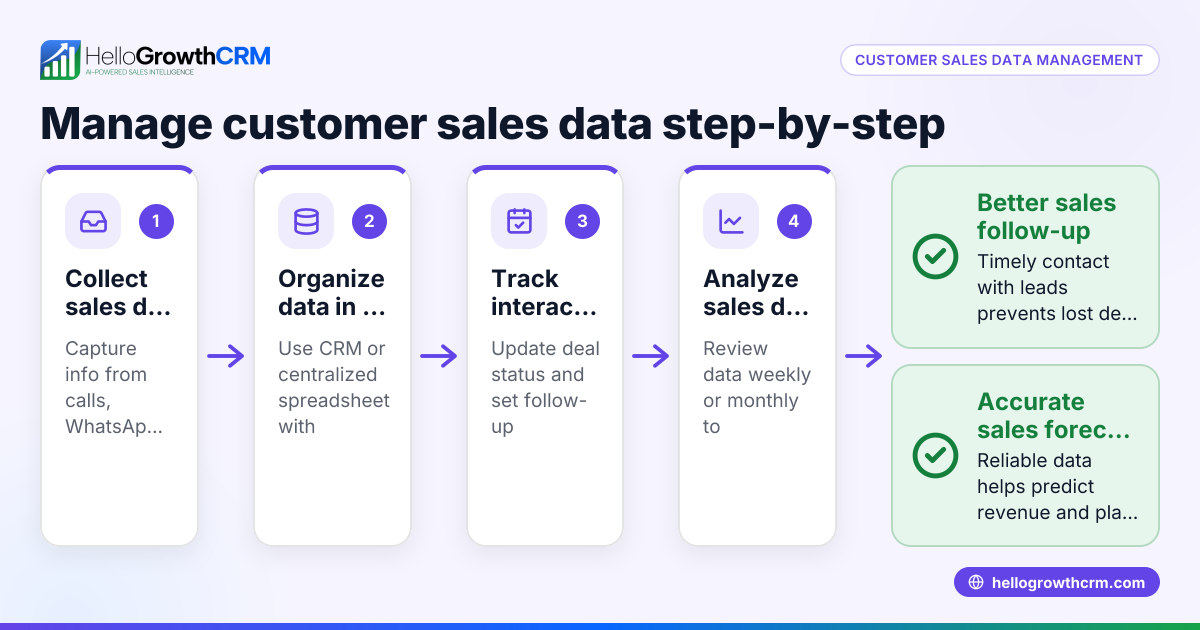
Use a CRM like HelloGrowthCRM to track your sales contracts as deals in a pipeline. For example, a quotation sent last week can appear at the 'quote sent' stage with a follow-up date, preventing it from being forgotten. Deals (pipeline) help you stay organized and timely.
Example (fictional figures)
A plumbing company in Austin, Texas, agrees to install a new water heater for a customer:
- Product: Water heater installation
- Price: $1,500
- Payment terms: 50% upfront, 50% upon completion
- Delivery: Installation scheduled for 07/15/2026
Calculation for payment: $1,500 × 50% = $750 (upfront payment) $1,500 × 50% = $750 (final payment)
The contract states the customer pays $750 on signing and $750 after installation. The company logs this contract as a deal in HelloGrowthCRM, setting a follow-up reminder for the installation date.
Common mistakes
- Forgetting to specify payment terms clearly: Prevent by detailing payment amounts, deadlines, and methods.
- Using vague product or service descriptions: Prevent by being specific to avoid disputes.
- Not getting signatures from both parties: Prevent by requiring signed contracts before work begins.
- Losing track of contracts and follow-ups: Prevent by using tools like HelloGrowthCRM’s Deals (pipeline) to monitor status and reminders.
- Ignoring cancellation and dispute terms: Prevent by including clear policies to handle these situations.
- Relying solely on informal communication channels: Prevent by formalizing agreements in writing.
Doing this in HelloGrowthCRM
HelloGrowthCRM helps small businesses manage sales contracts through its Deals (pipeline) feature. When you send a quotation, it appears as a deal at the 'quote sent' stage with a follow-up date, so you never forget to follow up. For businesses with field reps, the Territories and field operations tools allow logging visits from mobile phones and give managers visibility of daily activities. Additionally, Managed RevOps support is available for founders without a sales manager, providing weekly follow-up execution and pipeline hygiene to keep contracts moving forward. Learn more about how HelloGrowthCRM supports your sales process at HelloGrowthCRM for the United States and explore the WhatsApp and SMS CRM and built-in CRM dialer features.
Frequently asked questions
What is the difference between a sales contract and a sales agreement? They are often used interchangeably, but a sales contract is a formal, legally binding document detailing the terms of sale. A sales agreement can be less formal but still outlines the obligations of both parties.
Do I need a lawyer to create a sales contract? While not always necessary, consulting a lawyer ensures the contract complies with local laws and covers all important terms. For standard contracts, templates and CRM tools can help you create effective agreements.
Can I use email or text messages as a sales contract? Emails or texts can sometimes serve as contracts if they clearly show agreement on terms, but they risk being incomplete or unclear. Written contracts signed by both parties are safer and easier to enforce.
How can I keep track of multiple sales contracts? Using a CRM like HelloGrowthCRM helps you organize contracts as deals, set follow-up reminders, and monitor progress, reducing the risk of lost or forgotten contracts.
What should I do if a customer refuses to sign a contract? Explain the benefits of having clear terms to protect both parties. If they still refuse, proceed with caution and consider whether to do business without a contract.
Key takeaways
- Sales contracts clearly define the terms of sale and protect both parties.
- Include all important details: parties, products/services, price, delivery, payment, and dispute resolution.
- Use signatures to make contracts legally binding.
- Avoid common mistakes like vague terms and lost follow-ups.
- HelloGrowthCRM’s Deals (pipeline) feature helps track contracts and follow-ups efficiently.
- Field operations and Managed RevOps support improve sales management for growing teams.
Start managing your sales contracts effectively by using HelloGrowthCRM. Start on the Free Forever plan (200 leads, no credit card) and keep your sales organized from lead to close.
Ready to put this into practice?
Set up your pipeline, WhatsApp follow-ups, and AI lead scoring in minutes — free, no credit card.
Try HelloGrowthCRM freeGet CRM tips in your inbox
Join thousands of sales professionals who get weekly insights on CRM strategy, AI automation, and pipeline optimization.

The HelloGrowthCRM team publishes guides on CRM strategy, AI sales tools, and revenue operations for small business sales teams.