HelloGrowthCRM software
Built for real small-business sales teams
HelloGrowthCRM helps reps qualify faster, follow up on time, and close more deals—with practical automation in one place.
- AI lead scoring and pipeline visibility
- Built-in dialer, WhatsApp, and email automation
- Sales forecasting and RevOps-ready reporting
A customer service SLA (Service Level Agreement) is a contract or agreement that sets clear expectations for the level and speed of service your business promises to deliver to customers. It typically includes metrics like response time, resolution time, and communication standards. For small businesses in Singapore, having an SLA ensures customers know when to expect help and helps your team stay accountable.
Why this comes up / what goes wrong
Small business owners often face challenges with customer service because they lack clear service standards. Without SLAs, customers may feel frustrated by slow or inconsistent responses, leading to lost trust and repeat business. Sales and support teams juggling multiple channels like WhatsApp, email, and spreadsheets can struggle to track and resolve requests promptly. This confusion often results in missed deadlines and unhappy customers.
Step-by-step
- Identify key service metrics to include Decide what matters most to your customers. Common SLA metrics often include first response time, resolution time, and availability hours, though specific targets can vary depending on the agreement.
- Set realistic and measurable targets Base your SLA on your team's capacity and customer needs. For example, promising a 1-hour reply might be unrealistic for a small team. Choose targets you can consistently meet.
- Document the SLA clearly Write the SLA in simple language, specifying what customers can expect and what your team will do. Include definitions for terms like "response" and "resolution."
- Communicate the SLA to customers Share the SLA on your website, customer portal, or in welcome emails. Transparency helps build trust.
- Train your team on SLA adherence Make sure everyone understands the SLA and their role in meeting it. Use tools to track response and resolution times.
- Monitor and review SLA performance regularly Track how well your team meets SLA targets using reports or dashboards. Adjust targets or processes if needed.
- Use technology to support SLA management Consider a CRM with ticketing and customer portals to centralise service requests and monitor SLAs easily.
Example (fictional figures)
A renovation contractor in Jurong, "RenovateRight Pte Ltd," commits to an SLA promising first response within 4 hours and resolution within 3 working days for service requests.
- On 01/04/2026, a customer submits a repair request at 10:00 AM.
- The team responds at 2:00 PM the same day.
- Response time calculation: 2:00 PM - 10:00 AM = 4 hours (meets SLA).
- The repair is completed on 04/04/2026 at 3:00 PM.
- Resolution time calculation: 04/04/2026 3:00 PM - 01/04/2026 10:00 AM = 3 days 5 hours (meets SLA).
Because RenovateRight tracks these times, they can report SLA compliance and improve customer satisfaction.
Common mistakes
- Setting unrealistic SLA targets: Avoid promising faster responses than your team can deliver. Prevent by analysing team capacity first.
- Not communicating the SLA to customers: Customers need to know what to expect. Prevent by publishing SLAs on your customer portal or website.
- Ignoring SLA tracking: Without measurement, you won’t know if you meet targets. Prevent by using tools that log timestamps and generate reports.
- Mixing channels without centralisation: Managing requests on WhatsApp, email, and spreadsheets separately causes delays. Prevent by consolidating service requests in one system, such as a CRM with ticketing.
- Failing to review and update SLAs: Business needs change, so should SLAs. Prevent by scheduling regular SLA reviews.
Doing this in HelloGrowthCRM
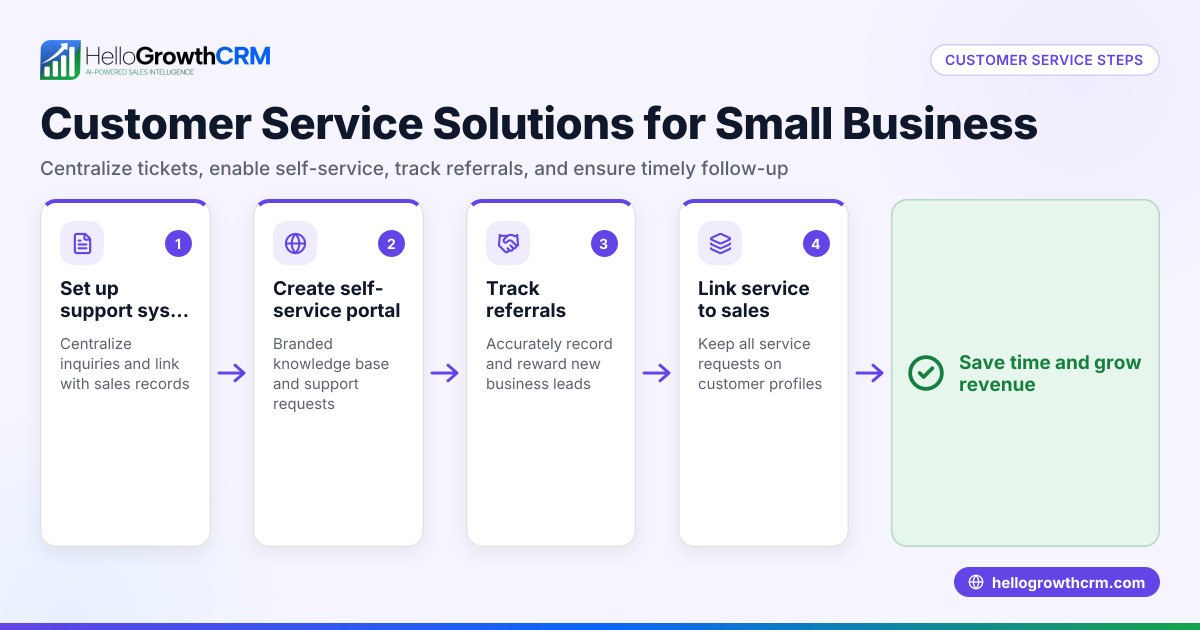
HelloGrowthCRM supports customer service SLAs by keeping service requests linked to the same customer record as the deal, making it easier to track history and follow up. Its customer portal allows customers to submit and track tickets themselves, reducing back-and-forth. The built-in tickets and knowledge base help your team resolve issues faster while maintaining SLA standards. To learn more, see how HelloGrowthCRM helps with customer health score and manage your service process.
Frequently asked questions
What is a typical SLA response time for small businesses? Response times vary by industry and team size, so it's important to establish a first response time that works best for your business. The key is to set targets your team can meet consistently and communicate these clearly to customers.
How can I track SLA compliance effectively? Using a CRM with ticketing features helps by automatically recording when requests arrive and when responses or resolutions occur. This removes manual tracking errors and provides reports to monitor performance.
Can I set different SLAs for different customer types? Yes, SLAs can vary by customer segment or service level. For example, premium customers might get faster responses. Your SLA should specify these differences clearly.
Why is centralising customer service important for SLA adherence? When requests come through multiple channels like WhatsApp and email without central tracking, it’s easy to miss deadlines. Centralising in one system improves visibility and accountability. Learn more about managing WhatsApp and SMS channels with HelloGrowthCRM WhatsApp and SMS CRM.
What happens if my team misses an SLA? Missed SLAs can hurt customer trust. It’s important to notify customers proactively, explain delays, and take steps to prevent recurrence through process improvements.
Key takeaways
- A customer service SLA sets clear response and resolution expectations for your customers.
- Define realistic, measurable targets based on your team’s capacity.
- Communicate SLAs openly to build trust and manage expectations.
- Use a centralised system to track service requests and SLA compliance.
- Regularly review and update your SLA to reflect business changes.
- HelloGrowthCRM helps by linking service requests to customer records and offering a customer portal with tickets and knowledge base.
Start improving your customer service today. Start on the Free Forever plan (200 leads, no credit card) and manage your SLAs efficiently.
Ready to put this into practice?
Set up your pipeline, WhatsApp follow-ups, and AI lead scoring in minutes — free, no credit card.
Try HelloGrowthCRM freeGet CRM tips in your inbox
Join thousands of sales professionals who get weekly insights on CRM strategy, AI automation, and pipeline optimization.

The HelloGrowthCRM team publishes guides on CRM strategy, AI sales tools, and revenue operations for small business sales teams.