HelloGrowthCRM software
Built for real small-business sales teams
HelloGrowthCRM helps reps qualify faster, follow up on time, and close more deals—with practical automation in one place.
- AI lead scoring and pipeline visibility
- Built-in dialer, WhatsApp, and email automation
- Sales forecasting and RevOps-ready reporting
Secondary sales tracking means keeping track of sales your distributors or resellers make to their customers. Unlike primary sales, which are your direct sales to distributors, secondary sales show the actual market movement of your products. This helps you understand demand, manage inventory, and plan marketing or incentives effectively.
Why this comes up / what goes wrong
For many small and mid-sized Indian businesses, especially those selling through distributors, it is common to lose visibility after the product leaves the warehouse or showroom. You may have good records of what you sold to your distributors (primary sales), but not what they sold onward (secondary sales). This gap can cause stock imbalances, missed revenue opportunities, and poor sales forecasting.
Distributors often have multiple sales agents or retailers, and without a clear system, you rely on manual reports or verbal updates that can be delayed or inaccurate. This makes it hard to know which products are selling well, which areas need support, or if incentives are working. Slow or inaccurate secondary sales tracking leads to lost leads and missed growth.
Step-by-step
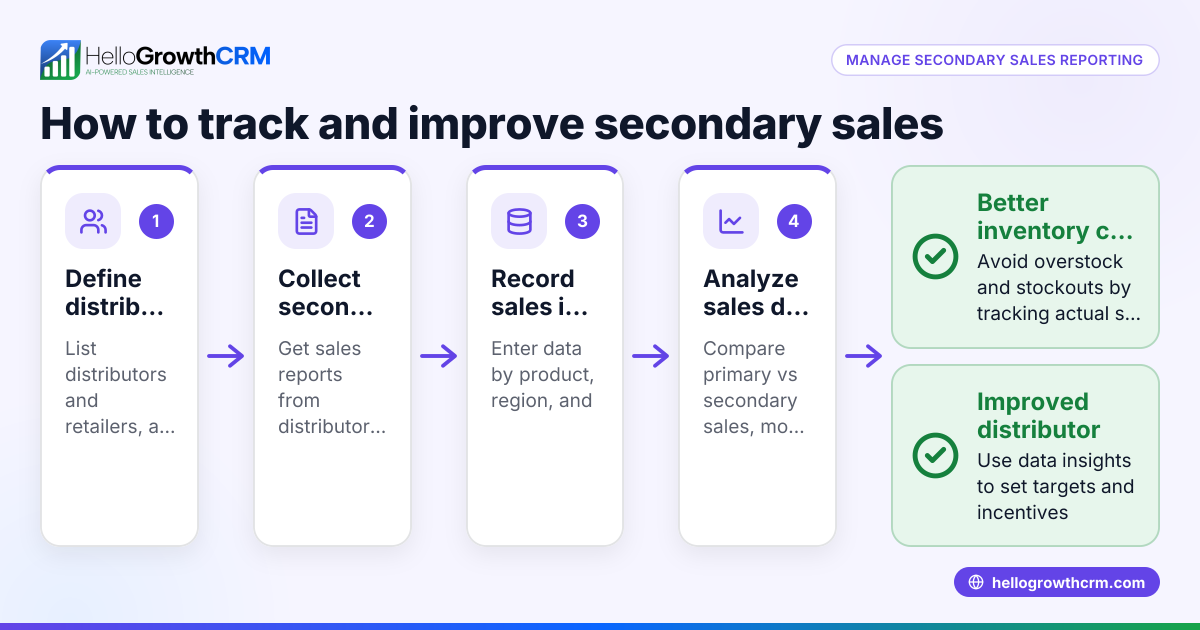
- Define your distributor network and sales points
- List all distributors and their sales agents or retailers.
- Assign territories or regions to each distributor if applicable.
- Check that you have contact details and communication channels established.
- Set up a reporting mechanism for secondary sales
- Decide how distributors will report sales: daily, weekly, or monthly.
- Use simple digital tools like WhatsApp, Excel sheets, or web forms for data submission.
- Confirm the data fields needed: product code, quantity sold, date, retailer name.
- Collect and consolidate data regularly
- Gather sales reports from all distributors.
- Check for completeness and consistency in the data.
- Follow up promptly on missing or unclear entries.
- Analyze secondary sales data
- Compare secondary sales with your primary sales and inventory.
- Identify fast-moving products and slow movers.
- Spot regional trends and demand fluctuations.
- Use insights to adjust operations
- Plan production and stock replenishment based on real market demand.
- Design incentives or marketing campaigns targeting weak areas.
- Communicate feedback and support needs to distributors.
- Automate and digitize tracking for scale
- Implement CRM tools that capture leads and sales data from distributors.
- Use mobile apps for field sales agents to log visits and sales.
- Monitor sales pipelines and follow-ups digitally to avoid delays.
Example (fictional figures)
ABC Electronics sells home appliances through distributors. On 01/03/2024, they sold 500 units of a mixer grinder to Distributor X at ₹1,500 each.
Distributor X reports secondary sales for the month as:
- Mixer grinders sold: 350 units
- Average selling price per unit: ₹1,600
Calculations:
Primary sales value = 500 units × ₹1,500 = ₹7,50,000
Secondary sales value = 350 units × ₹1,600 = ₹5,60,000
Unsold stock with Distributor X = 500 units - 350 units = 150 units
ABC Electronics uses this data to plan production and marketing support for Distributor X’s territory.
Common mistakes
- Relying on manual, paper-based reports: Leads to delays and errors. Prevent by digitizing data collection using WhatsApp or web forms.
- Not defining clear reporting timelines: Causes irregular updates. Prevent by setting fixed schedules and reminders.
- Ignoring data inconsistencies: Results in inaccurate insights. Prevent by regular data validation and follow-ups.
- Lack of communication with distributors: Leads to poor cooperation. Prevent by maintaining regular contact and support.
- Not using technology to track leads and deals: Causes lost opportunities. Prevent by adopting CRM tools that integrate lead capture and pipeline tracking.
Doing this in HelloGrowthCRM
HelloGrowthCRM helps you track secondary sales by capturing every enquiry from forms, calls, or WhatsApp as a lead with an assigned owner and next step, so no opportunity is lost. Its Deals (pipeline) feature lets you track quotations sent to distributors or retailers with follow-up dates, ensuring timely follow-ups. For field sales, territories and field operations tools allow distributor reps to log visits from their phones, and managers can monitor daily beats and commissions. These features help you maintain visibility and control over your secondary sales process efficiently. Learn more about HelloGrowthCRM for India, its WhatsApp and SMS CRM, and the built-in CRM dialer.
Frequently asked questions
What is the difference between primary and secondary sales tracking? Primary sales tracking monitors your direct sales to distributors, while secondary sales tracking monitors what your distributors sell to their customers. Secondary sales give a clearer picture of market demand.
Why is secondary sales tracking important for small businesses? It helps you understand product movement beyond your warehouse, manage inventory better, support distributors effectively, and avoid stockouts or overstock situations.
How can I get distributors to report secondary sales accurately? Set clear reporting schedules, use simple digital tools like WhatsApp or web forms, and maintain regular communication to encourage timely and accurate data submission.
Can I track secondary sales without software? Yes, but it is time-consuming and prone to errors. Using tools like HelloGrowthCRM to capture leads and deals digitally improves accuracy and saves time.
How does HelloGrowthCRM assist with secondary sales tracking? It captures every enquiry as a lead, tracks deals with follow-up dates, and supports field sales logging through mobile apps, helping you monitor distributor activities and sales closely.
Key takeaways
- Secondary sales tracking monitors what distributors sell to end customers, not just what you sell to distributors.
- It improves inventory management, demand forecasting, and distributor support.
- Use clear reporting processes, digital tools, and regular communication for accurate tracking.
- Avoid manual errors and delays by adopting CRM tools with lead capture and pipeline features.
- HelloGrowthCRM offers lead management, deal tracking, and field sales tools to streamline secondary sales tracking.
Start tracking your secondary sales efficiently by trying HelloGrowthCRM. You can Start on the Free Forever plan (200 leads, no credit card) today.
Ready to put this into practice?
Set up your pipeline, WhatsApp follow-ups, and AI lead scoring in minutes — free, no credit card.
Try HelloGrowthCRM freeGet CRM tips in your inbox
Join thousands of sales professionals who get weekly insights on CRM strategy, AI automation, and pipeline optimization.

The HelloGrowthCRM team publishes guides on CRM strategy, AI sales tools, and revenue operations for small business sales teams.