HelloGrowthCRM software
Built for real small-business sales teams
HelloGrowthCRM helps reps qualify faster, follow up on time, and close more deals—with practical automation in one place.
- AI lead scoring and pipeline visibility
- Built-in dialer, WhatsApp, and email automation
- Sales forecasting and RevOps-ready reporting
Targeted lead generation means focusing your efforts on finding and engaging prospects who fit your ideal customer profile, rather than trying to reach everyone. This approach helps small businesses save time and resources by attracting leads who are more likely to convert.
Why this comes up / what goes wrong
Many small-business owners struggle with slow sales growth because their lead generation is too broad or unfocused. They might collect inquiries from various sources like web forms, calls, or WhatsApp messages but fail to qualify or prioritize these leads properly. As a result, sales teams waste time on low-quality leads, miss follow-ups, or lose potential customers to competitors. Without a clear target, marketing messages may not resonate, leading to poor conversion rates.
Step-by-step
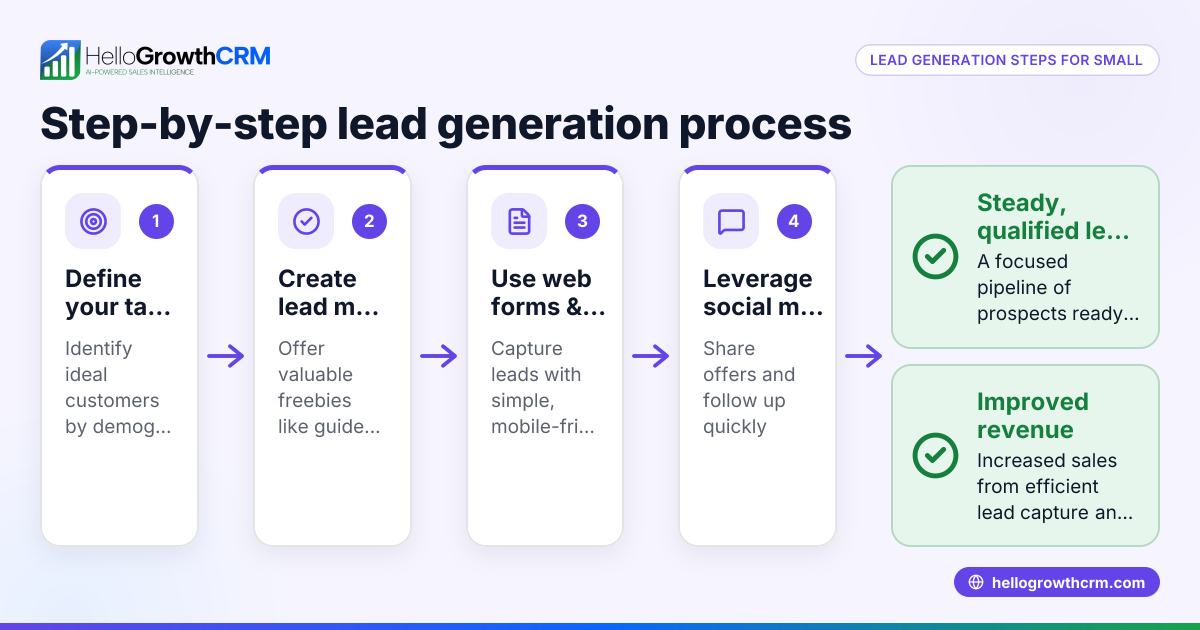
- Define your ideal customer profile (ICP): Identify key traits such as industry, company size, location, budget, and pain points. Check that these characteristics align with your product or service benefits.
- Identify lead sources that attract your ICP: Choose channels where your target audience spends time, such as industry-specific websites, LinkedIn groups, or local business events. Check the quality of leads from each source regularly.
- Create targeted marketing messages: Craft content and offers that address your ICP’s specific needs and challenges. Test different messages and check engagement metrics like click-through and response rates.
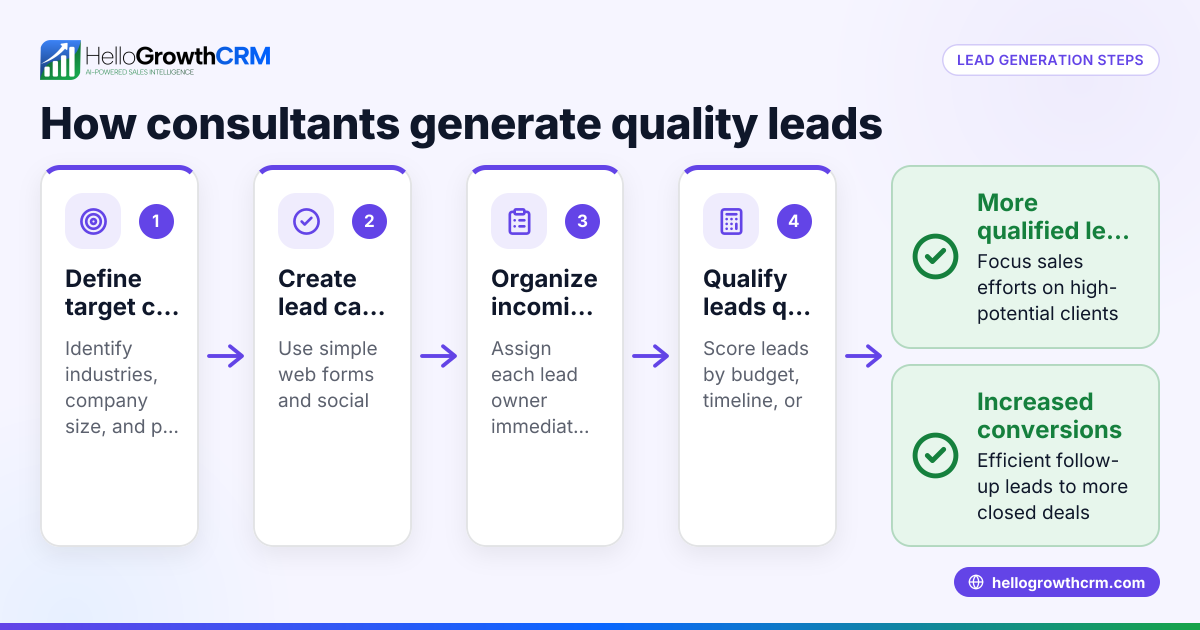
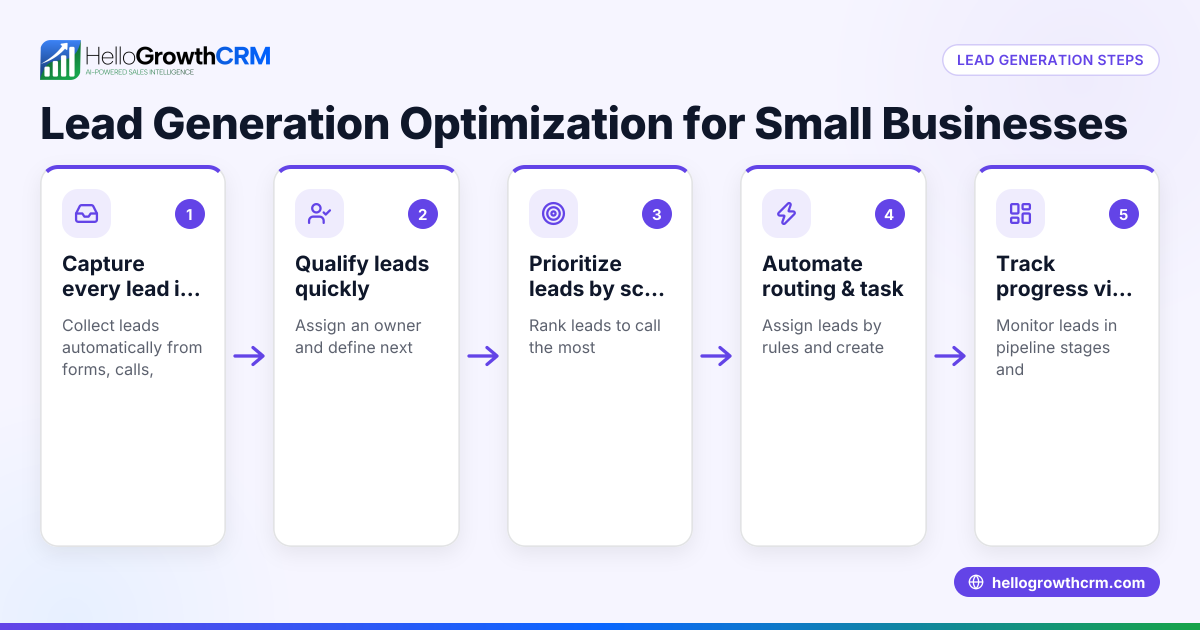
- Capture leads efficiently: Use web forms, calls, WhatsApp messages, or other methods to gather inquiries. Ensure every lead’s contact information and source are recorded accurately.
- Qualify leads quickly: Score leads based on criteria like budget, authority, need, and timeline to prioritize follow-up. Check that your scoring system reflects your ICP and sales goals.
- Assign leads to sales team members: Use round-robin or territory-based assignment to distribute leads fairly and ensure timely follow-up. Check that each lead has an owner and a next step.
- Follow up promptly and track progress: Contact leads based on their score and stage in the pipeline. Monitor task completion and update lead status regularly.
- Review and refine your process: Analyze conversion rates and lead sources periodically to improve targeting and messaging. Check for bottlenecks or drop-offs in your sales funnel.
Example (fictional figures)
A B2B software reseller in Denver, Colorado, wants to generate targeted leads for its new cloud security product.
- They define their ICP as companies with 50-200 employees in the healthcare sector.
- They focus on LinkedIn ads and healthcare IT conferences as lead sources.
- Their marketing message highlights compliance and data protection benefits.
- They capture leads through LinkedIn lead forms and event sign-ups.
- They assign a lead score out of 100 based on company size, budget, and urgency.
- Leads scoring above 70 are called within 24 hours; lower scores get email sequences.
In Q1 2026, they generate 200 leads:
- 50 leads score above 70 and receive calls.
- 150 leads score below 70 and receive emails.
If 20 of the called leads convert with an average deal size of $25,000:
20 × $25,000 = $500,000 in sales
If 10 of the emailed leads convert with an average deal size of $15,000:
10 × $15,000 = $150,000 in sales
Total sales = $500,000 + $150,000 = $650,000
This targeted approach helps focus sales efforts on high-value leads while nurturing others efficiently.
Common mistakes
- Not defining a clear ideal customer profile: Prevent by researching your best customers and documenting their traits.
- Using too many or irrelevant lead sources: Prevent by tracking lead quality and focusing on the best channels.
- Ignoring lead qualification and prioritization: Prevent by implementing an AI lead scoring system or manual criteria.
- Delaying follow-up with hot leads: Prevent by assigning leads immediately and setting reminders.
- Failing to track lead progress and outcomes: Prevent by using a CRM with pipeline and task tracking.
- Relying on manual lead management like notebooks or spreadsheets: Prevent by adopting a CRM to automate capture and routing.
Doing this in HelloGrowthCRM
HelloGrowthCRM helps small businesses manage targeted lead generation by automatically capturing every enquiry from forms, calls, or WhatsApp messages as leads with an owner and next step. Its AI lead scoring lets telecallers prioritize calling leads most likely to convert first. Automated workflows and lead routing assign new enquiries round-robin and create first-call tasks automatically, ensuring no lead is missed or delayed. Learn more about AI lead scoring and WhatsApp and SMS CRM features. HelloGrowthCRM is designed for the United States small businesses to organize and accelerate their sales process.
Frequently asked questions
What is the difference between targeted lead generation and general lead generation? Targeted lead generation focuses on attracting prospects who closely match your ideal customer profile, increasing the chances of conversion. General lead generation casts a wider net without specific focus, which can result in lower-quality leads and wasted effort.
How can I measure if my targeted lead generation is working? Track metrics like lead quality, conversion rates, cost per lead, and sales revenue from each lead source. Improvements in these indicators show your targeting is effective.
Can small businesses do targeted lead generation without a big marketing budget? Yes. Focus on channels where your ideal customers are active, use organic content, networking, and affordable digital ads. Qualifying and prioritizing leads with tools like AI lead scoring helps maximize limited resources.
How does AI lead scoring improve targeted lead generation? AI lead scoring analyzes lead data to predict which prospects are most likely to convert, helping sales teams focus their efforts efficiently and increase conversion rates.
What are the best lead sources for targeted lead generation? It depends on your ideal customer profile. Common sources include industry-specific websites, LinkedIn, trade shows, referrals, and targeted online ads. Regularly review performance to focus on the best channels.
Key takeaways
- Targeted lead generation means focusing on prospects who fit your ideal customer profile.
- Define your ICP, choose the right lead sources, and create relevant marketing messages.
- Capture, qualify, and prioritize leads quickly to improve sales efficiency.
- Avoid common mistakes like poor qualification and slow follow-up by using a CRM.
- HelloGrowthCRM automates lead capture, AI scoring, and routing to help small businesses convert leads faster.
Start managing your targeted leads today with HelloGrowthCRM. Start on the Free Forever plan (200 leads, no credit card).
Ready to put this into practice?
Set up your pipeline, WhatsApp follow-ups, and AI lead scoring in minutes — free, no credit card.
Try HelloGrowthCRM freeGet CRM tips in your inbox
Join thousands of sales professionals who get weekly insights on CRM strategy, AI automation, and pipeline optimization.

The HelloGrowthCRM team publishes guides on CRM strategy, AI sales tools, and revenue operations for small business sales teams.