Skip to content
Telecaller Meaning

Telecaller Meaning: Who a Telecaller Is and What the Job Involves

A plain explanation of the telecaller role in India: the types of telecalling, what the day looks like, the skills that matter, how performance is measured and where the job leads.

Last updated:

Free Forever • No Credit Card Required

Quick answer

What is a telecaller?

A telecaller is a person who speaks to customers and prospects over the phone on behalf of a business. Telecallers answer enquiries, call leads, explain products, book appointments, send reminders, collect feedback or payments, and record the outcome of every call. The role can be inbound, where customers call in, outbound, where the telecaller calls out, or a mix of both.
  • Telecaller is the broad term. Telemarketing and telesales are kinds of telecalling
  • The job is judged on conversations and outcomes, not on the number of calls dialled
  • In Hindi: टेलीकॉलर, explained in our Hindi article

Telecaller meaning in HindiTelecaller job description

01

Telecaller meaning in simple words

A telecaller is someone whose job is to talk to customers on the phone for a business. The word joins tele, meaning at a distance, with caller. If you have ever been rung by a coaching institute after filling in a form, reminded about an insurance renewal, or asked to rate a service visit, you have spoken to a telecaller.

The role exists because a phone call is still the fastest way to turn an enquiry into a conversation. A form on a website tells a business that someone is interested. A telecaller finds out what they need, answers the first questions, and agrees the next step, whether that is a visit, a demo, a payment or simply a call back next week.

Telecallers work in call centres, but far more of them work inside ordinary businesses: real estate offices, schools and coaching classes, clinics, insurance agencies, banks and lenders, travel agents, car dealers, software companies and local service firms.
02

Telecaller, telemarketer, telesales: what is the difference?

Job adverts use these titles loosely, which confuses applicants and employers alike. The differences are about what the call is for.

TitleWhat it meansTypical work
TelecallerAnyone whose main work is speaking to customers by phoneEnquiries, follow-ups, appointments, surveys, reminders, sales
TelemarketerA telecaller who promotes products or servicesOutbound promotional calls to generate interest or leads
Telesales executiveA telecaller who closes the sale on the callPitching, handling objections, taking the order or payment
Customer care executiveHandles calls from existing customersQueries, complaints, service requests, renewals
BPO voice process agentWorks for an outsourcing company on a client's callsAny of the above, for another business, often in shifts
Inside sales representativeSells remotely using phone, email and videoLonger B2B sales with several conversations per deal

Selling by phone has its own page: telesales meaning.

03

Types of telecalling

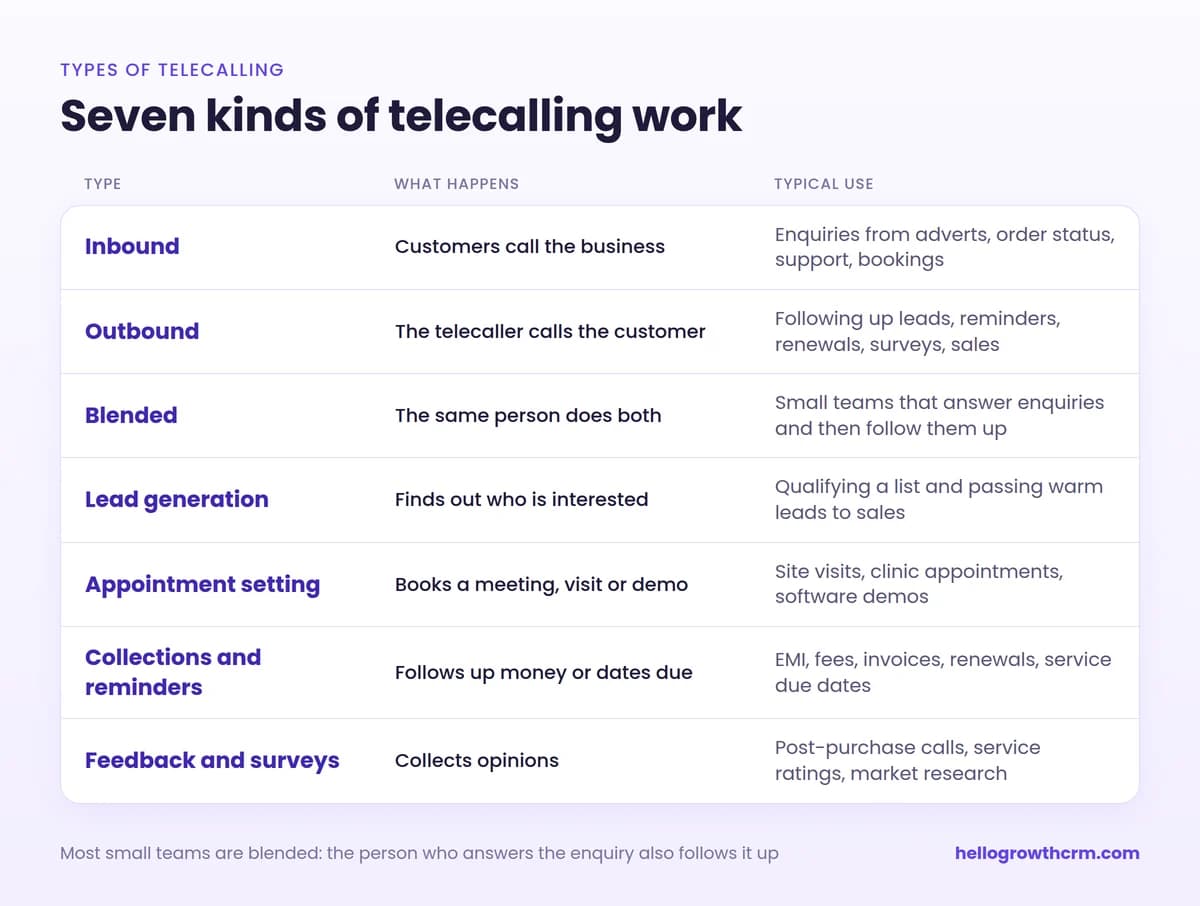
Telecalling is divided first by the direction of the call, and then by its purpose. One person may do several of these in a day.

TypeWhat happensExamples
InboundCustomers call the businessEnquiries from adverts, order status, support, bookings
OutboundThe telecaller calls the customerFollowing up leads, reminders, renewals, surveys, sales
BlendedThe same person does bothSmall teams, where enquiries are answered and then followed up
Lead generationFinds out who is interestedQualifying a list and passing warm leads to sales
Appointment settingBooks a meeting, visit or demoReal estate site visits, clinic appointments, software demos
Collections and remindersFollows up money or dates dueEMI, fees, invoices, policy renewals, service due dates
Feedback and surveysCollects opinionsPost-purchase calls, service ratings, market research
Types of telecalling: inbound, outbound, blended, lead generation, appointment setting, collections and reminders, feedback and surveys
Seven kinds of telecalling work.
04

What a telecaller does in a day

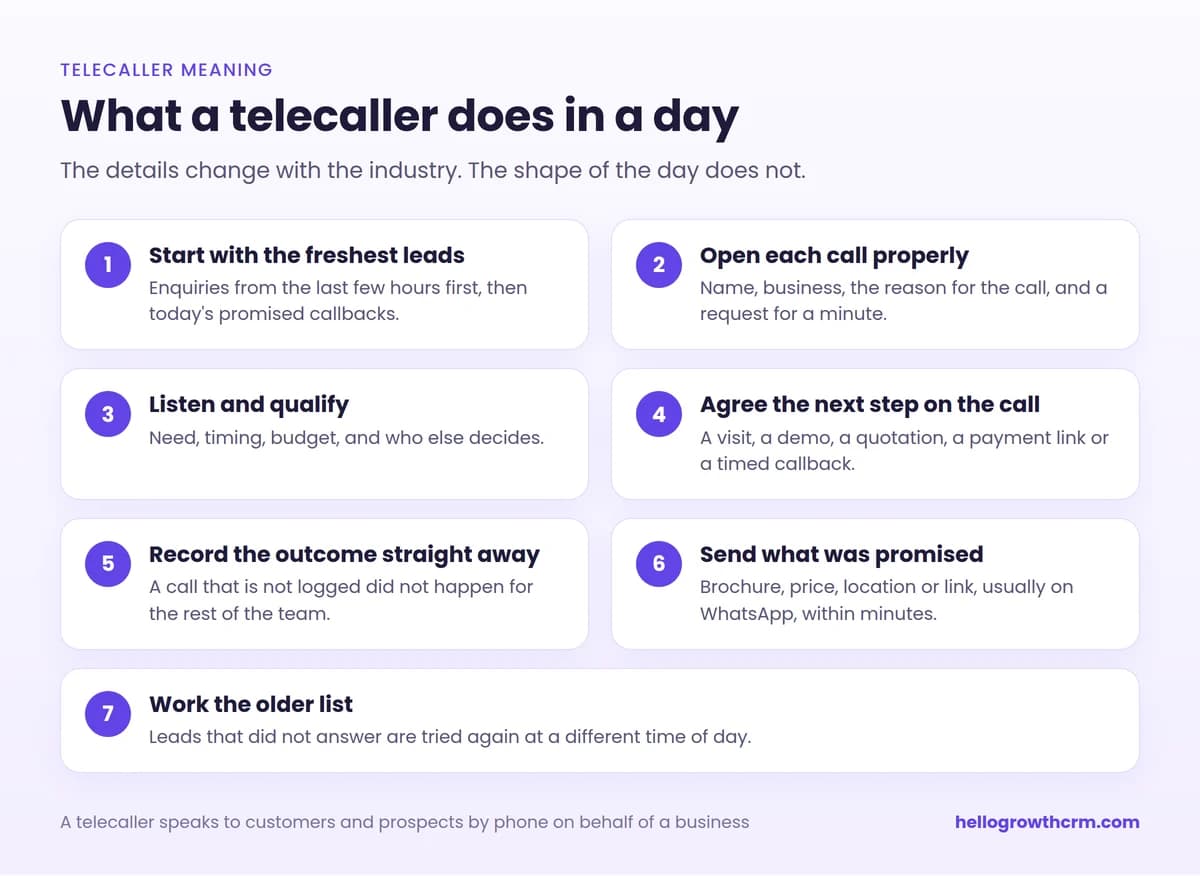
The details change with the industry. The shape of the day does not.

  1. Start with the freshest leads. Enquiries from the last few hours come first, because interest fades quickly. Next come the callbacks promised for today.
  2. Open each call properly.Name, business and the reason for the call, then a request for a minute of the person's time.
  3. Listen and qualify. What do they need, by when, within what budget, and who else decides? Four questions are usually enough on a first call.
  4. Agree the next step on the call. A visit, a demo, a quotation, a payment link, or a callback at a stated time.
  5. Record the outcome straight away. A call that is not logged did not happen, as far as the rest of the team is concerned.
  6. Send what was promised. Brochure, price, location or link, usually on WhatsApp, within minutes.
  7. Work the older list. Leads that did not answer earlier are tried again at a different time of day.

Ready-to-use wording for each of these moments is in telecalling scripts for Indian sales teams.

What a telecaller does in a day: start with fresh leads, open the call, listen and qualify, agree the next step, record the outcome, send what was promised, work the older list
A telecaller's day in seven steps.
05

Skills that make a good telecaller

Listening

The best telecallers talk less than the customer. They hear the real objection behind send me the details on WhatsApp, and answer that.

Clear speech in the customer's language

Most business calls in India move between English and a regional language. Matching the language the customer opens in builds trust faster than perfect English.

Product knowledge

Enough to answer the ten questions that come up every day without putting the customer on hold, and the honesty to say I will find out and call you back for the rest.

Handling rejection

Most calls end in no. The skill is sounding as fresh on the fortieth call as on the first, and not taking the last call into the next one.

Discipline with records

Logging every call and keeping every callback is what separates a telecaller whose numbers grow from one who stays busy with nothing to show for it.

Comfort with software

The work happens in a dialer and a CRM. Typing while talking, and finding a record quickly, are part of the job.

06

How telecallers are measured

A well-run team looks at several numbers together, because any single one can be gamed. Dial count alone rewards short, useless calls.

MeasureWhat it countsWhat it tells you
Calls attemptedHow many numbers were dialledEffort. Easy to inflate, so never judged alone
Connect rateShare of attempts where someone answeredThe quality of the list and the timing of calls
Talk timeMinutes spent in conversationWhether calls are real conversations or ten-second rejections
Outcomes loggedShare of calls with a specific result recordedDiscipline, and whether the data can be trusted
Callbacks keptPromised callbacks made on timeReliability, which customers notice more than anything
ConversionsAppointments, sales or payments achievedThe result the role exists to produce
Quality scoreA team leader's rating of sampled callsAccuracy, courtesy and compliance on the call
07

Tools a telecaller uses

A headset, a phone line or softphone, a script, and a system that holds the leads. In small teams that system is often a spreadsheet, which works until callbacks start getting missed. The next step is a CRM with a dialer, where the list, the call, the recording, the outcome and the follow-up live on one screen. That is what our telecalling CRM does, built on the CRM dialer. If you are comparing products, see best CRM for telecalling teams.

08

Rules a telecaller should know

Commercial calling in India is regulated. Customers can register a preference not to receive promotional calls, businesses that call at scale have obligations as telemarketers, and a request to stop calling has to be honoured. The safest practice is simple: call people who contacted you first, keep to reasonable daytime hours, say who you are at the start, tell the customer if the call is recorded, and remove anyone who asks not to be called. The detail is in our guide to NDNC and telecalling rules in India.

09

Where the job leads

Telecalling is an entry-level role with several ways up. Strong performers become team leaders, who manage a group of callers, or quality analysts, who review calls and coach. Those who enjoy the selling side move into telesales, inside sales or field sales. Those who prefer looking after existing customers become relationship managers or CRM executives, a role explained on our CRM full form page. Pay depends on the city, the language, the industry and above all the incentive plan, so check current listings on the job portals for your city instead of relying on a published average.

10

Telecaller meaning in Hindi

टेलीकॉलर वह व्यक्ति होता है जो कंपनी की ओर से फोन पर ग्राहकों से बात करता है। वह पूछताछ का जवाब देता है, नए ग्राहकों को कॉल करता है, प्रोडक्ट की जानकारी देता है, अपॉइंटमेंट तय करता है और हर कॉल का नतीजा दर्ज करता है।

The full Hindi article is here: telecaller meaning in Hindi. Employers looking for a hiring template should see the telecaller job description.

Challenges we solve

What makes a telecalling team struggle, and the fix

If you manage telecallers, these four problems will be familiar. None of them is about the people.

  • Telecallers dial from a printed list or a spreadsheet, and half the working day goes on finding the next number and writing down what happened.

    Give callers a queue that serves the next lead and a one-tap way to log the outcome. The time saved goes straight into conversations.Call queue and one-tap logging

  • Callbacks are promised and then forgotten, so a lead who was interested on Monday has bought elsewhere by Friday.

    Capture the callback time while still on the call and let the system remind the caller. A promise made at eleven becomes a task at four.Timed callbacks

  • Outcomes are written as interested or not interested, which tells a manager nothing about why calls succeed or fail.

    Use a specific list of outcomes: wrong number, not reachable, call back at a stated time, needs information, not in the market now, lost to a competitor, booked.Specific call outcomes

  • New telecallers are handed a script and a list on day one and left to work out the rest.

    Pair the script with recordings of real calls that went well, and review two calls a week with each new caller for the first month.Coaching from real calls

What you get

Why teams choose HelloGrowthCRM

AI-powered CRM with the features you need to close more deals.

  • A call list that is already sorted, so the telecaller starts with today's enquiries and promised callbacks instead of choosing whom to ring
  • A built-in dialer that places the call from the lead record, so no number is copied by hand and no call goes unlogged
  • Call outcomes picked from a fixed list, such as interested, call back, not reachable or wrong number, straight after each call
  • A callback set on the call becomes a reminder at the promised time, so the customer who said ring me at four is rung at four
  • Call recording where consent applies, which settles disputes and gives team leaders real calls to coach from
  • WhatsApp follow-up from the same screen, so details promised on the call are sent before the customer has put the phone down
  • A script and the customer's history visible during the call, so the telecaller is not reading from a separate sheet
  • Missed and unanswered calls can trigger a message and a callback task, so a lead is not lost because the first attempt failed
  • Live numbers for the team leader: calls made, calls connected, talk time, outcomes and conversions by telecaller
  • AI lead scoring that ranks leads, so calling time goes to the people most likely to buy

HelloGrowthCRM by the numbers

$12
per user/month list price — $10/user/mo on annual billing, ₹899/user/mo in India
$0
free forever starter plan — no credit card required
14-day
trial included on paid plans
259+
live integrations, from WhatsApp to Tally and QuickBooks
500+
teams worldwide run their pipeline on HelloGrowthCRM

Frequently Asked Questions

Common questions about the telecaller role, answered briefly.

More CRM guides to explore

Browse related HelloGrowthCRM guides and see how different teams run their pipelines.

Ready to grow?

Join small businesses that close more deals with HelloGrowthCRM.

Free Forever • No Credit Card Required

Take the next step

Free Forever • No Credit Card Required

Prefer email? Write to sales@hellogrowthcrm.com