HelloGrowthCRM software
Built for real small-business sales teams
HelloGrowthCRM helps reps qualify faster, follow up on time, and close more deals—with practical automation in one place.
- AI lead scoring and pipeline visibility
- Built-in dialer, WhatsApp, and email automation
- Sales forecasting and RevOps-ready reporting
The main types of sales pitches used by small and mid-sized businesses include:
- Elevator pitch: A brief, compelling summary of your business or product designed to quickly capture interest, usually under two minutes.
- Product pitch: Focuses on the features and benefits of a specific product or service, highlighting how it solves a problem.
- Consultative pitch: Engages the prospect by asking questions to understand their needs and tailoring the pitch accordingly.
- Storytelling pitch: Uses a narrative to connect emotionally and illustrate value through relatable customer experiences.
- Transactional pitch: A direct approach aimed at closing the sale quickly, often with a special offer or incentive.
Understanding these types helps you select the right approach for your prospects and sales context. This article covers why knowing sales pitch types is important, step-by-step instructions to create and use them, a fictional example with detailed calculations, common mistakes to avoid, and how HelloGrowthCRM supports your sales process.
Why this comes up / what goes wrong
Small-business owners often face challenges with inconsistent or ineffective sales approaches. They may lose leads because their pitches don’t match the customer’s stage or interest. For instance, using a transactional pitch too early might scare off prospects, while a long product pitch can overwhelm someone needing a quick overview.
Many small businesses run sales through text messages, email, and spreadsheets, making it difficult to track follow-ups and pitch effectiveness. This often results in slow responses and missed deals.
Step-by-step
- Identify your prospect’s stage and needs. Determine if they are just learning about your business (early stage) or ready to buy (late stage).
- Choose the appropriate pitch type. Use an elevator pitch for first contact, a consultative pitch to explore needs, or a transactional pitch when closing.
- Prepare your pitch content. For product pitches, list key benefits; for storytelling, develop a relatable customer story.
- Practice delivering your pitch clearly and confidently. Avoid jargon and keep it concise.
- Follow up with tailored communication. Use email, WhatsApp, or SMS sequences to continue the conversation based on the pitch type. HelloGrowthCRM offers WhatsApp and SMS CRM to help with this.
- Track pitch outcomes in your sales pipeline. Check if the pitch led to interest, a meeting, or a sale. Use HelloGrowthCRM’s Deals (pipeline) for this.
- Adjust your pitch based on feedback and results. Refine your approach to improve effectiveness.
Example (fictional figures)
A plumbing company in Austin, Texas, aims to secure a new commercial client by 09/15/2026. They use a consultative pitch to understand the client's needs.
- Initial meeting scheduled after elevator pitch: 08/30/2026
- Client requires a maintenance contract worth $12,000 per year
- Product pitch highlights 24/7 emergency support and quick response times
- Proposal sent on 09/05/2026
- Follow-up call set for 09/10/2026
Calculations:
$12,000 × 1 year = $12,000 total contract value
The company tracks this deal in their sales pipeline at the "quote sent" stage with a follow-up date to avoid losing the lead. This ensures timely follow-up and better chance of closing the deal.
Common mistakes
- Using the wrong pitch type for the sales stage. Prevent this by assessing the prospect’s readiness before pitching.
- Overloading the pitch with too much information. Keep it concise and focused on the prospect’s needs.
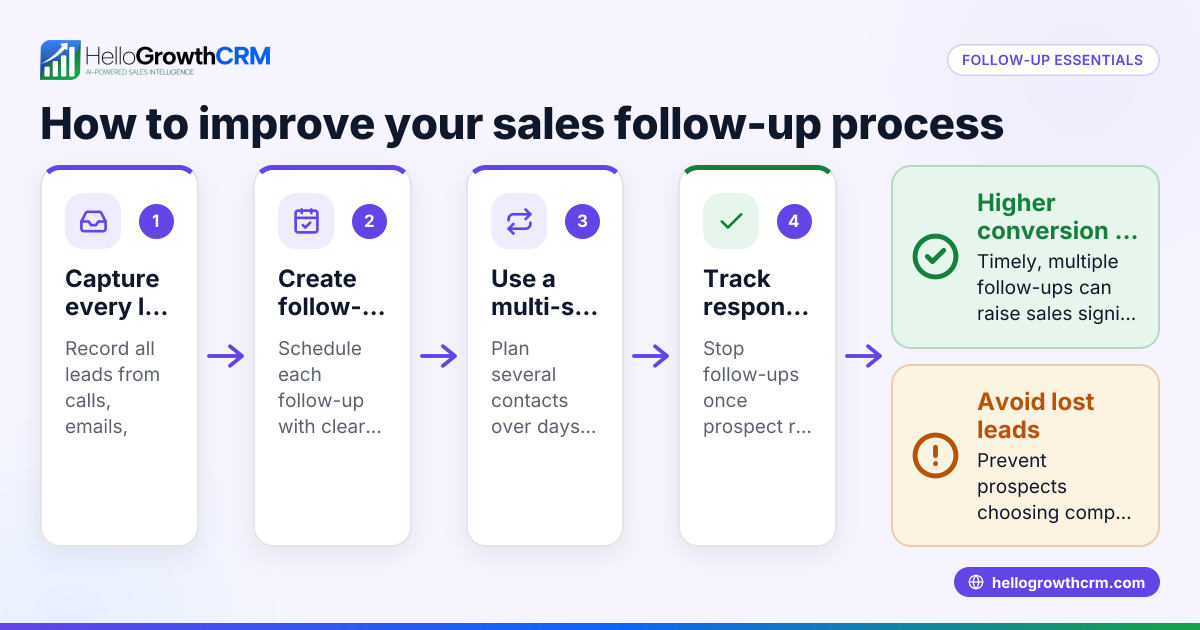
- Failing to follow up promptly. Schedule follow-ups and reminders to maintain momentum using tools like HelloGrowthCRM’s pipeline and communication sequences.
- Ignoring feedback from prospects. Listen carefully and adapt your pitch accordingly.
- Not tracking pitches and outcomes systematically. Use a CRM pipeline to monitor progress and avoid lost leads. HelloGrowthCRM’s Deals (pipeline) feature helps with this.
Doing this in HelloGrowthCRM
HelloGrowthCRM helps manage your sales pitches and follow-ups effectively. When you send a quotation, it appears as a deal at the "quote sent" stage with a follow-up date, so it is not forgotten. For businesses with field sales, the Territories and field operations feature lets reps log visits from their phone while managers monitor the daily beat. If you don’t have a sales manager, Managed RevOps provides weekly follow-up support to keep your sales pipeline active. Learn more about HelloGrowthCRM’s Deals (pipeline), Territories and field operations, and Managed RevOps.
Frequently asked questions
What is the best type of sales pitch for small businesses? It depends on your prospect’s stage and needs. An elevator pitch works well for initial contact, consultative pitches help build relationships, and transactional pitches are best when the prospect is ready to buy.
How long should a sales pitch be? Keep it brief—typically 30 seconds to 2 minutes for an elevator pitch. Consultative or storytelling pitches may take longer but should remain focused and engaging.
Can I use multiple pitch types with the same prospect? Yes. Start with an elevator pitch, then move to consultative or product pitches as you learn more. Adjust your approach based on the prospect’s responses.
How can I track which pitch works best? Use a CRM pipeline to record each pitch and its outcome. This helps identify patterns and refine your sales approach. HelloGrowthCRM offers pipeline tracking to simplify this.
Should I follow up after every pitch? Yes. Timely follow-up increases the chance of closing deals. Use reminders and sequences via email, WhatsApp, or SMS to stay in touch.
Key takeaways
- Different sales pitches serve different purposes: elevator, product, consultative, storytelling, and transactional.
- Match your pitch type to the prospect’s stage and needs for better results.
- Prepare, practice, and follow up consistently to improve sales success.
- Avoid common mistakes like wrong timing, overloading info, and poor follow-up.
- Use a CRM pipeline like HelloGrowthCRM to track deals and manage follow-ups effectively.
Start improving your sales process today by trying HelloGrowthCRM’s Free Forever plan with 200 leads and no credit card required at Start on the Free Forever plan (200 leads, no credit card).
This article is general information, not tax or legal advice. Rules change; confirm the current position with the IRS or your state's department of revenue, or with your CPA, before acting.
Ready to put this into practice?
Set up your pipeline, WhatsApp follow-ups, and AI lead scoring in minutes — free, no credit card.
Try HelloGrowthCRM freeGet CRM tips in your inbox
Join thousands of sales professionals who get weekly insights on CRM strategy, AI automation, and pipeline optimization.

The HelloGrowthCRM team publishes guides on CRM strategy, AI sales tools, and revenue operations for small business sales teams.