HelloGrowthCRM software
Built for real small-business sales teams
HelloGrowthCRM helps reps qualify faster, follow up on time, and close more deals—with practical automation in one place.
- AI lead scoring and pipeline visibility
- Built-in dialer, WhatsApp, and email automation
- Sales forecasting and RevOps-ready reporting
UK AI lead scoring workflows are CRM-based systems that use first-party engagement data, firmographic enrichment from Companies House, and rule-based or machine learning automation to rank B2B leads for sales action while staying aligned with UK GDPR, the Data Protection Act 2018, ICO guidance, and PECR in the United Kingdom.
For British B2B teams, that means scoring leads with signals you can justify, document, and act on. In practice, the best workflows help London, Manchester, and Birmingham revenue teams focus on accounts that fit their ideal customer profile, show buying intent, and can be contacted lawfully.
Key Takeaways
- UK AI lead scoring workflows should start with lawful, documented first-party data before adding enrichment.
- Companies House data is useful for firmographic fit, but it should support qualification, not excuse poor consent practices.
- The safest workflow separates lead scoring, marketing consent, and sales outreach logic inside the CRM.
- HelloGrowthCRM helps UK teams combine AI Lead Scoring, Email Automation, and AI CRM workflows in one system.
- PECR, ICO guidance, and UK GDPR affect how you track behaviour, send marketing emails, and justify automated actions.
- Simple score models often outperform overly complex ones when sales teams need trust, speed, and auditability.
What are UK AI lead scoring workflows?
UK AI lead scoring workflows are automated CRM processes that assign points or predictive scores to B2B leads using fit, intent, and engagement signals, then trigger routing or follow-up actions in a way that respects UK privacy law, consent rules, and internal sales governance.
At a practical level, a workflow has three layers:
- Data inputs
- Scoring logic
- Actions triggered by score thresholds
For most British B2B teams, the strongest inputs are first-party. These include:
- Form fills
- Demo requests
- Pricing page visits
- Email replies
- Meeting bookings
- Webinar attendance
- Product sign-ins
- Sales call outcomes
You can then enrich that record with company-level context from Companies House. That often includes:
- Registered company name
- Company number
- Filing status
- SIC code
- Incorporation date
- Registered office location
That is useful for fit scoring. It helps teams identify whether an account matches sectors, maturity, and geography you can serve.
In HelloGrowthCRM, this sits naturally inside an AI CRM workflow. A lead can enter from a form, pick up enrichment through All Integrations, gain points through AI Lead Scoring, and trigger a next step through Sales Task Boards or Meeting Scheduler.
Why UK teams need a distinct approach
UK teams cannot just copy a US scoring playbook. The legal basis for processing, the role of consent, and the rules around electronic marketing are different. The ICO guide to PECR and the UK GDPR guide should shape how you build tracking and outreach.
In short, you can score a lead for internal prioritisation more broadly than you can email them for marketing. Those are related decisions, but they are not the same decision.
Why Companies House data is useful in lead scoring
Companies House data is useful in lead scoring because it gives UK B2B teams a reliable, public source of company-level facts that improve ideal-customer-fit scoring, territory routing, and account verification without relying only on self-reported form fields.
Used well, it helps answer early qualification questions such as:
- Is this a real registered business?
- Is it active?
- Does it fall into a target industry?
- Is it located in a priority market like London, Manchester, or Birmingham?
- Is it mature enough for your sales motion?
This matters because form data is often patchy. A prospect may type “Head of Growth” and “Acme” into a demo form. That does not tell you enough. A Companies House match can strengthen the record and reduce manual research.
What Companies House data should and should not do
Use Companies House data to support fit scoring. Do not use it as a shortcut for intrusive profiling.
Good uses include:
- Matching legal entity names
- Checking incorporation age
- Mapping SIC codes to ICP segments
- Routing by region
- Flagging dissolved or overdue-filing companies
Poor uses include:
- Assuming a person has consented because their company is public
- Treating a company director record as permission for marketing
- Building opaque scores with no internal explanation
In one rollout I did with a 12-person sales team, adding company age and SIC-code filters cut wasted SDR follow-up on poor-fit firms within two weeks. The win was not “more AI.” The win was cleaner qualification and fewer false positives.
How UK GDPR, the Data Protection Act 2018, ICO guidance, and PECR affect lead scoring
UK AI lead scoring must be designed so that data collection, scoring, and outreach each have a clear legal basis, because UK GDPR, the Data Protection Act 2018, ICO guidance, and PECR govern different parts of the workflow and not every scored lead can be marketed to in the same way.
This is where many teams get confused. They mix three separate questions:
- Can we collect this data?
- Can we use it for scoring?
- Can we contact the person using email, SMS, or cookies-based remarketing?
Those answers may differ.
The UK government’s overview of the Data Protection Act 2018 and UK GDPR explains the UK framework for lawful processing and individual rights.
A practical compliance split for CRM teams
A simple way to structure this in your CRM is:
| Workflow area | Main purpose | Main rule to check | Practical CRM control |
|---|---|---|---|
| Website tracking | Capture behavioural events | PECR + UK GDPR | Consent banner, event controls, cookie categories |
| Lead scoring | Prioritise leads internally | UK GDPR lawful basis, transparency, minimisation | Score-field logic, documented data sources |
| Marketing automation | Send nurture emails or texts | PECR + consent rules | Subscription status, suppression lists |
| Sales outreach | One-to-one follow-up | UK GDPR + PECR context | Role-based workflows, lawful basis review |
| Enrichment | Improve company fit data | UK GDPR fairness and minimisation | Restrict to relevant firmographic fields |
This split helps teams avoid a common mistake. They assume a high score should always trigger a marketing email. It should not. Sometimes the right next step is a manual review, not automated outreach.
Where teams usually go wrong
When I have audited pipelines like this, the most common issues are:
- Scoring on too many hidden fields
- No written logic for score thresholds
- Cookie-derived intent signals used without clear consent controls
- No separation between contactability and lead quality
- SDRs unable to explain why a lead is “hot”
That last point matters. If your reps do not trust the score, adoption drops fast. In HelloGrowthCRM, I recommend keeping the visible score drivers easy to inspect through AI Deal Insights, Smart Inbox, and workflow history.
Which data signals are safest and most useful for UK B2B scoring?
The safest and most useful data signals for UK B2B scoring are first-party events, declared form data, and relevant company-level enrichment because they are easier to justify, easier to document, and usually more predictive than broad third-party signals with weak provenance.
Start with what your team directly collects. Good scoring signals include:
High-intent first-party signals
- Requested a demo
- Visited pricing more than once
- Replied to an email
- Booked a meeting
- Opened a proposal
- Returned to the site within seven days
- Viewed product comparison pages
Fit signals
- UK-based company
- Target SIC code
- Incorporated more than 12 months ago
- Team size in target range
- Existing tech stack match
- Right seniority or function
Negative signals
- Personal email for enterprise form
- Student or consultant not in ICP
- Dissolved company
- Unsubscribed from marketing
- Duplicate lead
- No activity for 60 days
In HelloGrowthCRM, these can feed AI Lead Scoring, Revenue Attribution, and AI Pipeline Management so teams can see both score and downstream revenue impact.
Keep your model explainable
A simple weighted model is often best for UK mid-market teams:
- Demo request: +30
- Pricing page visit: +15
- Meeting booked: +25
- Target SIC code: +10
- Active company status: +10
- Unsubscribed: -50
- No activity in 30 days: -15
This works well for teams under 50 reps. Above that, expect pressure for more granular models, territory logic, and model governance. Even then, I still start with rules before moving to black-box prediction.
How to build UK AI lead scoring workflows in HelloGrowthCRM: Step-by-Step
Building UK AI lead scoring workflows in HelloGrowthCRM means connecting compliant first-party data capture, Companies House enrichment, transparent scoring logic, and automated follow-up rules so sales and marketing can prioritise the right accounts without sending messages that your consent and PECR setup cannot support.
- Define your scoring goal
Pick one outcome first. For most teams, that is “qualified meeting booked” or “sales accepted lead.” Avoid scoring for vague “interest.” - Map your lawful data sources
List every signal you want to use. Separate form data, site behaviour, email engagement, and public company data. Document where consent or notice applies. - Connect first-party capture points
Feed forms, site events, and email actions into your CRM. HelloGrowthCRM can connect web forms, Gmail, Google Meet, Microsoft Teams, and Calendly data for a cleaner activity record. - Add Companies House enrichment carefully
Match legal company names and append only relevant firmographic fields. Focus on active status, SIC code, location, and incorporation date. - Create a weighted score model
Start with 8-12 signals. Use a mix of fit and intent. Make sure every point value has a business reason. - Set threshold-based actions
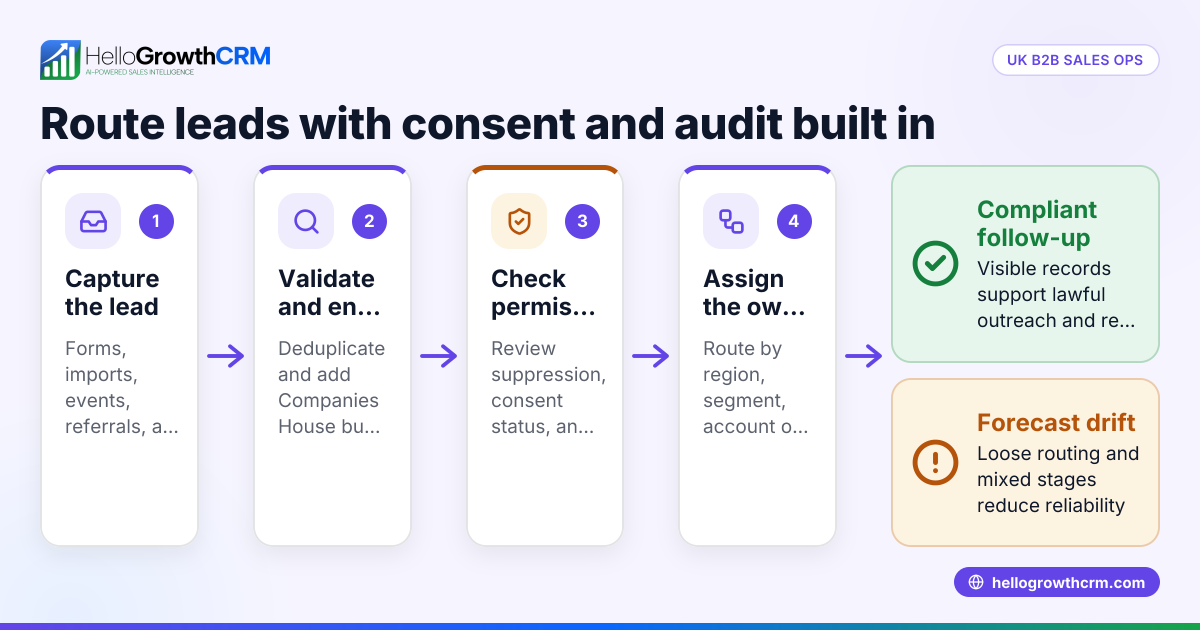
At 40 points, assign SDR review. At 60 points, create a call task. At 75 points, notify sales in Slack and suggest a sequence. - Separate score from consent status
Keep a distinct field for marketing consent and suppression. A lead can be high-scoring and still not eligible for automated marketing emails. - Trigger human-friendly follow-up
Use Email Automation, CRM Dialer, or WhatsApp & SMS CRM only where your channel rules and lawful basis are clear. - Review score accuracy every month
Compare scores against meetings, opportunities, and wins. Use Sales Forecasting and the Pipeline Health Score to spot inflation or drift. - Document and train
Give reps a one-page score guide. If the team cannot explain why a lead is hot, the workflow will not stick.
What automations should happen after a lead score changes?
The best automations after a lead score changes are routing, task creation, enrichment checks, and channel-specific follow-up prompts, because these actions help sales move faster without assuming that every high-scoring lead should automatically enter a marketing sequence.
A strong post-score workflow usually includes:
For mid-score leads
- Create a review task for SDR
- Suggest research prompts
- Check for duplicate accounts
- Enrich missing company fields
For high-score leads
- Assign owner by territory
- Push alert to Slack
- Create call task with due date
- Recommend email template
- Surface recent web and meeting activity
For very high-score leads with buying signals
- Trigger instant handoff to account executive
- Start internal deal review
- Generate meeting prep notes with AI Sales Copilot
- Flag risk or urgency with the Deal Risk Agent
In HelloGrowthCRM, I prefer action chains that are short and visible. One score update should trigger one clear next step. Over-automation causes noise.
A practical example for a Manchester software vendor might be:
- Score hits 45: SDR review task
- Score hits 60: assign by territory and notify manager
- Score hits 75: propose call script and meeting link
- Score drops below 30 after 30 days: move to lower-touch nurture
How do you measure whether AI lead scoring is actually working?
AI lead scoring is working when higher-scored leads convert better, move faster, and waste less rep time than lower-scored leads, because the point of scoring is not to create interesting numbers but to improve pipeline efficiency and revenue outcomes.
Track these metrics:
- Score-to-meeting conversion rate
- Sales accepted lead rate
- Opportunity creation rate
- Stage-velocity in days
- Win rate by score band
- Rep response time
- False positive rate
According to the ICO, organisations should be clear about how they use personal data and only use what is necessary for their purpose. That principle also improves model quality. Cleaner, smaller signal sets are easier to defend and easier to tune.
A simple reporting view
Use three score bands:
| Score band | Meaning | Typical action | KPI to watch |
|---|---|---|---|
| 0-39 | Low priority | Nurture or hold | Re-engagement rate |
| 40-69 | Review | SDR qualification | Meeting rate |
| 70-100 | High priority | Fast sales action | Opportunity rate |
In one Birmingham rollout, we found that a “70+” score only worked after we added a negative weighting for inactive or overdue-filing companies. Before that, the model was overvaluing web visits from poor-fit accounts.
If you want to benchmark current process quality before redesigning scoring, use HelloGrowthCRM’s RevOps Maturity Assessment or a CRM ROI Calculator to estimate the business case.
British B2B teams that want faster qualification and safer automation can use HelloGrowthCRM to combine AI Lead Scoring, workflow automation, consent-aware outreach, and account enrichment in one place. If you want to see how this would work for your London, Manchester, or Birmingham sales team, explore Features, review Pricing, book a Demo, or start a Free Trial.
About the author
Tom Barrett is a Sales Operations Lead at HelloGrowthCRM with 11 years of experience in B2B SaaS revenue operations, CRM design, and lead management. He has led CRM and scoring projects for UK sales teams selling into finance, software, and business services. One project that informed this article involved redesigning lead routing and score thresholds for a 12-person UK sales team using public company data and first-party engagement signals to improve SDR acceptance rates.
Frequently Asked Questions
Q: What is a UK AI lead scoring workflow?
A: A UK AI lead scoring workflow is a CRM process that ranks B2B leads using first-party activity, company fit data, and automation rules while staying aligned with UK GDPR, PECR, and related UK privacy requirements. It helps sales teams prioritise the right accounts faster. The key is separating internal scoring from marketing consent.
Q: Can I use Companies House data for lead scoring?
A: Yes, you can use Companies House data for lead scoring when you use relevant public company information to assess fit and document why it is needed. It works best for firmographic qualification. It does not replace consent for marketing.
Q: Does UK GDPR ban AI lead scoring?
A: No, UK GDPR does not ban AI lead scoring, but it does require lawful processing, transparency, and proportionate use of personal data. Most issues come from poor implementation. Teams need clear logic, limited data use, and documented controls.
Q: Is a high lead score the same as marketing consent?
Frequently Asked Questions
Ready to put this into practice?
Set up your pipeline, WhatsApp follow-ups, and AI lead scoring in minutes — free, no credit card.
Try HelloGrowthCRM freeGet CRM tips in your inbox
Join thousands of sales professionals who get weekly insights on CRM strategy, AI automation, and pipeline optimization.

The HelloGrowthCRM team publishes guides on CRM strategy, AI sales tools, and revenue operations for small business sales teams.