HelloGrowthCRM software
Built for real small-business sales teams
HelloGrowthCRM helps reps qualify faster, follow up on time, and close more deals—with practical automation in one place.
- AI lead scoring and pipeline visibility
- Built-in dialer, WhatsApp, and email automation
- Sales forecasting and RevOps-ready reporting
UK CRM consent tracking for B2B sales is the practice of capturing, storing, proving, and actioning each prospect’s lawful marketing preferences inside your CRM so sales and marketing teams can contact UK business buyers in line with PECR, UK GDPR, the Data Protection Act 2018, and current ICO guidance.
Key Takeaways
- UK B2B sales teams need consent and preference records that are clear, time-stamped, channel-specific, and easy to audit.
- PECR and UK GDPR affect different parts of outreach, so your CRM must track both marketing permissions and broader lawful-basis context.
- Companies House data can support compliant B2B enrichment, routing, and account planning when you use it with purpose limitation and data minimisation in mind.
- Good consent tracking should speed sales up, not slow it down, by automating suppression, routing, tasking, and pipeline visibility.
- HelloGrowthCRM works best when consent fields, cookie-linked form capture, Email Automation, and AI Pipeline Management are configured together.
- Audit trails matter most when a prospect complains, opts out, or asks what data you hold and why you contacted them.
Why UK CRM consent tracking matters for B2B sales teams
UK CRM consent tracking for B2B sales matters because it helps teams prove who agreed to what, by which channel, and when, while reducing the risk of sending non-compliant emails or SMS messages and giving managers cleaner reporting, routing, and forecasting across the whole pipeline.
For British revenue teams, compliance is not just a legal footnote. It affects response rates, deliverability, and trust. In London, Manchester, and Birmingham, most B2B teams now run multi-channel outreach across forms, email, calls, LinkedIn, events, and WhatsApp. Without one system of record, consent becomes fragmented fast.
The ICO says organisations must keep records of consent, including who consented, when, how, and what they were told at the time. That guidance is set out in the ICO’s consent guidance at ico.org.uk. That is exactly why a CRM should hold more than a single “opt-in” tick box.
In practice, I have seen most risk come from three simple failures:
- marketing forms writing to one tool, not the CRM
- sales reps exporting lists and emailing outside approved workflows
- channel preferences being stored at account level, not contact level
When I have audited pipelines like this, the commercial impact was obvious. Reps chased people who had opted out. Marketing could not prove source of consent. Forecasts were inflated by leads that should never have been active. A properly configured AI CRM fixes this by making preference data operational, not just archived.
The legal building blocks your CRM must reflect
Your CRM does not need to replace legal advice. It does need to mirror the real working rules your team follows.
At a minimum, your setup should reflect:
- UK GDPR for lawful, fair, and transparent processing
- Data Protection Act 2018 as the UK’s domestic data protection framework, summarised at gov.uk
- PECR for electronic marketing rules, cookies, and similar technologies, with guidance from the ICO
- ICO consent guidance for what counts as valid consent and how to evidence it
This is also where Managed RevOps can help. The issue is rarely the rule itself. The issue is translating the rule into fields, automations, and permissions that sales people will actually use.
What consent data should a UK B2B CRM store at contact level?
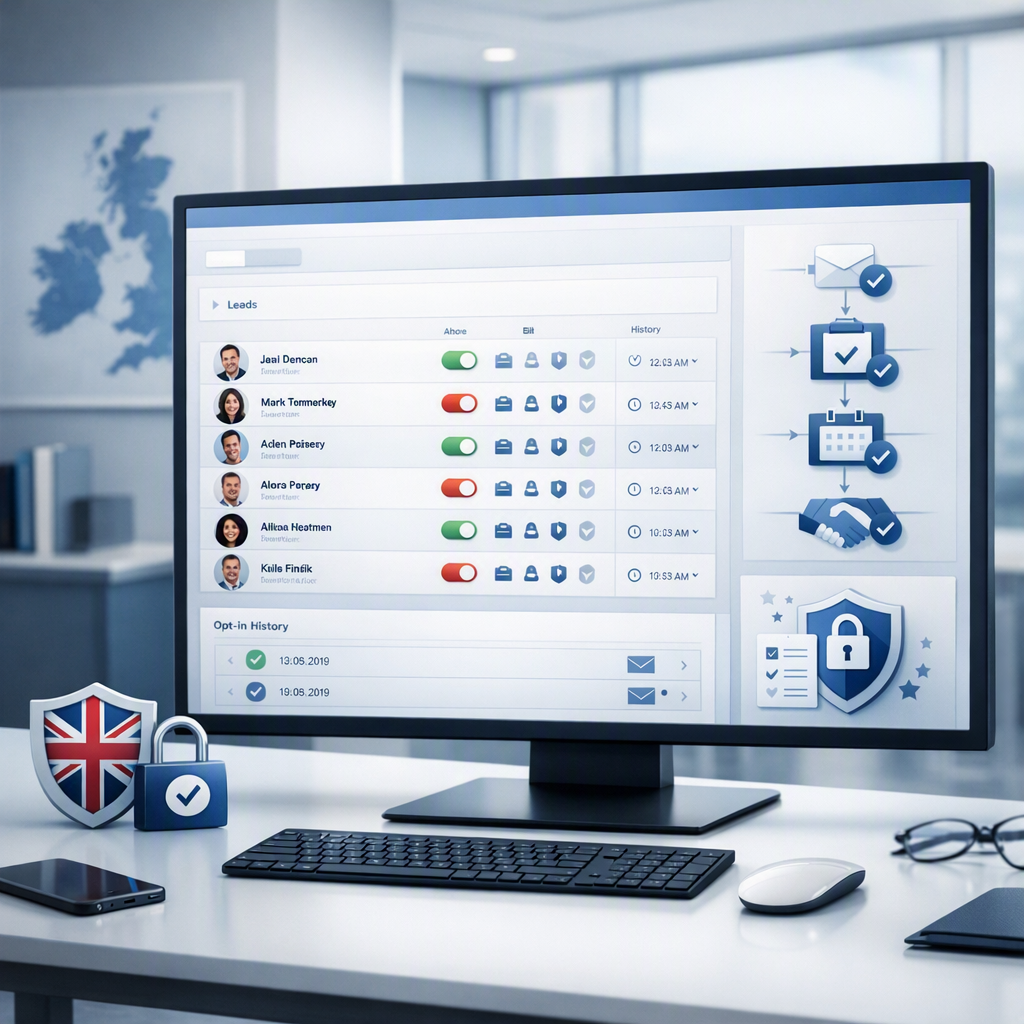
A UK B2B CRM should store contact-level consent data that shows the permission status for each marketing channel, the source and wording of the consent, the time and method of capture, the linked policy version, and any later withdrawal, suppression, or objection history.
A single field called “marketing consent = yes/no” is not enough. It cannot answer the questions the ICO or your own ops team will ask later. In HelloGrowthCRM, we recommend a structured field model that works for both frontline reps and audit reviews.
Recommended contact-level consent fields
Use fields like these on each person record:
| Field | Purpose | Example |
|---|---|---|
| Email marketing status | Track email permission state | Opted in |
| SMS/WhatsApp marketing status | Track mobile channel permission | Not set |
| Phone outreach preference | Store contact preference | Calls allowed weekdays |
| Consent source | Show where permission came from | Website demo form |
| Consent timestamp | Prove when captured | 2026-07-12 10:43 BST |
| Capture method | Show mechanism | Checkbox + submit |
| Consent statement version | Preserve wording used | Privacy v3.2 |
| Cookie/session ID reference | Link digital evidence | GA4 session or CMP ID |
| Withdrawal timestamp | Prove opt-out timing | 2026-08-02 14:17 BST |
| Suppression reason | Block future sends | Unsubscribed via footer |
This is where Smart Inbox, WhatsApp & SMS CRM, and Email Automation should all point to the same preference logic. If each channel has its own rules, mistakes happen.
Separate marketing consent from sales process fields
Keep consent fields distinct from qualification and pipeline fields such as:
- lead source
- ICP fit
- MEDDPICC status
- buying stage
- next meeting date
- forecast category
That separation matters because legal preference data and revenue data change for different reasons. Your Sales Task Boards can still assign follow-ups, but suppression logic should override campaign enrolment automatically.
How PECR, UK GDPR, and ICO guidance affect CRM workflows
PECR, UK GDPR, and ICO guidance affect CRM workflows by deciding when you can send electronic marketing, what records you must keep, how cookies and forms collect permission, and how quickly your systems need to honour opt-outs, objections, and preference changes across every channel.
For B2B teams, the hardest part is not the legislation. It is workflow design. Sales leaders want speed. Compliance leads want control. Good CRM architecture gives both.
Practical workflow differences to account for
Your CRM should account for these operational realities:
- Email marketing needs clear permission controls and suppression logic.
- Cookie-linked forms need evidence of what the visitor saw and chose.
- Phone and meeting follow-up need clear internal rules on legitimate outreach versus marketing.
- Unsubscribe events must sync back to the contact record without delay.
- Preference changes should update active sequences, audiences, and task queues instantly.
In one rollout we did with a 12-person sales team in London, the biggest fix was not adding more legal text. It was removing three duplicate forms and routing every opt-in through one standard property set. That cut list-cleaning time each week and stopped reps re-adding opted-out contacts into old cadences.
Why cookie-linked form capture matters
If your lead capture relies on website forms, preserve the evidence around the submission:
- form ID and page URL
- consent statement shown at submit
- privacy policy version
- cookie consent state where relevant
- timestamp and IP or session reference, if your policy supports storing it
This is where HelloGrowthCRM’s All Integrations approach matters. If your form tool, CMP, website analytics, and CRM do not sync, your audit trail breaks. Connecting Gmail, Slack, and Zapier can also help route alerts when consent changes affect live opportunities.
How Companies House data supports compliant B2B enrichment and routing
Companies House data supports compliant B2B enrichment and routing by helping teams verify company identity, status, registered details, and account ownership rules without relying on guesswork, which improves territory assignment, duplicate control, and pipeline reporting while supporting data minimisation and purpose-led processing.
Companies House is a strong source for account-level enrichment because it is an official public register. The service is available through Companies House. For B2B teams, that means cleaner account creation and better routing.
Useful Companies House fields for CRM workflows
Use Companies House data to enrich the company record, not to over-collect personal data.
Helpful fields include:
- registered company name
- company number
- incorporation date
- registered office address
- active or dissolved status
- SIC code
- filing status
These fields improve:
- lead routing through Territory Management
- duplicate prevention across inbound and outbound
- forecast quality using cleaner account hierarchies and Sales Forecasting
- pipeline visibility using firmographic segmentation and Revenue Attribution
In Manchester, I have seen SDR teams waste hours on companies that were dormant or dissolved because enrichment was left to manual Googling. Once Companies House status was added to routing rules, those leads were either suppressed or redirected to partner workflows.
Limits and compliance considerations
Companies House data is useful, but it is not a free pass to collect everything. Keep these limits in mind:
- use only fields relevant to sales, routing, or compliance
- avoid copying unnecessary personal details into the CRM
- document why each enrichment field exists
- refresh company status regularly to avoid stale records
This works very well for teams under 50 reps. Above that, expect to need stricter governance, role permissions, and periodic field audits.
HelloGrowthCRM workflow design for compliant consent tracking
HelloGrowthCRM workflow design for compliant consent tracking combines contact-level preference fields, source-linked audit trails, channel suppression logic, and account enrichment so British sales teams can keep outreach moving while reducing manual errors, complaint risk, and forecast distortion from contacts who should not be marketed to.
HelloGrowthCRM is the product I am discussing here, so I want to be clear about the bias. I believe it fits UK B2B teams well because it joins compliance controls to day-to-day sales execution. It is not the only way to track consent, but it is strong for teams that want fewer tools and faster operational change.
A practical field and automation blueprint
A clean HelloGrowthCRM build usually includes:
- contact-level consent fields
- account-level Companies House fields
- form-source and policy-version properties
- automated suppression from campaigns and sequences
- alerts to owners when consent changes on open opportunities
- dashboards for opted-in lead volume by source and region
This setup works especially well when paired with AI Lead Scoring, Meeting Scheduler, and AI Deal Insights. Qualified, consented contacts move faster. Low-consent or unclear-status contacts are quarantined for review.
Example audit trail for one contact
A useful audit trail on a single person record should show:
- form submitted on a pricing page
- email consent box checked
- wording version displayed
- cookie/session reference stored
- confirmation email sent
- rep assigned by region and SIC code
- unsubscribe event later received
- all future marketing suppressed automatically
The UK Government explains the core principles of data protection and accountability at gov.uk. Your CRM should make those principles visible in daily work, not just in policy documents.
How to implement UK CRM consent tracking for B2B sales: Step-by-Step
Implementing UK CRM consent tracking for B2B sales means standardising consent fields, connecting forms and cookie evidence, automating channel suppression, enriching accounts carefully with Companies House data, and testing every opt-in and opt-out path so reps can work quickly without creating avoidable compliance risk.
- Map your channels
List every path where a prospect can be contacted or captured. Include website forms, events, referrals, outbound imports, webinars, email, SMS, and WhatsApp. - Define contact-level fields
Create separate status fields for email, SMS, WhatsApp, and phone preference. Add source, timestamp, method, wording version, and withdrawal fields. - Standardise form capture
Reduce forms to a controlled set. Link each form to a policy version and store page URL, timestamp, and relevant cookie or session reference. - Connect suppression logic
Ensure unsubscribes and objections remove contacts from active automations. In HelloGrowthCRM, pair Email Automation with AI Pipeline Management so compliance updates hit campaigns and pipeline views at once. - Enrich account records with Companies House data
Add company number, status, and registered name to account records. Use that for routing, deduplication, and reporting rather than broad personal-data scraping. - Set routing rules by geography and fit
Route London, Manchester, and Birmingham accounts by territory, SIC, or segment. Territory Management helps here, especially when multiple teams share similar account lists. - Build an audit dashboard
Track consent source, opted-in lead volume, opt-out rate, suppressed contacts, and records missing proof. Pipeline Health Score and RevOps Maturity Assessment can help identify process gaps. - Test complaint and SAR scenarios
Pick a contact and verify you can answer basic questions fast. What did they agree to, when, by which route, and has every downstream system updated correctly? - Train reps on exceptions
Reps do not need legal jargon. They need simple rules for when to call, when to email, when to escalate, and when to stop. - Review quarterly
Audit stale fields, duplicate records, old form versions, and disconnected tools. This is also the right time to review Features, evaluate Pricing, or book a Demo for a cleaner rollout.
The ICO reported that it had issued over £2.7 million in fines under PECR during one 12-month period in its annual report, underlining that electronic marketing compliance remains an active enforcement area; see the ICO annual report archive and PECR enforcement materials at ico.org.uk.
For British teams evaluating fit, the next best step is to start a Free Trial or request a Demo of HelloGrowthCRM and model your real consent fields, Companies House enrichment, and suppression workflows before rollout. That is the fastest way to see if the platform can protect compliance without slowing pipeline growth.
About the author
James Carter is a Revenue Operations Lead at HelloGrowthCRM with 11 years of experience in B2B SaaS sales operations, CRM architecture, and UK go-to-market compliance workflows. He has led CRM redesigns for scaling teams across London and Manchester, including one project that rebuilt consent capture, account enrichment, and lead routing for a 12-person sales team selling into regulated industries. His work focuses on turning messy operational rules into clean, usable systems that sales teams actually adopt.
Frequently Asked Questions
Q: Do UK B2B sales teams always need consent before contacting a business prospect?
A: No, UK B2B sales teams do not always need consent before every contact, but they do need clear rules for electronic marketing and must respect PECR, UK GDPR, and objections or opt-outs. The exact position depends on channel, message type, and who the contact is.
Q: What should a CRM audit trail include for consent tracking?
A: A CRM audit trail for consent tracking should include who consented, when they consented, how consent was captured, what wording they saw, and any later withdrawal or suppression event. It should also show source form, timestamp, and linked policy version.
Q: Can Companies House data be used in a CRM for B2B sales?
A: Yes, Companies House data can be used in a CRM for B2B sales when it supports legitimate business purposes like account verification, routing, deduplication, and reporting. The key is to use relevant company data, not collect unnecessary personal data.
Q: How should email and WhatsApp consent be stored in a CRM?
A: Email and WhatsApp consent should be stored in separate CRM fields because each channel carries different permissions and risk. A single marketing opt-in field is too broad and often fails during audits, suppression checks, and complaint handling.
Frequently Asked Questions
Ready to put this into practice?
Set up your pipeline, WhatsApp follow-ups, and AI lead scoring in minutes — free, no credit card.
Try HelloGrowthCRM freeGet CRM tips in your inbox
Join thousands of sales professionals who get weekly insights on CRM strategy, AI automation, and pipeline optimization.

The HelloGrowthCRM team publishes guides on CRM strategy, AI sales tools, and revenue operations for small business sales teams.