HelloGrowthCRM software
Built for real small-business sales teams
HelloGrowthCRM helps reps qualify faster, follow up on time, and close more deals—with practical automation in one place.
- AI lead scoring and pipeline visibility
- Built-in dialer, WhatsApp, and email automation
- Sales forecasting and RevOps-ready reporting
A UK CRM lead capture and routing workflow is the end-to-end process a British B2B sales team uses to collect inbound leads, enrich company and contact records with trusted data such as Companies House, assign ownership by rules, track consent and service-level agreements, and move qualified demand into pipeline quickly and compliantly.
Key Takeaways
- A strong workflow links form capture, enrichment, routing, consent tracking, and follow-up SLAs inside one CRM.
- Companies House data helps standardise legal company names, registration details, and firmographic checks for UK B2B teams.
- UK GDPR, the Data Protection Act 2018, ICO guidance, and PECR affect what you capture, store, and use for marketing.
- Good routing rules improve speed-to-lead, cleaner forecasting, and fairer rep workloads across London, Manchester, and Birmingham teams.
- HelloGrowthCRM works best when lead scoring, automation, pipeline management, and attribution are set up together, not as separate tools.
What is a UK CRM lead capture and routing workflow?
A UK CRM lead capture and routing workflow is the set of rules, fields, automations, and handoffs that turns an inbound enquiry into an assigned sales opportunity while keeping data accurate and compliant with UK privacy and electronic marketing rules. It helps sales leaders reduce admin, improve response speed, and forecast with more confidence.
In practice, this workflow usually spans five layers:
- Capture from web forms, chat, events, referrals, paid campaigns, and inbound calls
- Enrich with legal entity and firmographic data
- Score using fit, intent, and source quality
- Route by territory, segment, account owner, or round robin
- Track consent, SLA compliance, and conversion through pipeline stages
For UK B2B teams, Companies House is useful because it gives a reliable base record for incorporated businesses. You can use Companies House data to standardise legal company names, company numbers, incorporation status, and registered office details. That reduces duplicate accounts and improves matching across forms, enrichment, and finance systems.
Inside HelloGrowthCRM, this becomes easier when you combine AI CRM, AI Lead Scoring, AI Pipeline Management, and Revenue Attribution in one workflow rather than stitching together separate apps.
Why UK teams need a local workflow design
A London SaaS team, a Manchester consultancy, and a Birmingham manufacturing supplier often share one problem: inbound leads arrive in different formats, through different channels, with inconsistent data. Without standard rules, reps cherry-pick leads, managers cannot trust stage progression, and forecasts drift.
When I have audited pipelines like this, the main problem was rarely lead volume. It was broken handoff logic. Enquiries sat unassigned, duplicate accounts split activity history, and reps logged consent notes in free text instead of structured fields.
Why use Companies House data in lead capture and routing?
Companies House data helps UK CRM lead capture and routing by giving B2B teams a trusted reference point for company identity, which improves matching, deduplication, territory assignment, and reporting accuracy. It does not replace buyer intent data, but it gives your workflow a clean legal-company foundation.
Companies House is especially valuable for:
- Account matching: map a lead to the correct legal entity
- Duplicate control: avoid five account records for one company group
- Territory logic: route by registered region, SIC proxy, or named account
- Enrichment confidence: validate company status before sales time is spent
- Reporting quality: tie opportunities to the right business entity
This matters for forecasting. If ten enquiries from one target account sit under five account names, pipeline value looks inflated and rep activity fragments. With a standardised company number field and matching rules, forecast reviews become more believable.
What Companies House can and cannot do
Companies House can give you legal entity signals. It cannot tell you who has current buying intent. That means your workflow should combine Companies House with behavioural signals such as:
- Form submissions
- Email engagement
- Meeting booked
- Pricing page visits
- Product-use signals for PLG motions
HelloGrowthCRM handles this well when Meeting Scheduler, Email Automation, Smart Inbox, and Sales Forecasting are connected to the same record.
How do UK GDPR, the Data Protection Act 2018, ICO guidance, and PECR affect this workflow?
UK GDPR, the Data Protection Act 2018, ICO guidance, and PECR affect a UK CRM lead capture and routing workflow by shaping what personal data you collect, your lawful basis, how you record consent or preferences, how you contact leads electronically, and how long you retain data. Compliance should be designed into fields and automation, not added later.
The UK government explains the UK GDPR framework and its relationship to the Data Protection Act 2018 at gov.uk. The ICO also provides direct guidance on lawful basis, consent, and direct marketing at ico.org.uk.
The UK Information Commissioner’s Office states that consent must be freely given, specific, informed and unambiguous in its UK GDPR guidance at https://ico.org.uk/for-organisations/uk-gdpr-guidance-and-resources/.
For B2B sales leaders, the practical point is simple: do not bury compliance in legal docs and hope reps remember it. Build it into the CRM.
Minimum compliance fields to create in the CRM
Use structured fields, not notes:
| Field | Type | Purpose |
|---|---|---|
| Lawful basis | Dropdown | Record why personal data is being processed |
| Marketing consent status | Dropdown | Show opt-in, opt-out, unsubscribed, not asked |
| Consent source | Text/dropdown | Web form, webinar, referral, event, call |
| Consent timestamp | Date-time | Show when consent was captured |
| PECR contact channel status | Multi-select | Email, phone, SMS, WhatsApp |
| Privacy notice accepted | Checkbox | Track notice acknowledgement where relevant |
| Company number | Text | Match to Companies House record |
| Data retention review date | Date | Prompt data hygiene reviews |
Common compliance mistakes I see
In one rollout we did with a 12-person sales team serving London and Birmingham accounts, the biggest issue was not spam volume. It was missing evidence. Reps thought “they filled in a form” was enough. The CRM had no timestamp, source, or channel-level preference. We fixed that by making consent fields required at capture and by logging every preference change automatically.
Also note a limitation: this article is practical guidance, not legal advice. For higher-risk processing, special categories of data, or complex cross-border setups, involve your legal or privacy team.
What should the workflow look like inside HelloGrowthCRM?
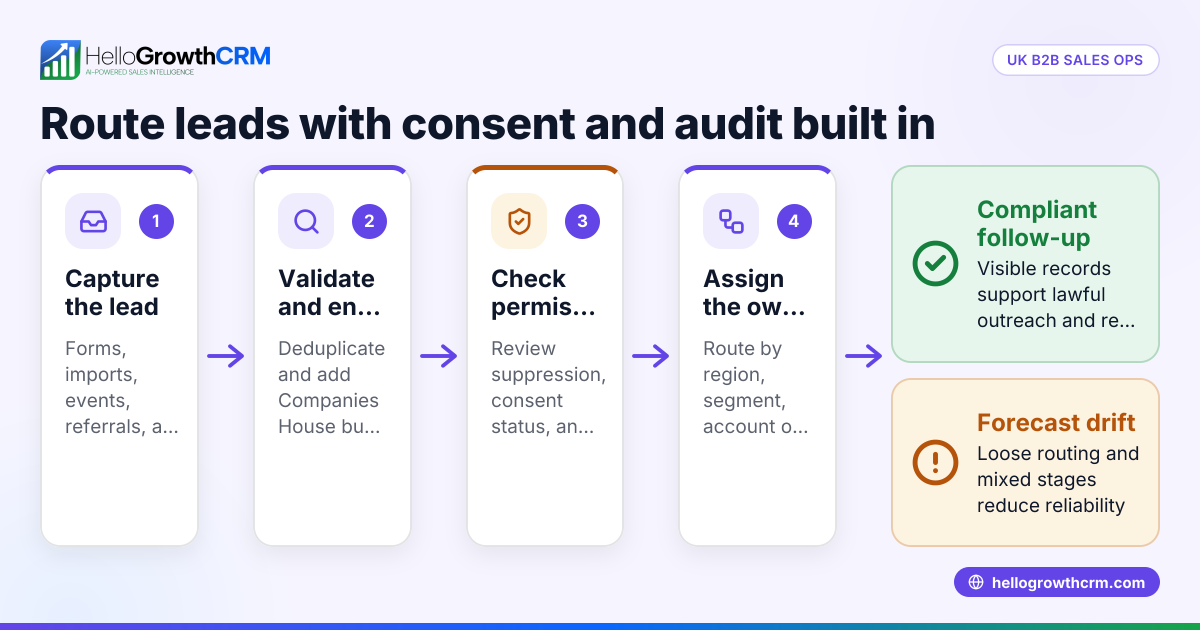
A strong HelloGrowthCRM workflow captures every inbound lead in one place, enriches the record with company identity and fit data, scores urgency and ICP match, routes ownership by clear rules, and triggers SLA-based follow-up tasks so managers can trust pipeline speed and forecast quality.
The best setup uses connected building blocks. A typical stack includes Features, AI Lead Scoring, Sales Task Boards, CRM Dialer, Gmail, and Slack.
Core workflow stages
1. Capture every enquiry source
Connect forms, inbound calls, LinkedIn lead forms through Zapier, event lists, and partner referrals. Push all of them into one lead object. Do not let reps import CSVs directly without mapping and dedupe checks.
2. Match and enrich the company
Use company name, domain, and postcode where available. Then append legal company name and company number from Companies House. If no match is found, mark confidence as low and route for manual review.
3. Score lead fit and urgency
Fit signals may include employee size, sector, region, account tier, and buying role. Urgency signals may include demo request, pricing visit, repeat site activity, or a booked meeting. This is where Lead Scoring Calculator can help you define weights before you automate.
4. Route by rules
Common UK routing rules include:
- Named account owner first
- Territory by region or patch
- Segment by company size
- Product line by enquiry type
- Round robin within an SDR pod
- Overflow rules after SLA breaches
5. Trigger follow-up and monitoring
Create tasks, alerts, and cadences automatically. With Follow-Up Cadence Builder, Smart Inbox, and AI Sales Copilot, reps can move fast without creating manual admin.
How to build a UK CRM lead capture and routing workflow: Step-by-Step
Building a UK CRM lead capture and routing workflow means defining data standards first, then connecting capture sources, adding Companies House enrichment, setting compliance fields, scoring leads, routing by clear rules, and enforcing follow-up SLAs with automation and reporting so speed improves without hurting data quality or compliance.
- Define your operating model
Decide whether inbound is owned by SDRs, AEs, territory reps, or account managers. Document what counts as an MQL, SQL, and sales-accepted lead. - Create mandatory CRM fields
Set required fields for source, company name, email, country, lawful basis, consent status, and enquiry type. Add company number and enrichment confidence for UK records. - Connect inbound channels
Connect your website forms, Calendly, Google Meet, ads, and call flows. Ensure every lead enters through one controlled path. - Match against existing accounts and contacts
Deduplicate by email, domain, company number, and legal name. If the lead belongs to an open opportunity or named account, route to the current owner. - Enrich with Companies House data
Append legal entity details, status, and registered office information where relevant. Keep a clear source field so teams know what came from public records versus user-supplied input. - Add lead scoring rules
Combine fit and intent. Use AI Lead Scoring for dynamic prioritisation, but keep your scoring logic visible enough for managers to audit. - Set routing rules and exceptions
Route by territory, segment, named account, or round robin. Add exceptions for strategic accounts, existing customers, and duplicate or low-confidence matches. - Apply channel-specific consent logic
Track whether email, phone, SMS, or WhatsApp follow-up is allowed. If you use WhatsApp & SMS CRM, align templates and preferences with PECR and ICO guidance. - Create SLA timers and alerts
Set first-response targets, such as 15 minutes for demo requests and 4 working hours for general contact forms. Push breach alerts to Slack and manager dashboards. - Report on speed, quality, and conversion
Track stage-velocity in days, acceptance rate, first-touch compliance, and opportunity conversion by source. Use Pipeline Health Score and Sales Forecasting to spot routing issues early.
Suggested SLA model for UK B2B teams
A simple SLA model works well for teams under 50 reps:
- Demo request: first response in 15 minutes
- Contact sales form: first response in 1 hour
- Content lead with high score: first action in 4 working hours
- Partner referral: same business day
- Existing customer expansion lead: immediate route to account owner
This works for most mid-market teams. Above that size, expect more complex territory and queue logic.
Which routing model is best for London, Manchester, and Birmingham teams?
The best routing model for London, Manchester, and Birmingham teams depends on coverage, segment mix, and account ownership, but most UK B2B teams do best with a hybrid model that prioritises named accounts first, then territory or segment, with round robin only inside clearly defined rep pools.
Use this decision table when evaluating your design:
| Routing model | Best for | Pros | Risks |
|---|---|---|---|
| Round robin | Small SDR teams | Fair distribution, simple setup | Ignores account context |
| Territory-based | Regional field teams | Clear ownership, local coverage | Uneven lead volume |
| Segment-based | Mid-market vs enterprise motions | Better skill alignment | Can create handoff friction |
| Named account | ABM and strategic sales | Protects account continuity | Needs strict account hygiene |
| Hybrid | Most scaling UK B2B teams | Balances fairness and context | More setup work |
In one rollout for a Manchester-based software firm, we moved from pure round robin to hybrid routing. Named accounts and existing opportunities got priority. New logos then flowed by segment and region. Within six weeks, manager escalations dropped because reps stopped arguing over ownership.
Routing rules that usually improve forecast quality
Forecast quality improves when opportunity ownership is stable. Use rules like:
- Existing open opportunity owner takes precedence
- Existing customer expansion goes to account manager
- Strategic named accounts override round robin
- Low-confidence company matches go to rev ops review
- Unworked leads recycle after SLA breach with an audit log
That kind of structure pairs well with Territory Management, AI Deal Insights, and Managed RevOps if you need help designing governance.
How do you measure whether the workflow is working?
You measure a UK CRM lead capture and routing workflow by tracking speed, data quality, assignment accuracy, conversion, and forecast reliability, not just raw lead volume. The right dashboard shows whether leads are getting to the right rep quickly, with compliant data and enough context to progress.
Track these metrics weekly:
- Speed-to-lead: minutes from capture to first rep action
- Assignment accuracy: percent of leads routed correctly first time
- SLA attainment: percent of leads touched within target
- Duplicate rate: percent of new records merged or flagged
- Lead-to-opportunity conversion
- Stage-velocity in days
- Forecast variance
- Consent completeness rate
A practical scorecard
A simple starting scorecard for a UK team:
- 95%+ of inbound leads assigned automatically
- 90%+ consent/source completeness on captured records
- Under 15 minutes for demo request first action
- Duplicate rate under 3%
- Clear source-to-pipeline reporting via Revenue Attribution
If you want to benchmark your current setup before changing systems, run a RevOps Maturity Assessment and compare it with the costs shown in the CRM ROI Calculator.
For British B2B teams that want cleaner inbound execution without extra admin, HelloGrowthCRM brings capture, enrichment workflows, routing, SLA tracking, forecasting, and AI-driven prioritisation into one system. You can explore the product through a Demo, review Pricing, or start a Free Trial to see how it fits your London, Manchester, or Birmingham sales process.
About the author
Tom Ellison is Sales Operations Lead at HelloGrowthCRM with 11 years of experience in B2B SaaS revenue operations, CRM design, and sales process improvement. He has led CRM and routing redesigns for UK sales teams across London, Manchester, and Birmingham, with a focus on inbound management, forecasting, and compliance-friendly automation. One project that informed this article was a full inbound workflow rebuild for a 12-person SaaS sales team, where Companies House matching and SLA automation cut manual triage and improved pipeline visibility. HelloGrowthCRM is the product discussed in this article.
Frequently Asked Questions
Q: What is the main benefit of using Companies House data in a CRM workflow?
A: The main benefit of using Companies House data in a CRM workflow is better company matching and cleaner account records. It helps UK B2B teams standardise legal names, reduce duplicates, and route leads to the right owner with more confidence.
Q: Is Companies House data enough to qualify a B2B lead?
A: Companies House data is not enough to qualify a B2B lead on its own because it shows legal entity information, not buying intent. You still need behavioural signals, ICP fit, and qualification criteria such as budget, timeline, and stakeholder access.
Q: Do UK B2B teams need consent for every inbound lead?
Frequently Asked Questions
Ready to put this into practice?
Set up your pipeline, WhatsApp follow-ups, and AI lead scoring in minutes — free, no credit card.
Try HelloGrowthCRM freeGet CRM tips in your inbox
Join thousands of sales professionals who get weekly insights on CRM strategy, AI automation, and pipeline optimization.

The HelloGrowthCRM team publishes guides on CRM strategy, AI sales tools, and revenue operations for small business sales teams.