

Skip to content
Ecommerce CRM South Africa

CRM for Ecommerce in South Africa: Customers, Couriers and Returns

One system for own-site and marketplace customers, courier and collection point queries, returns handled properly and wholesale enquiries, built for South African online retailers.

Last updated:

Free Forever • No Credit Card Required

Live preview

Ecommerce CRM

A sample Ecommerce workspace. The names and figures are illustrative.

Open pipeline

42

+12% this month

Follow-ups due

9

5 automated

Response SLA

18m

-34% faster

Automation coverage

76%

Channel view

1

Ecommerce Account

Customer records that merge own-site and marketplace buyers where you can identify them

R420K

Returns workflow

1

Ecommerce Opportunity

Channel field on every order and conversation

R190K

Delivery context

1

Ecommerce Renewal

Courier and collection point query handling, with delivery method and status beside the conversation

R120K

Stockist pipeline

1

Ecommerce Follow-up

Returns and refund workflow with an owner and a deadline

R560K

Quick answer

Ecommerce CRM South Africa: what problem does HelloGrowthCRM solve first?

Marketplace and own-site customers are tracked in different places, so a loyal buyer looks like two first-time shoppers. Records merge where the customer can be identified and every order carries its channel, so repeat behaviour is visible and reporting shows what each channel really contributes.
  • Channel view
  • Returns workflow
  • Delivery context
  • Stockist pipeline

See pricingBook a demo

HelloGrowthCRM

Capture. Follow up. Close.

From Enquiry to Customer in One CRMEvery lead captured, followed up and tracked — so nothing goes cold.The path a lead takes inside HelloGrowthCRM, from first enquiry to a repeat customer.
  1. Step 1

    Capture

    Web forms, WhatsApp, calls and ads land in one inbox

  2. Step 2

    Qualify

    AI lead scoring flags who is ready to talk

  3. Step 3

    Assign

    Routed to the right rep automatically

  4. Step 4

    Follow up

    Reminders, sequences and WhatsApp nudges

  5. Step 5

    Track the deal

    Stages, value and next step in the pipeline

  6. Step 6

    Win & retain

    Renewals and repeat business stay on the radar

Every call, message and email is logged on the contact — the history travels with the lead.

One contact record, one pipeline, one clear next step.

01

How ecommerce sells in South Africa

Marketplace and own site are both real channels

Many retailers sell on a large marketplace and through their own store at the same time, with different margins, different customer data and different service expectations. Running them as two disconnected operations is how a genuinely loyal customer ends up looking like a series of unrelated first orders.

Delivery choice is part of the customer conversation

Shoppers choose between door delivery and collection points, and their questions are about a specific parcel rather than a general policy. Answering accurately requires the delivery method and status to be visible to the person replying, which is exactly what a separate courier dashboard prevents.
02

The CRM workflow a South African online retailer needs

One customer view across channels, with the channel recorded on every order and conversation. Returns handled as owned tasks with due dates. Delivery outcomes reported by province, courier and method so the operational choice rests on evidence. A wholesale pipeline for stockist enquiries. Meeting the returns and cooling-off rights your online customers have remains your own legal obligation and sits outside the software.

03

What to check before buying ecommerce CRM software in South Africa

Four questions. Can customer records span marketplace and own-site orders without becoming duplicates? Are returns owned tasks with due dates rather than email threads? Can delivery performance be compared by province, courier and method? And is pricing published per user, so a six-person team is not routed into an enterprise quote before seeing the product work.

04

Store platform, courier dashboard or HelloGrowthCRM

CapabilityStore platformCourier dashboardHelloGrowthCRM
Customer view across channelsPartialNoYes
Channel recorded on every orderPartialNoYes
Returns as owned tasks with due datesNoNoYes
Delivery outcomes by province and methodNoPartialYes
Wholesale and stockist pipelineNoNoYes
Dialer with call recordingNoNoYes
Repeat purchase sequencesPartialNoYes
Owned queues after an interruptionNoNoYes

A courier dashboard reports the parcel and a store platform reports the order. Neither one owns the stockist enquiry, the overdue return or the customer who has not bought since a bad delivery in March.

05

The returns window, day by day

The clock starts before anyone reads the email

A return request that arrives on a Friday afternoon and is opened on Tuesday has already consumed a meaningful part of the period you have to handle it. That is why the request needs to become an owned task the moment it lands rather than a message in a queue. The owner, the due date and the order history in one place mean the decision is made on the facts, and the customer receives an answer while they are still reasonable about it.

Collection, refund and replacement are different paths

Treating every return as one process is what makes them slow. A faulty item, a change of mind, a wrong size and a parcel that never arrived need different evidence, different courier arrangements and different finance steps. Recording which path a request is on, with the step it is waiting at, means nobody has to reconstruct the story before acting, and a request stuck waiting on a collection is visibly stuck rather than silently ageing.

The pattern in the reasons is worth more than the individual case

One return is an incident. Twenty returns on the same product for the same reason is a listing problem, a sizing problem or a packaging problem, and it is costing far more than the refunds suggest. Because reasons are recorded in a fixed set rather than as free text, the pattern is visible in a month rather than discovered a year later when someone finally reads the notes.

Challenges we solve

Common CRM problems in this industry — and how HelloGrowthCRM solves each one

Every team in this space loses revenue to the same recurring gaps. Each card below states one problem and the specific HelloGrowthCRM capability that closes it.

  • Problem: Marketplace and own-site customers are tracked in different places, so a loyal buyer looks like two first-time shoppers.

    How HelloGrowthCRM solves it: Records merge where the customer can be identified and every order carries its channel, so repeat behaviour is visible and reporting shows what each channel really contributes.

    HelloGrowthCRM capability: Channel view

  • Problem: Return requests are handled inconsistently and the deadline is discovered late, when the customer is already unhappy.

    How HelloGrowthCRM solves it: Returns become owned tasks with a due date and the order history attached, so the process is completed on time and the resolution is recorded rather than remembered.

    HelloGrowthCRM capability: Returns workflow

  • Problem: Customers ask where a parcel is and get an answer based on the last thing anyone remembers rather than the actual delivery status.

    How HelloGrowthCRM solves it: Delivery method and status sit beside the conversation, so the reply is accurate the first time and a genuinely delayed parcel is escalated rather than re-explained.

    HelloGrowthCRM capability: Delivery context

  • Problem: Wholesale and stockist enquiries arrive through the website and are answered days later, once the buyer has moved on.

    How HelloGrowthCRM solves it: Buyer enquiries become deals with an owner and stages from line sheet through first order, so a stockist is called back the same day and the quote follows quickly.

    HelloGrowthCRM capability: Stockist pipeline

What you get

Why teams choose HelloGrowthCRM

AI-powered CRM with the features you need to close more deals.

  • Customer records that merge own-site and marketplace buyers where you can identify them, so a repeat customer is recognised rather than counted twice as two strangers
  • Channel field on every order and conversation, because a marketplace customer, an own-site customer and a wholesale buyer need different handling and different reporting
  • Courier and collection point query handling, with delivery method and status beside the conversation, so an answer about a parcel is accurate rather than reassuring
  • Returns and refund workflow with an owner and a deadline, so the statutory rights South African online shoppers have are met on time rather than negotiated late by an unprepared agent
  • Delivery outcome reporting by province, courier and delivery method, so the choice between door delivery and a collection point rests on where each option actually works
  • Wholesale, stockist and corporate order pipeline for the buyer enquiries that arrive through a contact form, with stages from line sheet through first purchase order
  • Marketplace performance notes on the account, so a seller running both a marketplace storefront and an own site can see where a customer relationship actually started
  • Operational continuity notes for planned outages, since a small team needs to know which queues and callbacks were interrupted rather than discovering it from a complaint
  • Built-in dialer with recording for wholesale conversations, escalations and high-value customers, so commitments made on a call exist on the record afterwards
  • Repeat purchase and winback sequences timed from each customer own order pattern rather than from a fixed marketing calendar
  • AI scoring on wholesale enquiries and high-value customers, weighing order history, stage age and responsiveness so a small team calls the right buyer first
  • Reporting in rand by channel, province, courier and owner, showing whether growth came from own-site customers, marketplace volume or the wholesale channel
Watch it work

HelloGrowthCRM–eCommerce CRM: complete online store management

HelloGrowthCRM–eCommerce CRM: complete online store management
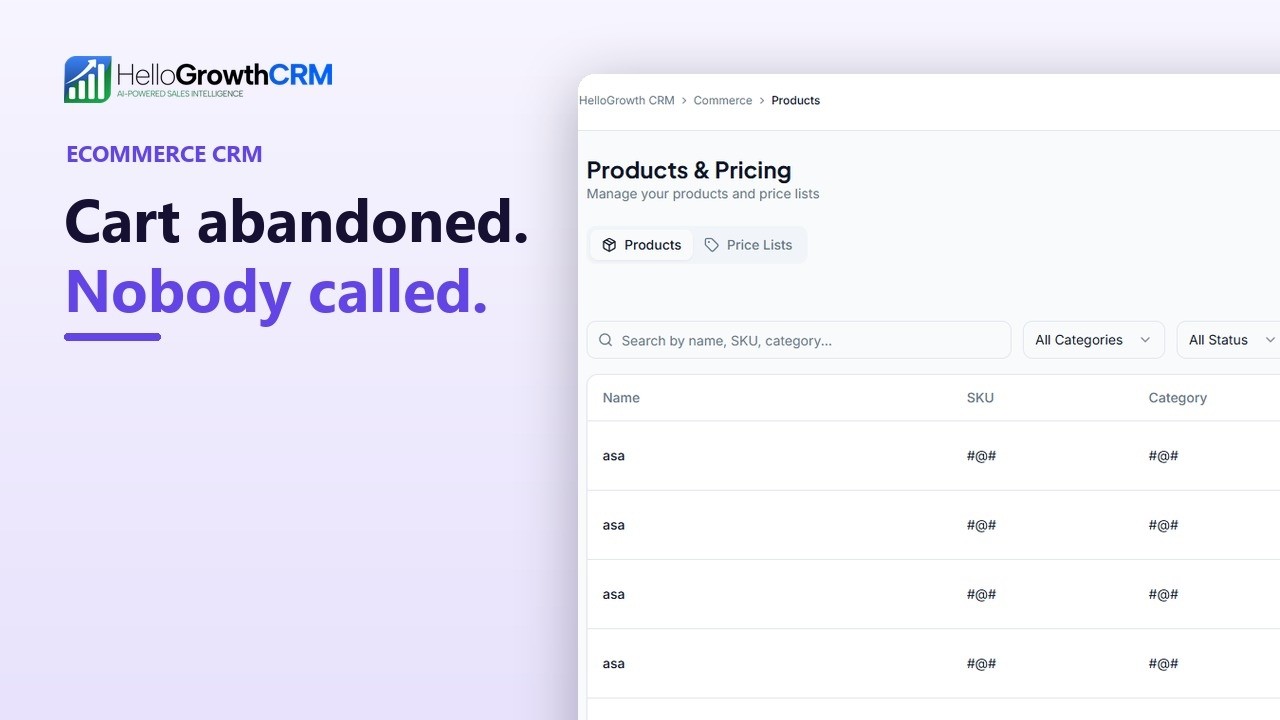
A short walkthrough of HelloGrowthCRM for eCommerce and D2C.

Key takeaways from this video

  • Customers, revenue, failed payments and shipments monitored from one dashboard.
  • Shopify, WooCommerce and manual orders managed in one place.
  • Customer lifecycle stages, including VIP and churn-risk segments.
  • Abandoned-cart recovery, returns and shipment tracking alongside customer history.

Watch the full video on its own page

HelloGrowthCRM by the numbers

$12
per user/month list price — USD 100/user/year, billed annually on annual billing, ₹899/user/mo in India
$0
free forever starter plan — no credit card required
14-day
trial included on paid plans
500+
teams worldwide run their pipeline on HelloGrowthCRM

Frequently Asked Questions

Common questions about using HelloGrowthCRM in your industry.

Yes, and the point is to stop treating them as separate businesses. Every order and conversation carries a channel, and customer records merge where the buyer can be identified, so a shopper who found you on a marketplace and later bought direct is one relationship rather than two anonymous transactions. Reporting keeps the channels distinct so you can see margin and repeat behaviour separately, while support and follow-up work from a single customer view instead of two half-complete ones. Return reasons are recorded from a fixed list rather than as free text, so a recurring sizing or packaging fault becomes visible within a month instead of being buried in agent notes.

As owned work with a deadline. A return request becomes a task with the order history attached, an owner and a due date, so it is completed within the period rather than negotiated late by whoever picks it up. Meeting the cooling-off and returns rights that South African consumers have when they buy online remains your own legal obligation, and the CRM simply makes sure the request is not sitting unread. Outcomes are recorded, so repeat return reasons become visible as a product or listing problem. Requests are split by path, since a faulty item, a change of mind and a parcel that never arrived need different evidence and different steps, and merging them into one queue is what makes returns slow.

It gives you the evidence. Delivery method, courier and outcome are recorded on every order, so success rates and query volumes can be compared by province and by method rather than argued from anecdote. A retailer often finds that one option performs well in metros and poorly elsewhere, or that a courier generating few failures generates a great many where-is-my-parcel conversations, which is a real cost even when the parcel eventually arrives on time.

Yes, as a proper pipeline. Enquiries from independent retailers, boutiques and corporate buyers run through line sheet sent, samples, pricing and terms, purchase order and first delivery, each with an owner and a next action. That prevents the usual failure where a stockist enquiry sits in a shared inbox behind consumer questions for a week. Reporting separates wholesale from retail revenue so you can see whether the channel is actually building or resting on two accounts.

Paid plans are USD 100/user/year, billed annually. The rate is per seat with no minimum, so six people cost six seats and nothing is hidden behind a quote request. A free plan is available if you want to run customer support and the wholesale pipeline before committing spend. Setup is self-service, so the cost of starting is a few days of your own time, and your consumer protection and tax obligations remain yours and sit outside the CRM.

The practical help is continuity of the record. Queues, owned tasks and callbacks are visible when the team comes back, so nobody has to reconstruct who was mid-conversation with which customer. Notes can be logged from a phone. A small team that loses several hours of trading usually loses more revenue to forgotten follow-ups than to the outage itself, and a shared queue with owners is what stops that second loss from happening quietly.

A couple of days. Import customers with order history and channel, connect email, the phone and your messaging number, set the returns workflow and the wholesale pipeline stages, then add the team. There is no configuration project. Most retailers start with support and returns because the improvement is immediate and measurable, then bring the wholesale pipeline and repeat purchase sequences across in the following weeks.

Ready to grow?

Join small businesses that close more deals with HelloGrowthCRM.

Free Forever • No Credit Card Required

Take the next step

Free Forever • No Credit Card Required

Prefer email? Write to sales@hellogrowthcrm.com