

Skip to content
CRM for Tile Showrooms

CRM for Tile Showrooms: From Sample Issue to Final Site Delivery

Trace every sample, quote from a real area schedule, keep batch continuity on top-ups and deliver in phases the site can actually store. From ₹899/user/month.

Last updated:

Free Forever • No Credit Card Required

Live preview

Tile Showrooms CRM

Live sample workspace for Tile Showrooms: Selection records with area schedules: room-wise area in square feet, tile.

Open pipeline

42

+12% this month

Follow-ups due

9

5 automated

Response SLA

18m

-34% faster

Automation coverage

76%

Selection records with area

1

Tile Showrooms Account

Selection records with area schedules: room-wise area in square feet,

Rs. 2.4L

Sample issue register

1

Tile Showrooms Opportunity

Sample issue register: which tiles left the showroom, with whom,

Rs. 1.1L

Box and wastage calculation

1

Tile Showrooms Renewal

Box and wastage calculation: convert area into boxes with a

Rs. 78K

Shade and batch continuity

1

Tile Showrooms Follow-up

Shade and batch continuity: record the lot supplied against each

Rs. 3.2L

Quick answer

Is HelloGrowthCRM right for CRM for Tile Showrooms?

Yes. HelloGrowthCRM gives CRM for Tile Showrooms a single system to capture every lead, automate follow-up across phone, WhatsApp, and email, prioritise leads with AI scoring, and forecast revenue — with calling and messaging built in instead of sold as add-ons. It's built for the problems these teams actually hit — like sample tiles leave the showroom every week with contractors and homeowners. Nobody records which went where, and most never come back or convert — rather than generic sales busywork.
  • Selection records with area schedules: room-wise area in square feet, tile size, series shortlisted and finish, so the quotation is built from a schedule rather than someone's memory of the visit
  • Sample issue register: which tiles left the showroom, with whom, on what date and whether they came back or converted, with reminders on any sample outstanding beyond your limit
  • Box and wastage calculation: convert area into boxes with a wastage allowance and a rounding rule, so the quantity quoted is the quantity that will actually be laid on site

See pricingBook a demo

HelloGrowthCRM

Capture. Follow up. Close.

From Enquiry to Customer in One CRMEvery lead captured, followed up and tracked — so nothing goes cold.The path a lead takes inside HelloGrowthCRM, from first enquiry to a repeat customer.
  1. Step 1

    Capture

    Web forms, WhatsApp, calls and ads land in one inbox

  2. Step 2

    Qualify

    AI lead scoring flags who is ready to talk

  3. Step 3

    Assign

    Routed to the right rep automatically

  4. Step 4

    Follow up

    Reminders, sequences and WhatsApp nudges

  5. Step 5

    Track the deal

    Stages, value and next step in the pipeline

  6. Step 6

    Win & retain

    Renewals and repeat business stay on the radar

Every call, message and email is logged on the contact — the history travels with the lead.

One contact record, one pipeline, one clear next step.

01

A tile sale is decided months before it is delivered

A homeowner walks into a tile showroom when the slab is being cast and lays the tiles when the plaster is dry. That gap is often four to eight months. In most showrooms the enquiry is quoted enthusiastically in week one, followed up twice in week three, and then forgotten, because nothing appears to be happening. What is actually happening is construction, and the buying decision is made at a moment nobody at the showroom is watching for.

Everything useful a tile CRM does follows from that fact. Park the deal with a wake-up date. Keep the shortlisted series on the record so the follow-up is specific. Track the construction stage, not the calendar age of the enquiry.
02

Who influences the specification

Architects and interior designers

They decide series, size and finish, often before the client sees a showroom. They are a channel, not a customer, and they need a relationship maintained between projects rather than a discount at the point of order.

Contractors and masons

They control quantity, timing and the top-up orders, and they influence the choice of dealer through availability, delivery reliability and how breakage claims are handled.

Builders and project engineers

Project supply is released floor by floor against an approved sample. The dealer who tracks the floor schedule is the one whose material is on site when the tiling gang arrives.

03

Diary and quotation pad versus a tile showroom CRM

What the showroom needsDiary and quote padHelloGrowthCRM
Samples issued and tracedRarelyRegister with ageing
Area schedule behind the quoteLoose sheetOn the site record
Wake-up before laying monthForgottenScheduled
Batch or lot suppliedNot recordedOn the site
Phased delivery planOne dispatchPhase-wise schedule
Architect referral valueUnknownPer account
Breakage claim ageingVerbalTicket with due date
04

The sample register is the cheapest control you can add

Tiles leave the showroom as samples every single day, carried away by contractors, homeowners and designers. In most showrooms nobody records it, so the business simultaneously loses stock and loses the strongest buying signal it will ever receive. Someone who carries a tile to a site to see it in daylight is far closer to purchase than someone who filled in an enquiry form.

Recording the issue takes fifteen seconds and creates a follow-up reason that does not feel like a sales call. Asking how the tile looked in the room is a better opening than asking whether they have decided.

05

The weekly management view

Samples outstanding beyond fourteen days. Selections whose expected laying month starts within thirty days. Quotations older than a month with no contact. Builder projects whose next floor release is due. Sites with a partial delivery and a pending balance. Open breakage claims past their promised date. And architect accounts with no contact in ninety days, which is where next quarter's specifications are quietly being decided.

Challenges we solve

Common CRM problems in this industry — and how HelloGrowthCRM solves each one

Every team in this space loses revenue to the same recurring gaps. Each card below states one problem and the specific HelloGrowthCRM capability that closes it.

  • Problem: Sample tiles leave the showroom every week with contractors and homeowners. Nobody records which went where, and most never come back or convert.

    How HelloGrowthCRM solves it: Every sample issue is a record with the tiles, the person, the site and a date. Samples out beyond your chosen limit generate a follow-up task, which doubles as a natural reason to call.

    HelloGrowthCRM capability: Sample issue register

  • Problem: A customer selects tiles in January and lays them in July. The quotation goes stale, nobody re-engages, and the order is placed with whoever called in June.

    How HelloGrowthCRM solves it: Long-cycle deals park with a wake-up date tied to the expected laying month. The showroom re-engages with the exact series that was shortlisted, before the customer starts looking again.

    HelloGrowthCRM capability: Long-dormancy handling

  • Problem: A site runs short by twelve boxes. The top-up is supplied from a different production lot and the shade difference is visible across the living room floor.

    How HelloGrowthCRM solves it: The batch supplied is recorded against the site. A top-up request shows the original lot, so your team either matches it or warns the customer before laying rather than after.

    HelloGrowthCRM capability: Shade and batch continuity

  • Problem: Architects and interior designers send steady specification business, but nobody can say which of them influenced what value this year.

    How HelloGrowthCRM solves it: Each professional is an account with the projects they specified, the value converted and the last contact date. The specification channel becomes measurable and therefore worth investing in.

    HelloGrowthCRM capability: Architect and designer accounts

What you get

Why teams choose HelloGrowthCRM

AI-powered CRM with the features you need to close more deals.

  • Selection records with area schedules: room-wise area in square feet, tile size, series shortlisted and finish, so the quotation is built from a schedule rather than someone's memory of the visit
  • Sample issue register: which tiles left the showroom, with whom, on what date and whether they came back or converted, with reminders on any sample outstanding beyond your limit
  • Box and wastage calculation: convert area into boxes with a wastage allowance and a rounding rule, so the quantity quoted is the quantity that will actually be laid on site
  • Shade and batch continuity: record the lot supplied against each site, so a top-up order six weeks later can be matched instead of producing a visible shade change across one floor
  • Phased site delivery: bathrooms first, floors later, terrace last, scheduled against the construction stage rather than dispatched as one truck the customer has nowhere to store
  • Architect, designer and contractor accounts: specifications influenced, projects referred, trade terms and last contact date, so the specification channel is worked deliberately
  • Builder project pipeline: multi-tower jobs with expected quantity, floor-wise schedule, approved sample reference and the site engineer who actually releases each material request
  • Long-dormancy handling: a customer selects tiles months before laying, so the deal parks with a wake-up date instead of ageing quietly out of view at the bottom of a list
  • WhatsApp inbox on the showroom number: tile photographs, layout images, quantity confirmations and delivery timings attach to the site record rather than a salesperson's personal chat
  • Breakage and shortage claims: a damaged consignment becomes a ticket with photographs and a resolution date, because unresolved breakage is the quickest way to lose a builder account
  • AI lead scoring: total area, construction stage, samples issued, architect involvement and quotation age, ranked so the showroom calls the sites that are genuinely close to buying
  • GST invoicing and outstanding: raise tax invoices against the site, record advances and part deliveries, and see which contractors are overdue before the next truck is loaded
Watch it work

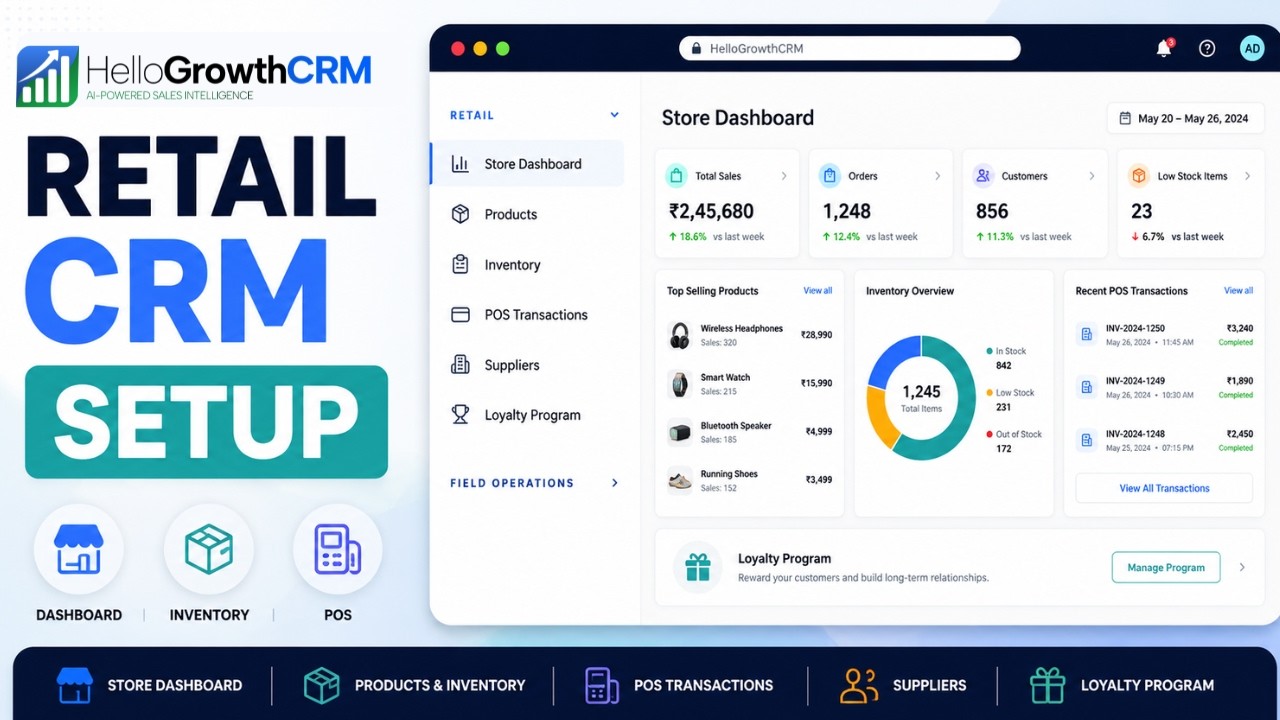
Complete Retail CRM Setup in HelloGrowthCRM | Store Dashboard, Products, Inventory & POS

Complete Retail CRM Setup in HelloGrowthCRM | Store Dashboard, Products, Inventory & POS
A short walkthrough of HelloGrowthCRM for retail.

Key takeaways from this video

  • Where the Retail module sits and how the Store Dashboard gives a daily overview.
  • Managing products and tracking inventory inside the CRM.
  • Handling POS transactions and suppliers.
  • Running a loyalty programme for repeat customers.

HelloGrowthCRM by the numbers

$12
per user/month list price — USD 100/user/year, billed annually on annual billing, ₹899/user/mo in India
$0
free forever starter plan — no credit card required
14-day
trial included on paid plans
500+
teams worldwide run their pipeline on HelloGrowthCRM

Frequently Asked Questions

Common questions about using HelloGrowthCRM in your industry.

It is a system built around the tile sales cycle, which is unusually long and unusually easy to lose in the middle. A showroom selling only counter quantities of repair tiles does not need it. A showroom quoting full houses, working with architects and contractors, issuing samples, and supplying builder projects in phases does, because that business involves dozens of open selections at different construction stages, and none of them can be held in a diary. The CRM holds the site, the area schedule, the samples issued and the delivery plan in one place.

Tile selling is photographic. Customers send room images, your team sends tile shots and layout suggestions, and quantities are confirmed by message. Connecting the showroom's business WhatsApp number keeps that entire visual thread on the site record, so the shortlisted series is still identifiable three months later. The built-in dialer works the day's call list: samples outstanding, quotations awaiting decision, sites whose laying month has arrived. Every call is logged with an outcome, so a customer handled by a salesperson who has left does not start from zero.

Most tile showrooms are running within one working day. Existing customer, contractor and architect lists import from Excel or CSV with field mapping. The two pipelines that matter are retail site selections and builder projects, and both take an afternoon to configure with your own stages. If you already keep a sample issue register on paper, the open entries can be entered in an hour and start generating follow-up tasks immediately. The habit that takes longest to settle is recording every sample issue at the counter, usually about two weeks.

Yes. Keep billing and stock where they are. HelloGrowthCRM owns the sales relationship layer: selections, samples, quotations, follow-up, delivery scheduling and outstanding conversations. An open API and webhooks let you push confirmed orders into billing and pull invoice, payment and stock availability back, so a salesperson quoting a series can see whether the quantity exists before promising a date. Web forms and landing pages feed enquiries into the pipeline directly, and email and calling are handled inside the CRM.

Role-based access means a salesperson sees their own sites and the architects assigned to them, while the owner sees the whole showroom including trade pricing. When someone leaves, access ends the same day and the site history stays with the business. GST invoicing is built in: raise the tax invoice against the site with the correct HSN and rate, record advances and part deliveries separately, and see outstanding by contractor with ageing before releasing the next dispatch from the godown.

Because a sample is both a cost and a signal. Physically it is stock leaving the building, and most showrooms never learn what happened to it. Commercially it is the strongest buying signal you get, stronger than any enquiry form, because someone carried tiles to a site to check them against the light. Recording the issue turns an invisible cost into a follow-up trigger. A call three days after a sample was taken, asking how it looked in the room, is one of the highest-converting calls a tile showroom can make.

Yes, and it should, because tiles are rarely wanted all at once. A site typically needs bathroom and utility tiles at one construction stage, floor tiles at another, and terrace or parking tiles last. The CRM holds a delivery schedule with a planned date and quantity per phase, tied to the site's progress. When the engineer or contractor confirms readiness, the phase becomes a dispatch task. This avoids both the storage problem of dumping everything at once and the breakage that comes with moving material around an active site.

CRM guides for related industries

See how teams in similar industries run their pipelines in HelloGrowthCRM.

Ready to grow?

Join small businesses that close more deals with HelloGrowthCRM.

Free Forever • No Credit Card Required

Take the next step

Free Forever • No Credit Card Required

Prefer email? Write to sales@hellogrowthcrm.com