Quick answer
HelloGrowthCRM's HRMS module runs payroll (with PF, ESI, PT and TDS), leave management, attendance and performance appraisals inside the same platform as your CRM — so employee records, sales activity and salary data live in one system, on one flat Rs.899/user/month plan, instead of a separate HR tool billed on top of your CRM.
Why running HR in a separate tool quietly costs you
Most growing Indian teams buy a CRM first, then bolt on a separate HRMS a year later. Two per-seat bills and two disconnected databases are where the friction starts:
✗ Two per-user subscriptions for the same people
Your 20 sales and field staff are already paid seats in your CRM. Buying Keka or GreytHR means paying per-user a second time for the exact same headcount.
✗ Employee data lives in two places
A rep's targets sit in the CRM; their salary, leave and appraisal sit in the HR tool. Nothing reconciles, and finance exports both to stitch a headcount cost report by hand.
✗ Field attendance and CRM check-ins are separate apps
Your field team punches attendance in one app and logs site visits in another. Two logins, two support tickets, and no single view of who was where.
✗ Payroll month-end is a spreadsheet fire drill
Without statutory rules stored centrally, every pay cycle means re-checking PF ceilings, ESI thresholds and PT slabs in a spreadsheet before you can pay anyone.
HelloGrowthCRM removes the second tool entirely. Payroll, leave, attendance and appraisals run beside your pipeline — one employee record, one login, one flat plan.
What the HRMS module does
A full HR and payroll stack for Indian SMEs — every part built to sit next to your sales and service operations, not in a silo.
Payroll runs with Indian statutory compliance
Process monthly payroll with PF, ESI, professional tax and TDS handled for you. Import compensation in bulk, run pay cycles, and generate payslips — no spreadsheet reconciliation at month-end.
Leave management with balances and approvals
Define leave types, set annual allocations, and let employees apply from their phone. Managers approve in one tap and balances update automatically — so no one argues about carried-forward leave in March.
Attendance and regularisation
Track daily attendance on a single grid, flag missing punches, and let staff raise regularisation requests. Field teams check in with geo-location from the mobile app — the same app they use for the CRM.
Performance appraisals and review cycles
Launch review cycles from reusable templates, collect self and manager ratings, and keep every appraisal in one timeline. Ratings sit next to sales performance data, so promotions are backed by numbers.
One employee directory across HR and sales
Every employee record — role, department, joining date, salary band — lives in the same system as your leads and deals. Your sales rep and their HR profile are one record, not two disconnected apps.
Offer letters with verifiable e-signatures
Generate offer and appointment letters, send them for native e-signature, and give every letter a public verification link. New joiners and background-check vendors confirm authenticity without emailing your HR team.
Compensation and headcount reporting
See payroll cost by department, headcount trends, and attrition in the same dashboards as revenue. Finance gets one number for salary spend against pipeline — not two exports to stitch together.
Role-based access and audit trails
Salary and appraisal data is locked behind field-level roles, so a sales manager never sees payroll and an HR user never sees deal margins. Every change is logged in a tamper-evident audit trail.
Statutory settings you set once
Configure PF ceilings, ESI thresholds, professional-tax slabs and pay components once. Every future payroll run inherits them, so a new state office or a slab change is a settings edit, not a migration.
Self-service for every employee
Staff apply for leave, view payslips, mark attendance and track appraisal status from the mobile app. HR stops being a helpdesk for routine requests and gets time back for hiring and retention.
Payroll that closes on time, every month
Payroll fails when statutory rules live in someone's head and a spreadsheet. With HelloGrowthCRM you set PF ceilings, ESI thresholds, professional-tax slabs and pay components once in statutory settings, and every run inherits them. Bulk-import compensation from your existing sheet, run the pay cycle, review the register, and generate payslips employees can open on their phone. Because compensation is a validated import — not free typing — you catch a wrong CTC before it becomes a wrong payslip. Finance sees salary cost by department in the same dashboard as pipeline revenue, so headcount spend is always measured against the business it supports.
Appraisal templates that weight what actually matters
Part of the HR edition. A review template is built from sections you weight yourself — KRA or Goal sections alongside Competency sections — so a review can say that delivery counts for more than attendance, or the reverse, and say it in the form rather than in a conversation afterwards. An HR admin sets the weights once and every review run on that template inherits them.
Most appraisal disagreements are not about the score. They are about a score whose weighting nobody agreed on in advance.
Self review, manager review, peer review, then acknowledgement
An employee submits their own self review. Their manager submits a review for them, and a peer submits one when invited to. Each person sees the review they are meant to fill in and not their colleagues' — an employee cannot open someone else's review.
The cycle finishes with the employee acknowledging the completed review, which is recorded as its own status. That last step is what turns an appraisal from something filed about a person into something they have confirmed they read.
Leave and attendance without the March-end arguments
Leave disputes happen when balances are tracked by memory. HelloGrowthCRM defines leave types with annual allocations, applies accrual and carry-forward rules automatically, and shows every employee their live balance before they apply. Managers approve or reject from the mobile app, and the balance updates instantly — no year-end reconciliation. Attendance sits on a single grid: mark daily presence, flag missing punches, and let staff raise regularisation requests that route to their manager. Field teams check in with geo-location from the same app they use to log site visits, so their attendance and their CRM activity are captured in one action instead of two.
Appraisals backed by real performance data
Review season is painful when ratings are subjective and scattered across forms. HelloGrowthCRM launches review cycles from reusable templates, collects self-assessment and manager ratings in a structured flow, and keeps every appraisal on one employee timeline. Because HR and sales share a platform, a rep's appraisal sits beside their actual pipeline, activity and conversion numbers — so a promotion or a rating is backed by evidence, not recall. Over time you can see which managers develop their people, where attrition risk is rising, and how appraisal outcomes map to real results.
One platform for the people who sell and the people who pay them
The reason HR and CRM belong together is simple: they describe the same people. Your field sales rep is an employee with a salary, a leave balance and an appraisal — and a lead owner with a pipeline and a target. Splitting that person across two tools creates duplicate records, two logins, two bills and two support queues. HelloGrowthCRM keeps the employee and the seller as one record, protected by field-level roles so salary and deal data never leak across teams. For a growing Indian SME, that means adding HR and payroll is a module you switch on — not a migration, a new vendor, or a second per-seat invoice.
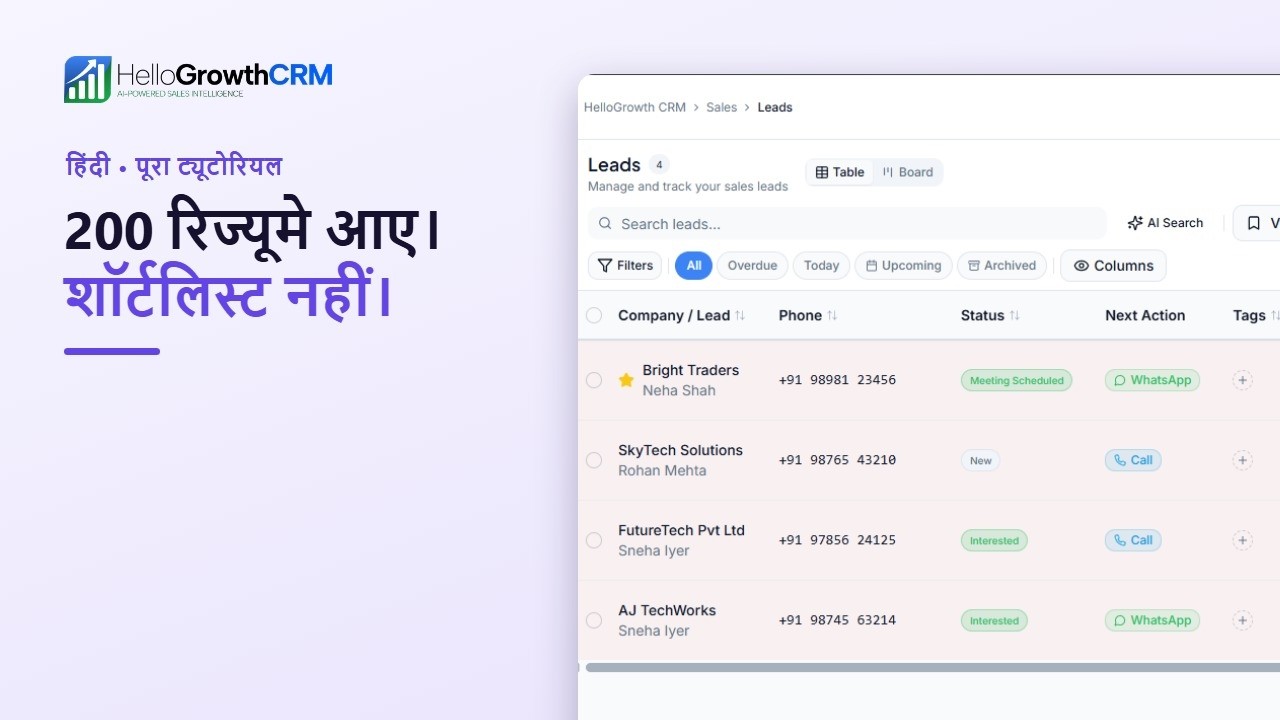
Watch: HR & Recruitment Module Walkthrough
See how the HR module works day to day — moving candidates through the hiring pipeline, keeping employee records in one place, and running the whole workflow beside your CRM.
Payroll software that finishes before the last working day
Payroll in most small businesses is not one job — it is a chain of small reconciliations. Attendance is exported from one place, leave deductions are checked against a second, salary revisions from the last appraisal cycle are remembered by one person, and the whole thing is assembled in a spreadsheet that only works because nobody else touches it. The month-end pressure comes from the joins, not from the calculation.
Running payroll against the same employee records that hold attendance and leave removes those joins. Days present, approved leave, unpaid absences, and the current CTC are already on the employee, so a pay run reads them rather than importing them. PF, ESI, professional tax, and TDS are applied from the statutory settings you configured once, and payslips generate for every employee in the run.
The parts that most often cause a rerun are worth calling out. Mid-month joiners and leavers are prorated on their actual working days rather than being adjusted by hand afterwards. A salary revision carries an effective date, so a change approved in March but backdated to January is handled as arrears instead of a manual one-off line. Full and final settlements pull the leave balance and notice period from the same record the employee's manager has been approving against all year.
For a business of fifteen to a hundred employees, the practical effect is that payroll stops being a two-day exercise for the person who understands the spreadsheet, and stops being a risk when that person is unavailable. That is a smaller claim than most payroll software makes, and it is the one that actually matters at this size.
Attendance tracking that works for field teams, not just desks
Attendance software is usually designed around an office door. That assumption breaks immediately for the businesses most likely to be reading this page — sales teams on the road, service technicians moving between sites, field staff who visit the office twice a month. Asking those people to swipe a biometric reader produces either bad data or a daily argument.
Geo-located mobile check-in solves the mechanics: staff mark attendance from the same app they use for their CRM tasks, with location captured at the point of check-in. Missing punches are flagged on the attendance grid rather than discovered at month-end, and employees raise regularisation requests that their manager approves in a tap. The correction happens on the day it is remembered, which is the only time anybody remembers accurately.
Keeping attendance next to the sales record has a second benefit that standalone HR tools cannot offer. A field rep's check-ins and their logged customer visits describe the same day, so a manager reviewing territory coverage is looking at one picture rather than reconciling two systems that disagree. Shift patterns, week-off rules, and holiday calendars are configured per location, which matters for businesses operating across states with different holiday lists.
Because the attendance data feeds the pay run directly, the usual month-end export and re-import disappears along with the transcription errors it produces. Leave balances, present days, and deductions are read from one source, so the payslip an employee queries can be traced back to the specific day and the specific approval that produced it.
Frequently asked questions
Is HelloGrowthCRM a full HRMS or just a CRM add-on?
HelloGrowthCRM ships a genuine HRMS module, not a light add-on. It covers payroll runs with Indian statutory deductions (PF, ESI, PT, TDS), leave management with balances and approval workflows, daily attendance with regularisation, and performance appraisal cycles with reusable review templates. The difference from a standalone HRMS is that all of this runs inside the same platform your sales and service teams already use — so an employee's HR record and their CRM activity are one record, billed on one flat plan.
Does the payroll support Indian statutory compliance like PF, ESI and TDS?
Yes. You configure PF ceilings, ESI thresholds, professional-tax slabs and pay components once in statutory settings, and every payroll run applies them automatically. You import compensation in bulk, run monthly pay cycles, and generate payslips without reconciling spreadsheets. Because the rules are stored centrally, a slab change or a new state office is a settings update rather than a rebuild of your payroll logic.
How is this cheaper than buying Keka or GreytHR separately?
Standalone HRMS tools like Keka and GreytHR are billed on top of whatever CRM you already pay for, so a growing team ends up with two per-user subscriptions. HelloGrowthCRM includes HRMS in the same Rs.899/user/month plan as the CRM, dialer, WhatsApp and project management. For a 20-person team that already needs a CRM, folding HR and payroll into the same platform removes a second per-seat bill and a second vendor to manage.
Can employees apply for leave and view payslips on mobile?
Yes. HelloGrowthCRM has a native iOS app and an Android PWA. Employees apply for leave, check remaining balances, mark attendance, view payslips and track their appraisal status from their phone — the same app your field team uses for the CRM. Managers approve leave and regularisation requests in one tap. This self-service removes most routine HR helpdesk traffic.
Is salary and appraisal data kept private from other teams?
Yes. Payroll, compensation and appraisal data sit behind field-level role-based access control. A sales manager can see their team's targets and activity but never their salaries; an HR user manages payroll but never sees deal margins. Every change to sensitive HR data is written to a tamper-evident audit log, and HelloGrowthCRM is operated by Soor LLC, which completed a SOC 2 Type II examination (Feb–Jun 2025).
Which businesses is the HRMS module best suited for?
It fits growing Indian SMEs of roughly 10 to 200 employees that already run sales or service operations on a CRM and want to stop paying for a separate HR tool. Real estate, manufacturing, education, agencies, IT services and field-service teams get the most value, because their sales staff and field staff already live in HelloGrowthCRM — adding payroll, leave and attendance means one login and one bill instead of two systems that never talk to each other.