Overview
Asana runs the delivery side of many service businesses — onboarding checklists, campaign builds, implementation projects. The handoff from "deal won" to "work started" is exactly where clients get dropped: sales celebrates, and delivery finds out days later via a forwarded email thread. The HelloGrowthCRM integration creates and updates Asana tasks and projects from CRM deals, so winning a deal starts the delivery clock automatically.
The flagship workflow is won-deal handoff: closing a deal spawns an Asana project from your onboarding template, pre-filled with client name, deal value, scope notes, and due dates. Status flows back the other way — when delivery milestones complete in Asana, the CRM record shows it, so account owners answer "how's my project going?" without asking the delivery team on chat.
What data is involved
- Asana tasks and projects created from CRM deals and tasks, with templates supported.
- Client name, deal value, scope, and close date passed into the Asana project on creation.
- Task status and completion synced back to the CRM deal timeline.
- Due dates aligned between CRM commitments and Asana schedules.
- Asana project link stored on the CRM record for one-click access.
- Milestone completion events usable to trigger CRM follow-ups or invoicing tasks.
Step-by-step setup
Setup at a glance (3-5 bullets)
- Open Settings → Integrations → Asana, click Connect, and approve the OAuth prompt for your Asana workspace.
- Pick the Asana project and section where CRM-driven tasks should land — for example a client onboarding project.
- Map CRM deal stages or task types to Asana projects, sections, and default assignees.
- Choose which CRM events create, update, or complete Asana tasks — deal won, task done, due-date changes.
- Move a test deal into the trigger stage and confirm the Asana task appears in the right section with the correct assignee and due date.
Sign in or sign up at HelloGrowthCRM. Open the login page, enter your credentials (or use Google), or choose Sign up if you need a new account. You must be signed in before you can open Settings and connect this integration.
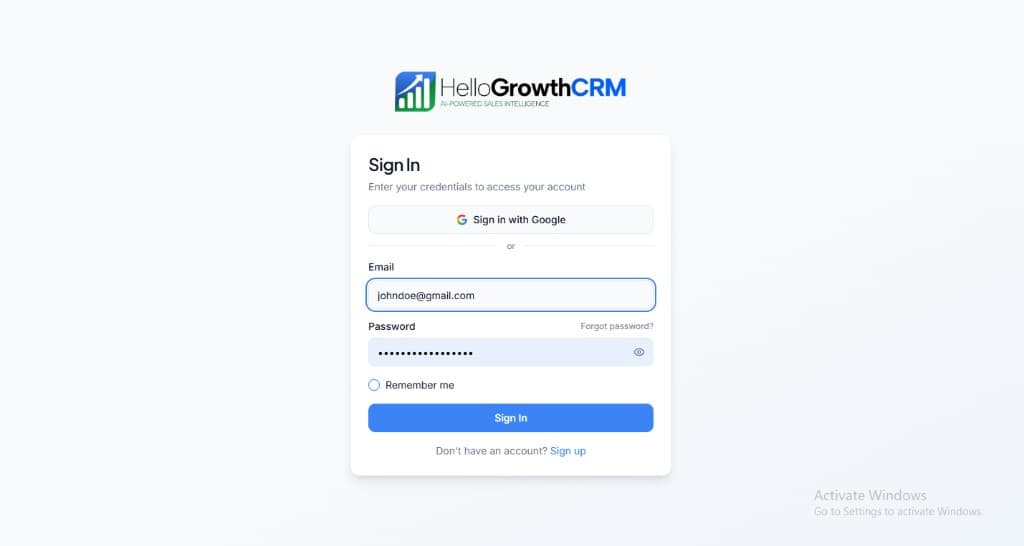
Open login page(opens in a new tab)app.hellogrowthcrm.com/login
Open Settings. In the left sidebar, under Admin, click Settings (you will land on the Settings area; the URL is app.hellogrowthcrm.com/settings).
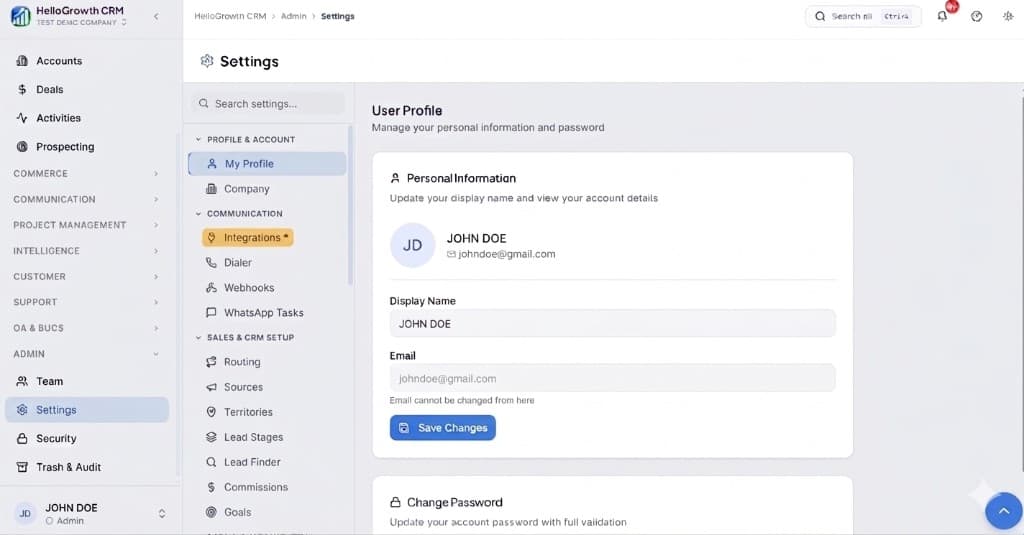
Open Settings(opens in a new tab)app.hellogrowthcrm.com/settings
Go to Integrations. On the Settings screen, use the middle settings menu. Under COMMUNICATION, click Integrations (star icon). Then find and configure this connector—the connector-specific steps below pick up from here.
Open Settings (Integrations)(opens in a new tab)app.hellogrowthcrm.com/settings
- Open Settings → Integrations → Asana, click Connect, and approve the OAuth prompt for your Asana workspace.
- Pick the Asana project and section where CRM-driven tasks should land — for example a client onboarding project.
- Map CRM deal stages or task types to Asana projects, sections, and default assignees.
- Choose which CRM events create, update, or complete Asana tasks — deal won, task done, due-date changes.
- Move a test deal into the trigger stage and confirm the Asana task appears in the right section with the correct assignee and due date.
Best practices
- Build the onboarding project as an Asana template and let the deal-won trigger instantiate it — consistency beats memory.
- Pass scope notes from the deal into the project description so delivery never re-briefs from scratch.
- Sync milestones, not micro-tasks, back to the CRM; account owners need 'kickoff done, build in progress', not forty checkbox updates.
- Trigger an invoicing task in the CRM when the final Asana milestone completes — the billing lag after delivery is pure cash-flow leak.
- Agree one owner for due-date changes; two systems editing dates independently erodes trust in both.
Best for & common use cases
Onboarding and delivery teams that execute in Asana what sales committed to in the CRM.
- Deal won → kickoff task set created in the client's Asana project with owners and due dates.
- Sales handoff tasks mirrored to the implementation pod so nothing is retyped.
- Delivery status synced back so reps see progress without opening Asana.
Expected outcomes
- Faster lead handoff between tools and CRM owners
- Cleaner activity history for follow-up and reporting
- Lower manual copy-paste errors in the pipeline
Troubleshooting
- Project not created on deal-won: the template ID in the mapping points to a deleted or renamed template — re-select it in the integration settings.
- Status not flowing back: the Asana webhook expired (they lapse when the target resource is deleted) — reconnect the project sync.
- Wrong team receiving projects: the OAuth user's default workspace differs from the mapped one — set the workspace explicitly in the mapping.
FAQ
Governance
Treat API keys and webhooks as production secrets. Align field mapping with your privacy policy and regional regulations (GDPR, marketing consent, telemarketing rules). Your admin controls which roles can install or edit integrations.
Related integrations in this category
Push CRM data to Airtable bases and tables for stakeholder views, partner reporting, and lightweight apps.
Creates Jira issues from CRM tasks for engineering and bug tracking.
Creates Linear issues from CRM tasks via the GraphQL API.
Creates support tickets from CRM records.
Creates Freshdesk tickets from CRM records.
Pushes CRM data to Notion databases with custom field mapping.
Send documents for e-signature and track status (sent, viewed, signed, declined).
E-signature workflows with status tracking, similar to DocuSign.