Overview
Zendesk is where your customers' problems live; the CRM is where their revenue lives. Without a connection between the two, sales walks into renewal conversations blind to the three escalated tickets from last month, and support answers tickets with no idea the account is mid-expansion. The HelloGrowthCRM integration links Zendesk tickets to CRM contacts and deals so both teams see one truthful account picture.
The practical shape: tickets created in Zendesk appear on the matching CRM contact timeline with status and priority, and reps can raise a ticket from a CRM record when a customer reports a problem mid-call. Account context — plan, deal stage, owner — travels the other way, so support agents can route and prioritise with revenue in view.
What data is involved
- Zendesk tickets linked to CRM contacts and companies, matched on email and domain.
- Ticket status, priority, and subject visible on the CRM contact and deal timeline.
- New tickets creatable from a CRM record, pre-filled with contact details.
- CRM account context (owner, stage, value) surfaced to support for prioritisation.
- Ticket-resolved events available to trigger CRM follow-up tasks.
- Historic ticket counts per account for health reporting.
Step-by-step setup
Setup at a glance (3-5 bullets)
- Settings → Integrations → Zendesk → subdomain and credentials.
Sign in or sign up at HelloGrowthCRM. Open the login page, enter your credentials (or use Google), or choose Sign up if you need a new account. You must be signed in before you can open Settings and connect this integration.
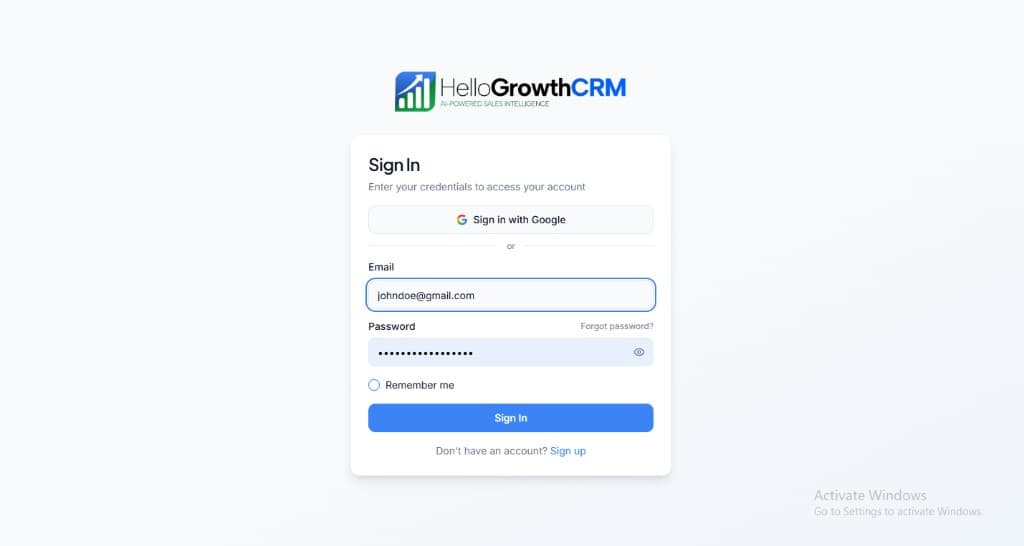
Open login page(opens in a new tab)app.hellogrowthcrm.com/login
Open Settings. In the left sidebar, under Admin, click Settings (you will land on the Settings area; the URL is app.hellogrowthcrm.com/settings).
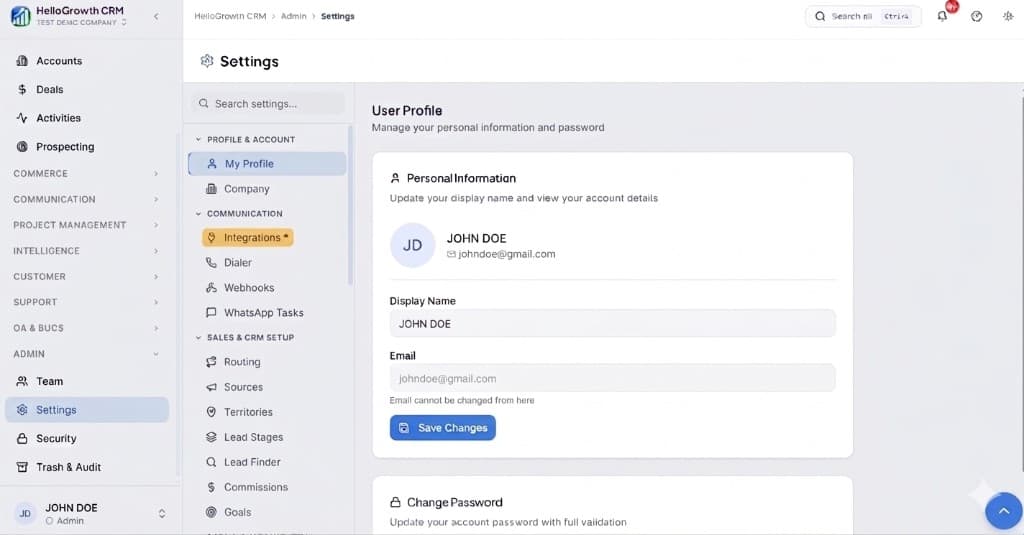
Open Settings(opens in a new tab)app.hellogrowthcrm.com/settings
Go to Integrations. On the Settings screen, use the middle settings menu. Under COMMUNICATION, click Integrations (star icon). Then find and configure this connector—the connector-specific steps below pick up from here.
Open Settings (Integrations)(opens in a new tab)app.hellogrowthcrm.com/settings
- Settings → Integrations → Zendesk → subdomain and credentials.
Best practices
- Match on verified email domains for company-level linking so tickets from any employee land on the right account.
- Show open-ticket count on the deal record and make checking it part of the pre-renewal playbook.
- Alert the account owner when a high-priority ticket opens on an account with an active deal — a live escalation changes how you run the deal.
- Close the loop: when support resolves a churn-risk ticket, trigger a CRM task for the owner to follow up personally.
- Do not sync every ticket field — status, priority, and subject cover 90% of what revenue teams need; more becomes noise.
Best for & common use cases
Escalating issues from sales to support with full context.
- B2B handoffs when onboarding stalls.
Expected outcomes
- Faster lead handoff between tools and CRM owners
- Cleaner activity history for follow-up and reporting
- Lower manual copy-paste errors in the pipeline
Troubleshooting
- Tickets not linking to accounts: the requester's email domain doesn't match any CRM company domain — add the domain to the company record.
- Duplicate contacts: the same person exists in Zendesk and CRM under different emails — merge in the CRM and the link re-resolves.
- Missing recent tickets: the API token was revoked or the OAuth grant expired — reauthorise from the CRM integration settings.
FAQ
Governance
Treat API keys and webhooks as production secrets. Align field mapping with your privacy policy and regional regulations (GDPR, marketing consent, telemarketing rules). Your admin controls which roles can install or edit integrations.
Related integrations in this category
Creates Freshdesk tickets from CRM records.
Pushes CRM data to Notion databases with custom field mapping.
Creates and updates Asana tasks and projects from CRM deals and tasks; syncs status and due dates so implementation and sales stay aligned.
Push CRM data to Airtable bases and tables for stakeholder views, partner reporting, and lightweight apps.
Creates Jira issues from CRM tasks for engineering and bug tracking.
Creates Linear issues from CRM tasks via the GraphQL API.
Send documents for e-signature and track status (sent, viewed, signed, declined).
E-signature workflows with status tracking, similar to DocuSign.