Overview
Jira is where engineering work gets tracked; the CRM is where customer commitments get made. The gap between them is where promises go to die — a rep commits to a fix on a call, tells the customer "it's with engineering", and then nobody connects the eventual Jira resolution back to the deal that depended on it. The HelloGrowthCRM integration creates Jira issues from CRM tasks and deals, keeps the link, and surfaces status changes back on the CRM record.
Typical flows: a technical blocker on a deal becomes a Jira issue in the right project with the deal link attached; a bug reported by a key account is filed with account context so engineering knows the revenue at stake; and when the issue moves to Done, the deal owner gets a CRM task to close the loop with the customer — the step that usually gets forgotten.
What data is involved
- Jira issues created from CRM tasks or deals, with summary, description, and project pre-filled.
- Bidirectional link: the CRM record shows the Jira key and status; the Jira issue links back to the deal.
- Issue status transitions reflected on the CRM timeline.
- Issue-resolved events usable to trigger CRM follow-up tasks for the deal owner.
- Account and deal-value context included in the issue description for prioritisation.
- Project and issue-type mapping configurable per pipeline or team.
Step-by-step setup
Setup at a glance (3-5 bullets)
- Settings → Integrations → Jira.
- Enter site URL and credentials.
- Create issues from task detail views in the CRM.
Sign in or sign up at HelloGrowthCRM. Open the login page, enter your credentials (or use Google), or choose Sign up if you need a new account. You must be signed in before you can open Settings and connect this integration.
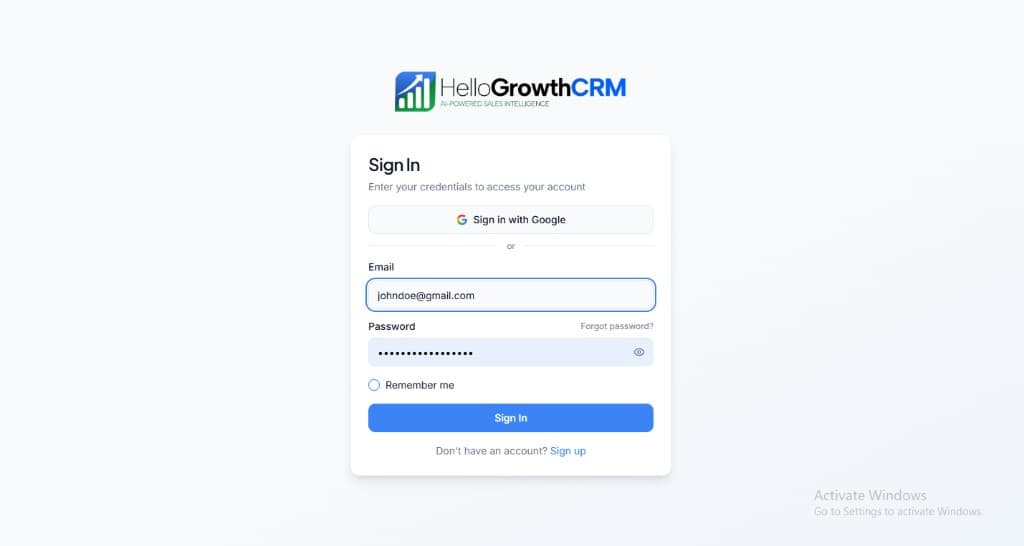
Open login page(opens in a new tab)app.hellogrowthcrm.com/login
Open Settings. In the left sidebar, under Admin, click Settings (you will land on the Settings area; the URL is app.hellogrowthcrm.com/settings).
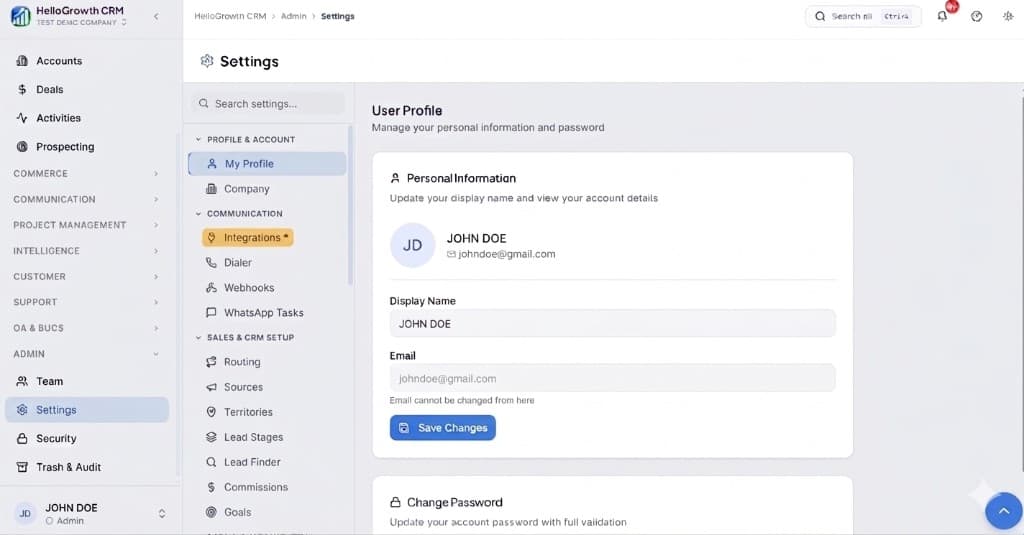
Open Settings(opens in a new tab)app.hellogrowthcrm.com/settings
Go to Integrations. On the Settings screen, use the middle settings menu. Under COMMUNICATION, click Integrations (star icon). Then find and configure this connector—the connector-specific steps below pick up from here.
Open Settings (Integrations)(opens in a new tab)app.hellogrowthcrm.com/settings
- Settings → Integrations → Jira.
- Enter site URL and credentials.
- Create issues from task detail views in the CRM.
Best practices
- Create issues from the CRM only for customer-impacting work — feature blockers, escalated bugs, implementation tasks — not for every sales wish.
- Include deal value and close date in the issue description; engineering triages better with revenue context than with 'urgent'.
- Automate the loop-closing task on issue resolution so the customer hears the fix landed from their rep, not from release notes.
- Agree the target project and issue type with engineering up front — sales filing directly into a team's sprint board uninvited burns goodwill.
- Review open CRM-linked issues in pipeline meetings; a deal blocked on engineering for three weeks is a forecasting fact.
Best for & common use cases
Linking customer-facing requests to dev backlogs.
- Sales-surfaced bugs routed to the right Jira project.
Expected outcomes
- Faster lead handoff between tools and CRM owners
- Cleaner activity history for follow-up and reporting
- Lower manual copy-paste errors in the pipeline
Troubleshooting
- Issue creation fails: the mapped project's required custom fields aren't being populated — either relax the field requirement or add it to the mapping.
- Status not updating in CRM: the Jira webhook for the project was removed — re-register it from the integration settings.
- Wrong project receiving issues: multiple pipelines share one mapping — set per-pipeline project mapping instead of a global default.
FAQ
Governance
Treat API keys and webhooks as production secrets. Align field mapping with your privacy policy and regional regulations (GDPR, marketing consent, telemarketing rules). Your admin controls which roles can install or edit integrations.
Related integrations in this category
Creates Linear issues from CRM tasks via the GraphQL API.
Creates support tickets from CRM records.
Creates Freshdesk tickets from CRM records.
Pushes CRM data to Notion databases with custom field mapping.
Creates and updates Asana tasks and projects from CRM deals and tasks; syncs status and due dates so implementation and sales stay aligned.
Push CRM data to Airtable bases and tables for stakeholder views, partner reporting, and lightweight apps.
Send documents for e-signature and track status (sent, viewed, signed, declined).
E-signature workflows with status tracking, similar to DocuSign.