Overview
FreshBooks is accounting software built for service businesses and freelancers-turned-agencies — time tracking, project billing, and invoicing that clients actually find readable. The HelloGrowthCRM integration creates and updates FreshBooks clients and invoices from CRM accounts and won deals, and brings payment status back to the account record.
For service firms the join is natural: the CRM runs the pipeline from enquiry to signed proposal, and the moment a deal closes, the client and first invoice exist in FreshBooks without re-entry. From there, payment status on the CRM timeline tells account owners who has paid and who needs a gentle chase — folded into normal client communication instead of outsourced entirely to dunning emails.
What data is involved
- CRM accounts and contacts synced to FreshBooks clients, matched to prevent duplicates.
- Won deals creating draft invoices in FreshBooks with amount and description from the deal.
- Invoice status — sent, viewed, paid, overdue — reflected on the CRM account timeline.
- Payment events able to trigger CRM workflows such as project kickoff tasks.
- Overdue invoices flagged to the account owner for personal follow-up.
- Client billing history visible from the CRM record for renewal and upsell context.
Step-by-step setup
Setup at a glance (3-5 bullets)
- Settings → Integrations → FreshBooks → OAuth.
- Map CRM companies to FreshBooks clients.
- Define when to create invoices from CRM milestones.
Sign in or sign up at HelloGrowthCRM. Open the login page, enter your credentials (or use Google), or choose Sign up if you need a new account. You must be signed in before you can open Settings and connect this integration.
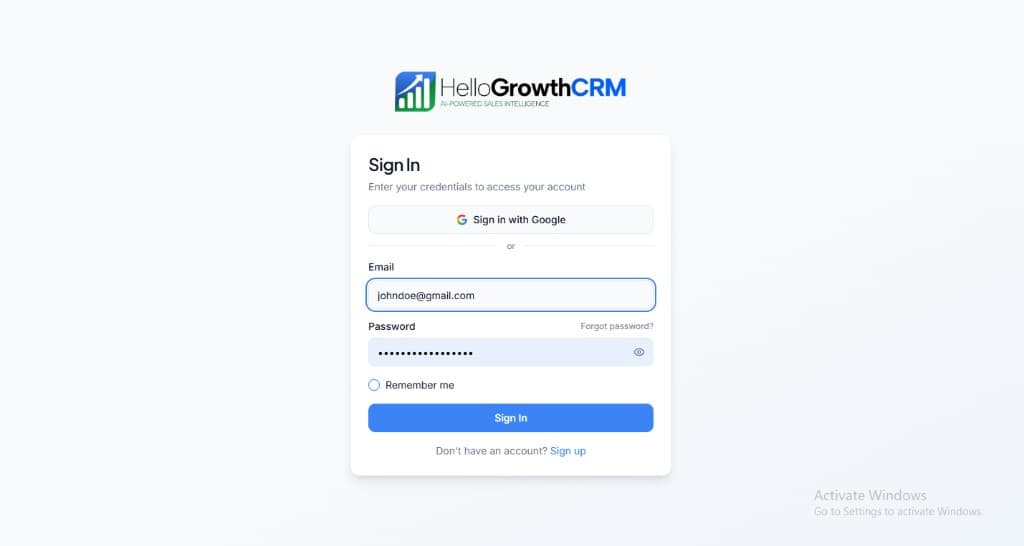
Open login page(opens in a new tab)app.hellogrowthcrm.com/login
Open Settings. In the left sidebar, under Admin, click Settings (you will land on the Settings area; the URL is app.hellogrowthcrm.com/settings).
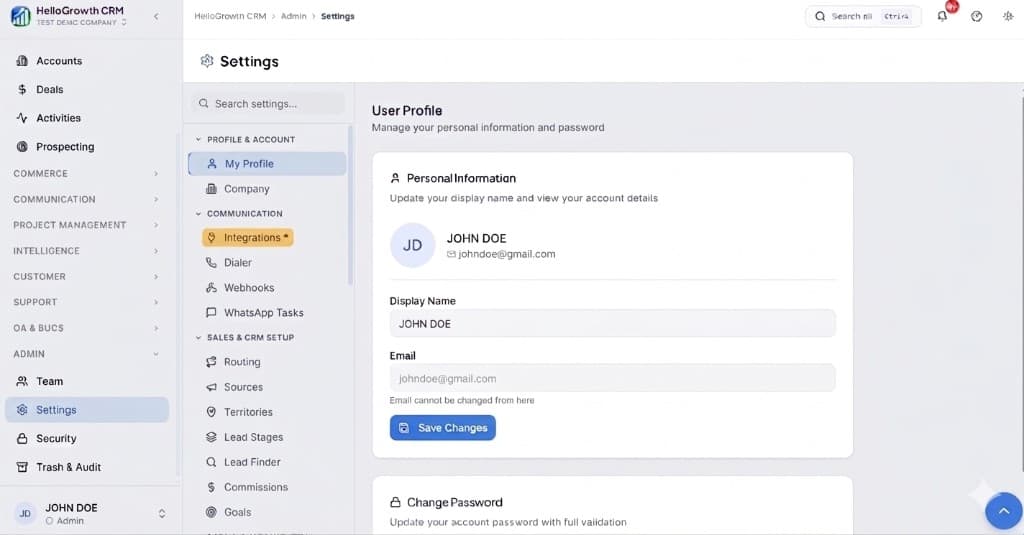
Open Settings(opens in a new tab)app.hellogrowthcrm.com/settings
Go to Integrations. On the Settings screen, use the middle settings menu. Under COMMUNICATION, click Integrations (star icon). Then find and configure this connector—the connector-specific steps below pick up from here.
Open Settings (Integrations)(opens in a new tab)app.hellogrowthcrm.com/settings
- Settings → Integrations → FreshBooks → OAuth.
- Map CRM companies to FreshBooks clients.
- Define when to create invoices from CRM milestones.
Best practices
- Let the CRM own client contact details and push them to FreshBooks; correcting an address in two places is how errors survive.
- Create invoices as drafts from won deals so billing keeps its checks while losing the retyping.
- Route overdue flags to the account owner, not just finance — service relationships collect faster through the person the client knows.
- Mirror your service catalog naming between CRM products and FreshBooks line items so invoices read consistently.
- If you bill time-and-materials, keep time tracking in FreshBooks and sync only invoice outcomes — duplicating timesheets across systems never survives contact with reality.
Best for & common use cases
Agencies and consultancies that invoice in FreshBooks.
- Time-and-materials projects linked to CRM opportunities.
Expected outcomes
- Faster lead handoff between tools and CRM owners
- Cleaner activity history for follow-up and reporting
- Lower manual copy-paste errors in the pipeline
Troubleshooting
- Invoice creation fails: FreshBooks requires a client email for sending — ensure the CRM account has a billing email mapped.
- Payment status stale: the webhook connection needs reauthorising after a FreshBooks password or plan change — reconnect from the integration settings.
- Clients duplicated: pre-existing FreshBooks clients spelled differently from CRM accounts — merge in FreshBooks and adjust the account name to match.
FAQ
Governance
Treat API keys and webhooks as production secrets. Align field mapping with your privacy policy and regional regulations (GDPR, marketing consent, telemarketing rules). Your admin controls which roles can install or edit integrations.
Related integrations in this category
Syncs CRM contacts to Wave customers and pushes invoice events for simple AR tracking for very small businesses.
Imports or exports ledger-aligned customer and invoice data with TallyPrime / Tally ERP via bridge or file connector for Indian GST compliance.
Accounting software sync for contacts, estimates, invoices, and payments alongside Zoho ecosystem tools.
KYC compliance for Indian businesses: validate GSTIN and PAN before high-value deals or invoicing.
Two-way customer & invoice sync with QuickBooks Online.
Two-way customer & invoice sync with MYOB accounting.
Syncs customers, invoices, payments, and items between HelloGrowthCRM and QuickBooks Online for aligned AR and revenue recognition.
Connects contacts and invoices to Xero (UK, AU, NZ, global) so finance and sales share one customer record and payment status.