Overview
Microsoft Dynamics 365 Sales is an enterprise platform built on Dataverse, with accounts, contacts, leads, opportunities, activities, and a deep web of option sets and custom entities. It is capable, but for many growing teams it is also expensive per seat and heavy to administer. Moving to HelloGrowthCRM keeps the parts sales reps actually touch every day — pipeline, contacts, activity history — while shedding the licensing overhead and admin complexity that came with Dynamics.
A Dynamics migration succeeds or fails on data modelling, not on the export itself. Dataverse stores choices as option sets, relationships as lookups, and ownership as security roles, so the mapping stage is where you translate that structure into a cleaner CRM schema. The recommended path is an export from the Dataverse data export service, a careful field and option-set mapping, a sandbox import you validate against record counts, and only then a production go-live.
What data is involved
- Accounts and contacts mapped to CRM companies and contacts with the existing relationships preserved.
- Open and closed opportunities mapped to deals, including amount, stage, and close date.
- Activities (emails, calls, appointments, tasks) imported onto the matching contact or deal timeline.
- Option-set values normalised into clean CRM picklists so reporting is not fragmented by legacy choices.
- Owner and business-unit data mapped to CRM users and teams for attribution.
- Custom-entity fields mapped to custom fields where they carry real sales meaning.
Step-by-step setup
Setup at a glance (3-5 bullets)
- Export data from Dynamics 365 using the data export service
- Map Dynamics fields to HelloGrowthCRM fields in the migration wizard
- Run sandbox migration and validate
- Go live
Sign in or sign up at HelloGrowthCRM. Open the login page, enter your credentials (or use Google), or choose Sign up if you need a new account. You must be signed in before you can open Settings and connect this integration.
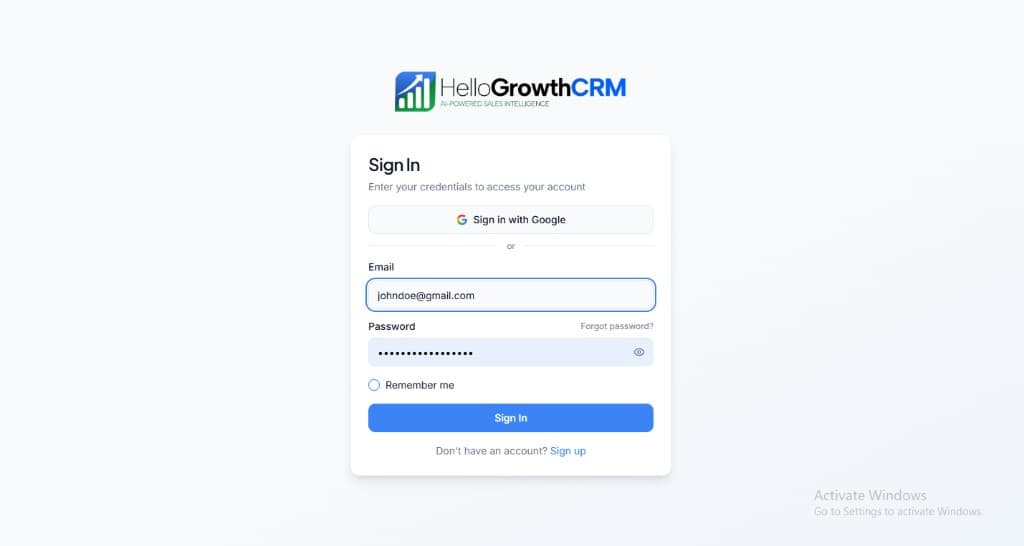
Open login page(opens in a new tab)app.hellogrowthcrm.com/login
Open Settings. In the left sidebar, under Admin, click Settings (you will land on the Settings area; the URL is app.hellogrowthcrm.com/settings).
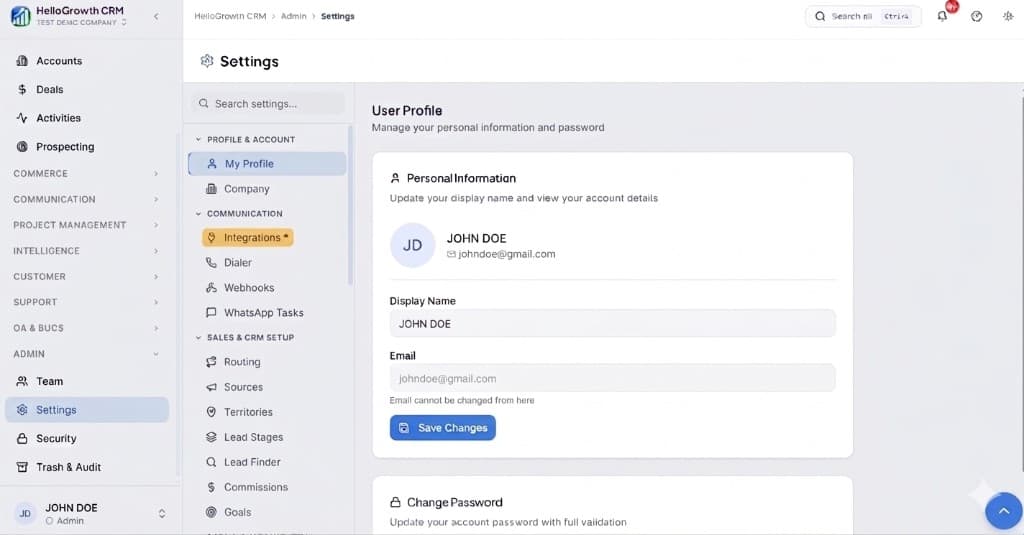
Open Settings(opens in a new tab)app.hellogrowthcrm.com/settings
Go to Integrations. On the Settings screen, use the middle settings menu. Under COMMUNICATION, click Integrations (star icon). Then find and configure this connector—the connector-specific steps below pick up from here.
Open Settings (Integrations)(opens in a new tab)app.hellogrowthcrm.com/settings
- Export data from Dynamics 365 using the data export service
- Map Dynamics fields to HelloGrowthCRM fields in the migration wizard
- Run sandbox migration and validate
- Go live
Best practices
- Inventory your Dynamics custom entities and option sets first — migrate the ones reps use, archive the rest rather than carrying dead fields across.
- Normalise duplicated or near-identical option-set values during mapping so pipeline reports stay readable.
- Validate the sandbox import against Dynamics record counts before signing off; a count mismatch is the fastest way to catch a broken mapping.
- Map business units to CRM teams up front so territory and manager reports work on day one.
- Schedule the final delta export for a low-activity window to minimise records created in Dynamics after cut-over.
Best for & common use cases
Enterprise teams on Dynamics, Businesses reducing Microsoft licensing costs, Teams needing India-first CRM features
- Full historical data migration from Dynamics
- Custom entity mapping to HelloGrowthCRM custom fields
- Post-migration validation and duplicate cleanup
Expected outcomes
- Faster lead handoff between tools and CRM owners
- Cleaner activity history for follow-up and reporting
- Lower manual copy-paste errors in the pipeline
Troubleshooting
- Opportunities imported without their account: contacts and accounts were imported after opportunities — re-run the import in dependency order.
- Picklist values look fragmented: legacy option sets were carried over verbatim; consolidate them in the mapping step and re-import.
- Activity timeline is sparse: the activities entity was not included in the export — add emails, calls, and tasks to the export set.
FAQ
Governance
Treat API keys and webhooks as production secrets. Align field mapping with your privacy policy and regional regulations (GDPR, marketing consent, telemarketing rules). Your admin controls which roles can install or edit integrations.
Related integrations in this category
Migrate boards, items, contacts, and pipeline data from Monday.com CRM to HelloGrowthCRM — converting Monday's board structure to CRM pipelines.
Migrate leads, contacts, accounts, deals, emails, notes, and activities from Freshsales to HelloGrowthCRM with owner attribution and timeline preserved.
Migrate Copper CRM contacts, opportunities, activities, and Google Workspace-linked data to HelloGrowthCRM.
Migrate Insightly contacts, leads, opportunities, projects, and custom fields to HelloGrowthCRM with relationship mapping preserved.
Ingests property inquiry leads from the 99acres portal.
Syncs leads from MagicBricks listings.
Captures leads from Housing.com listings with webhook ingestion.
Embeds maps on property or project pages and supports directions for site visits.