What growth audit does
A Growth Audit is a structured examination of your funnel: where leads drop off, which stages stall conversions, and which channels are producing pipeline that actually closes versus volume that just looks busy. It works through your CRM data systematically — sources, stage conversions, follow-up patterns — and returns findings you can rank and act on, instead of a vague sense that "something is off".
Without an audit, growth decisions run on impressions. Teams double spend on the channel that feels productive while the data shows its leads never convert past qualification; a stage that leaks half its deals goes unexamined for quarters because nobody measured stage-to-stage flow. The cost is not just wasted budget — it is the compounding effect of scaling a funnel with a hole in it.
How it works in HelloGrowthCRM
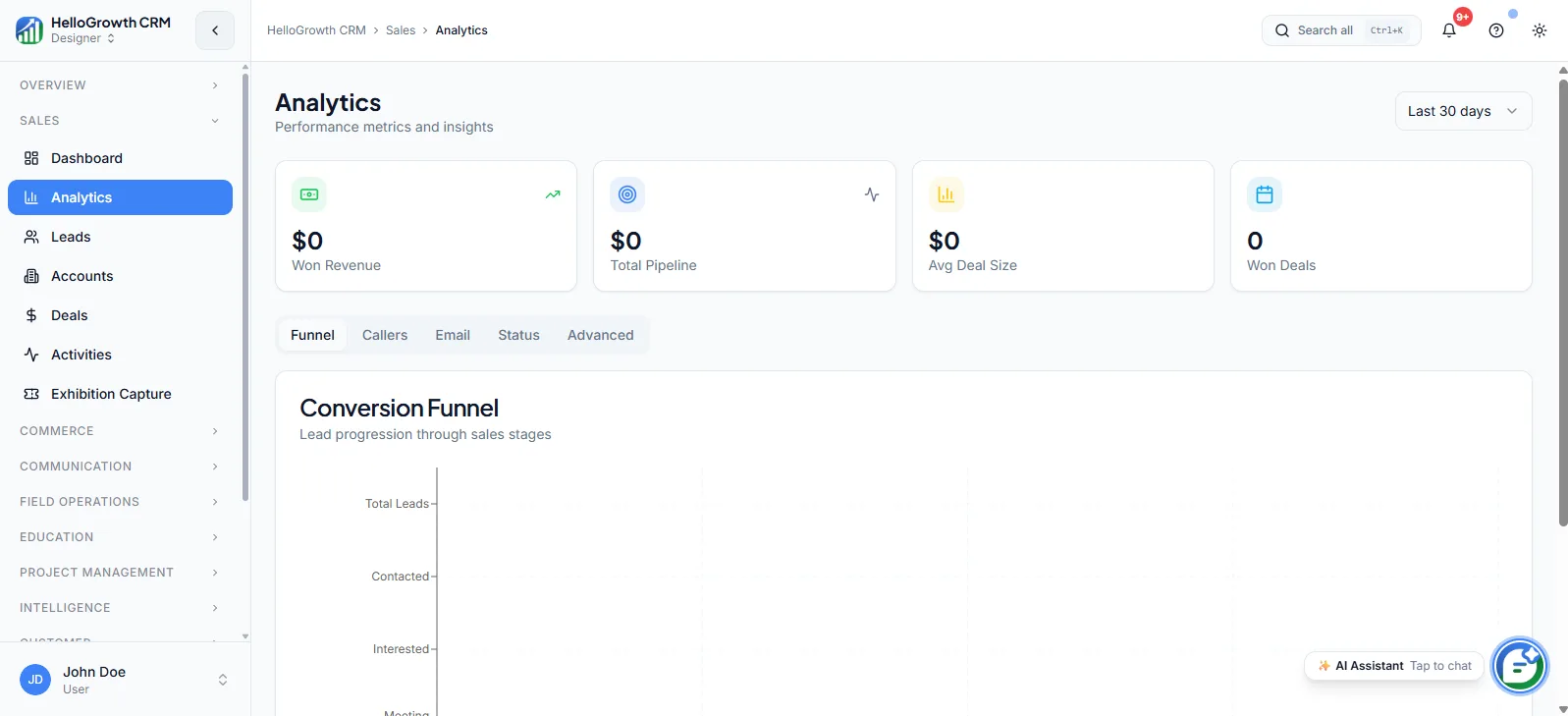
Growth Audit lives in the Intelligence Module and runs against the lead, deal, and activity data already in your workspace. You trigger an audit and it works through the funnel — source performance, stage-to-stage conversion, drop-off points, follow-up gaps — producing a structured set of findings that highlight where pipeline value is being lost and which channels earn their keep.
Findings connect straight to fixes elsewhere in the platform: a follow-up gap points to sequences, slow first response points to lead routing, and channel-level surprises can be cross-checked against Market Radar to separate execution issues from demand shifts.
See it in action
How this capability is packaged by plan
| Plan | Availability |
|---|---|
| Free Forever | 1 audit |
| Software Only | 3/month |
| Growth Engine | Unlimited |
| RevOps Partner | Unlimited |
Setting it up — step by step
- 1
Reconcile your funnel data
Make sure lead sources are captured and deal stages reflect reality, so the audit reads true numbers.
- 2
Run your first audit
Trigger the audit from the Intelligence Module and let it work through sources, stages, and drop-offs.
- 3
Rank the findings
Sort what it surfaces by revenue impact and fix effort, and pick the top two or three.
- 4
Assign fixes with owners
Turn each chosen finding into a concrete change — a sequence, a routing rule, a stage redesign — with a named owner.
- 5
Re-audit after changes
Run the next audit after fixes have had time to work, and compare against the previous findings.
Who uses growth audit
Founder/owner
Runs an audit before committing next quarter's marketing spend, so budget goes to channels the data says produce closable pipeline rather than the ones that feel busiest.
RevOps lead
Uses recurring audits as the diagnostic layer of a monthly operating rhythm — findings become the ops backlog, and successive audits verify whether last month's fixes actually moved the conversion numbers.
Marketing manager
Reads channel-level findings to defend or reallocate budget with evidence, and uses drop-off analysis to see whether leads fail because of lead quality or because sales follow-up never happened.
Growth Audit in practice — industry examples
Gyms
A gym chain audits its trial-to-membership funnel and finds walk-in trials convert at three times the rate of a heavily promoted online lead source — and that most online leads never got a second contact. The fix is a follow-up sequence for online trials, not more ad spend, and the next audit confirms the drop-off closing.
Education (India)
An edtech admissions team audits an admissions funnel fed by fairs, portals, and referrals. The audit shows portal enquiries stall at the counselling stage while referral leads sail through — pointing to a counselling capacity bottleneck during peak weeks rather than lead quality, which reshapes how the team schedules counsellors for the next intake.
Mortgage brokers
A brokerage audits six months of funnel data and discovers pre-qualified web leads drop off heavily between document collection and submission — a stage nobody owned. Assigning that stage a dedicated coordinator and a reminder workflow recovers deals that were abandoning mid-process, and the following audit quantifies the improvement.
Common mistakes to avoid
Auditing a funnel with untracked sources and mis-staged deals, so findings describe the data mess rather than the real funnel.
Treating the audit report as the deliverable and fixing nothing, so the same leaks appear in every subsequent audit.
Trying to act on every finding at once instead of ranking by impact, spreading the team thin and finishing nothing.
Running one audit ever and assuming its findings hold, while channel mix and team behaviour keep shifting underneath.
What teams usually care about here
Helps teams move from gut-feel prioritization to evidence-based growth decisions
Free tier includes one audit; paid tiers unlock recurring monthly audits
Useful after a strategy change, a slow quarter, or before scaling spend
How this fits the buying decision
Buyers usually do not evaluate growth audit in isolation. They want to know whether it improves execution, reporting, handoffs, and accountability inside the broader CRM workflow. That is why this capability matters most when it is connected to records, ownership, activity history, and manager review rather than living in a separate point tool.
The real decision is often less about whether a box is checked and more about how much depth the team needs. Lower tiers may be enough when the workflow is simple or the volume is small. Higher tiers become more valuable when teams need governance, faster response expectations, specialist execution, or a repeatable operating cadence around the process.
If this capability is important to your rollout, compare it in the context of the whole plan. That includes related workflows, support level, reporting expectations, and whether your team will manage the motion itself or rely on managed RevOps help to keep it consistent.
Frequently asked questions
How many audits does each plan include?
The Free Forever plan includes one audit, so you can see the diagnostic before paying anything. Software Only includes three audits per month, and both Growth Engine and RevOps Partner include unlimited audits — suited to teams running audits as a recurring operating rhythm.
What do I need in place before running an audit?
Enough funnel data to read: lead sources captured on records, deals staged with reasonable accuracy, and some months of history. The audit reads what your CRM contains, so a quick pass to fix untracked sources and obviously mis-staged deals materially improves the findings.
When is the right time to run one?
After a strategy change, after a slow quarter, or before scaling spend on any channel. Teams on unlimited-audit plans typically run them monthly as part of a review cadence, using each audit to verify whether the previous month's fixes actually closed the leaks they targeted.
How do audit findings turn into fixes?
Most findings map to a specific capability: follow-up gaps become sequences, slow first response becomes lead routing, leaky stages get redesigned with validation rules. On Growth Engine and RevOps Partner, the managed-services team can implement those fixes with you rather than leaving a report on the table.
How is Growth Audit different from the analytics dashboards?
Dashboards show ongoing metrics you choose to watch; an audit is a structured, point-in-time examination of the whole funnel that goes looking for leaks you were not watching for. The audit tells you where to dig; analytics is where you keep digging afterwards.
Related Pricing Capabilities
Market Radar
Market intelligence tooling that monitors competitive signals, keyword trends, and demand shifts so teams can adjust positioning and targeting.
Visitor Tracking
Website visitor intelligence that identifies which companies are browsing and maps anonymous traffic to CRM records for timely follow-up.
Gamification
Sales performance gamification that turns CRM activity and results into competitive scoreboards reps can see in real time.
Goals
Rep and team goal-setting tools that make targets visible inside the CRM alongside the activity and pipeline data used to hit them.
Leaderboard
A real-time team performance leaderboard that shows activity counts, deal progress, and revenue contribution across the sales team.
AI Insights
AI-generated analysis surfaced inside the CRM to help teams understand pipeline health, rep performance, and revenue signals without manual reporting.