Cold Outreach Campaigns — Automated Sequences That Feel Personal
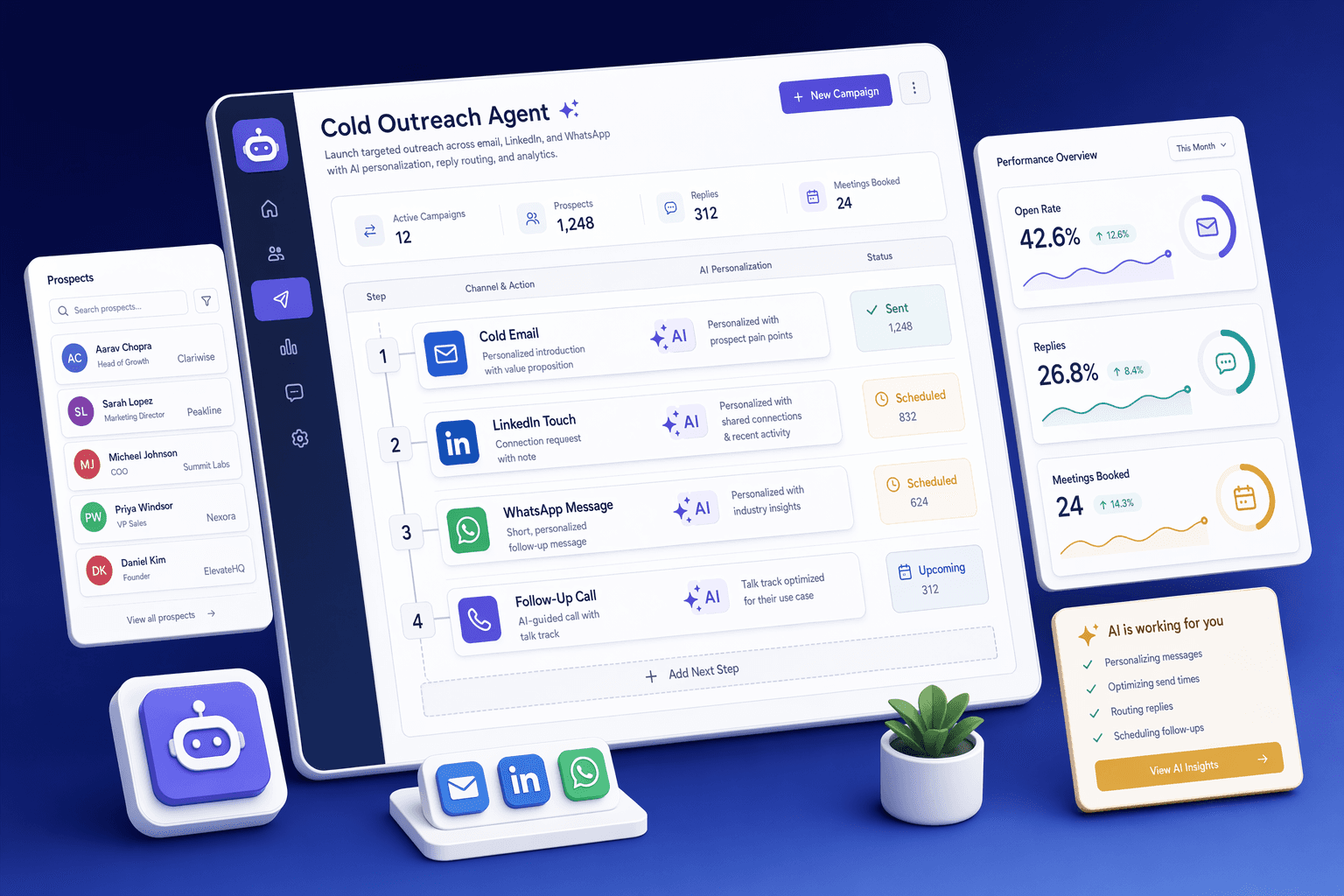
Launch cold outreach campaigns across email, LinkedIn, and WhatsApp from inside your CRM. HelloGrowthCRM's cold campaign engine personalizes at scale, tracks opens and clicks, and routes replies to the right rep.
By Rushabh Shah, Founder, HelloGrowthCRM · Reviewed by HelloGrowthCRM RevOps Team, Revenue Operations · Last updated July 2026
Key takeaways
- Cold outreach is first-touch contact with prospects who have not engaged yet — its whole job is to earn a reply, not to close.
- Automation handles the repetitive part (sending, tracking, following up) while AI personalization keeps each message specific to the prospect.
- Multi-channel sequences reach prospects on email, LinkedIn, and WhatsApp, reaching people your email alone would miss.
- Replies route straight to the right rep as CRM tasks, so a warm response never sits unanswered in a shared inbox.
- Deliverability and compliance (domain warm-up, opt-out handling, CAN-SPAM/GDPR) are the difference between landing in the inbox and landing in spam.
Why teams evaluate cold outreach
Cold Outreach usually becomes important when a repeated part of the revenue workflow is creating too much manual work, too little visibility, or too much tool-switching. Teams are rarely shopping for a feature in isolation. They are usually trying to make one meaningful workflow cleaner, faster, and easier to inspect.
That is why buyers usually look beyond the headline capability and inspect the surrounding details: Multi-channel cold outreach — email, LinkedIn tasks, WhatsApp messages in one campaign, AI-powered personalization per contact — personalizes subject lines, body text, and step timing, Cold campaign templates library — ready-to-use templates for SaaS, services, agency, and e-commerce, Deliverability management — domain rotation, warm-up, DNS/SPF/DKIM setup, inbox placement. Those details determine whether the feature actually improves day-to-day execution or simply adds another surface area to manage.
Where cold outreach fits in the workflow
Most teams adopt this capability as part of practical motions such as enterprise account hunting, product launch gtm, expansion territory prospecting. The value tends to show up fastest when the workflow is tied to a clear owner, a clear next action, and a visible outcome that managers can review later.
It also matters how this page connects to the rest of the stack. For many teams, tools such as Gmail, Outlook, LinkedIn, WhatsApp Business are what make the feature operational instead of theoretical because they keep data, communication, and handoffs in sync.
What a strong rollout looks like for cold outreach
The best rollout usually starts small: one high-value workflow, one clear ownership model, and one review rhythm for adoption. Once the team is consistently using the feature, managers can expand into deeper automation, reporting, or cross-functional handoffs without rebuilding the foundation.
In practice, that means evaluating not only what the feature can do, but also whether the team can maintain the process around it. Ease of use, reporting trust, and manager visibility matter just as much as the feature checklist itself.
- Use it first for enterprise account hunting if that is the workflow creating the most friction today.
- Use it first for product launch gtm if that is the workflow creating the most friction today.
- Use it first for expansion territory prospecting if that is the workflow creating the most friction today.
- Use it first for lead gen and reseller programs if that is the workflow creating the most friction today.
How It Works
Get started in three simple steps
Key Features
Use Cases
Enterprise Account Hunting
Launch 3-5 week cold campaigns to land and penetrate enterprise accounts with personalized research and case studies.
What teams care about
- Fast adoption with less manual cleanup for managers and reps.
- Clear visibility into workflow execution, outcomes, and accountability.
- Reliable handoffs into the CRM record so downstream teams keep full context.
Deep dive
Open the sections that matter most instead of scrolling through a long uninterrupted text block.
What Is Cold Outreach?
Cold outreach is proactive first contact with prospects who have not engaged with your business yet — no prior meeting, no form fill, no warm introduction. It runs across email, LinkedIn, and increasingly WhatsApp, and its single job is to earn a reply and start a conversation, not to close a deal on the first message.
That makes cold outreach different from both inbound and warm follow-up. Inbound leads have already raised a hand; warm leads know you. A cold prospect owes you nothing and will decide in seconds whether your message is relevant. Because of that, cold outreach lives or dies on targeting, personalization, and disciplined follow-up — the parts that are painfully manual at any real volume.
The comparison below places cold outreach next to the other two motions so the differences are clear.
| Motion | Prior relationship | Primary goal | What it needs most |
|---|---|---|---|
| Cold outreach | None | Earn a first reply | Targeting + personalization |
| Warm follow-up | Some prior contact | Advance the conversation | Timing + relevance |
| Inbound | Prospect reached out | Respond fast, qualify | Speed-to-lead |
How an Automated Cold Campaign Works — A Worked Example
An automated campaign turns cold outreach from a rep's daily chore into a repeatable system. The engine handles the mechanical steps — personalize, send, wait, track, follow up — and only pulls a human in when a prospect actually responds. The illustrative sequence below shows a single prospect moving through a five-touch campaign.
| Day | Step | Channel | What happens |
|---|---|---|---|
| 1 | Email 1 | Personalized opener referencing the prospect's company | |
| 2 | Connect | Connection request task created for the rep | |
| 4 | Email 2 | Short value-add follow-up if no reply yet | |
| 6 | Brief, permission-based nudge on a second channel | ||
| Any | Reply | Any | Sequence pauses; task routed to the assigned rep |
AI Personalization Makes Cold Email Feel Warm
Generic cold emails have low open and reply rates because prospects know they are bulk mail. AI-personalized cold emails reference specific company details, recent news, or industry challenges — making them feel written just for that prospect.
HelloGrowthCRM's AI personalizes subject lines, email body, call-to-action, and step timing based on prospect data. The result is cold campaigns that feel warm — higher open rates, higher reply rates, and more qualified conversations. The point is not to fake familiarity but to make sure the message is genuinely relevant to the person receiving it.
Multi-Channel Outreach vs. Email-Only Campaigns
Email-only outreach reaches a shrinking slice of prospects as inboxes fill and reply rates decline. Adding LinkedIn and WhatsApp touches lets a campaign reach people through the channel they actually respond on, and the combination typically outperforms any single channel — provided the touches are coordinated rather than simultaneous.
| Factor | Email only | Coordinated multi-channel |
|---|---|---|
| Reach | One inbox | Email + LinkedIn + WhatsApp |
| Chance of being seen | Lower as inboxes fill | Higher across channels |
| Risk if uncoordinated | Low | Feels spammy if not spaced |
| Setup effort | Lower | Higher, but automated in one sequence |
Best Practices for Cold Outreach That Gets Replies
The teams that win at cold outreach treat it as a system with quality controls, not a volume game. A handful of disciplines separate campaigns that book meetings from campaigns that burn a domain.
Narrow the list first — tight targeting beats a big, generic list every time.
Lead with the prospect's problem, not your product; make the first ask small and specific.
Authenticate domains and warm them up before scaling daily volume.
Personalize the opener with something real, not a mail-merge token.
Follow up several times with new angles; most replies come after the first message.
Honor opt-outs instantly and keep lists clean to protect deliverability.
Common Mistakes That Kill Cold Outreach
Most cold campaigns fail for predictable reasons that have nothing to do with the sending tool. Avoiding these protects both your reply rate and your sender reputation.
Blasting a huge unsegmented list with one generic message.
Sending from an unauthenticated or un-warmed domain and landing in spam.
Pitching the product in sentence one instead of the prospect's problem.
Giving up after one or two touches when most replies come later in the sequence.
Letting replies sit in a shared inbox instead of routing them to a rep immediately.
Ignoring opt-outs or regional rules like CAN-SPAM and GDPR.
Drawbacks & Limits (Honest View)
Cold outreach is not a fit for every business or every market. If your total addressable market is tiny, high-value, and relationship-driven, a handful of hand-written messages and referrals will beat any automated sequence — and automation can actively harm the relationship if it feels mechanical. Cold outreach also has a real reputational cost when done badly: poor targeting and aggressive volume damage your sending domain and your brand, and those effects are slow to reverse.
There are compliance and deliverability realities you cannot automate away. Regional laws (CAN-SPAM, GDPR, and local equivalents) govern what you can send and to whom, and mailbox providers increasingly filter cold volume aggressively. HelloGrowthCRM automates domain setup, warm-up, opt-out handling, and tracking, but it cannot make an irrelevant message wanted or a badly targeted list convert. Results vary widely by market, offer, and list quality, so treat cold outreach as a channel to test and tune, not a guaranteed pipeline switch.
Evidence: Why Speed and Consistency Win
The two things that most reliably improve cold outreach outcomes are responding fast when a prospect engages and following up consistently. The widely cited industry benchmarks below explain why — these are external figures, not HelloGrowthCRM measurements.
~60x — More likely to reach a decision-maker when you respond within an hour versus waiting 24 hours (Source: Harvard Business Review, "The Short Life of Online Sales Leads")
78% — Of buyers purchase from the company that responds first or most helpfully (Source: HubSpot)
~28% — Share of the work week reps lose to manual data entry and prioritization instead of selling (Source: Salesforce, State of Sales)
Cold Outreach Agent vs Traditional Cold Email Tools
Traditional cold email tools require you to upload a static list, write templates, set a send schedule, and manually review replies. The Cold Outreach Agent works differently: it pulls your ICP criteria from the CRM, identifies matching contacts, drafts personalized messages using AI, and routes replies to the right rep — all without manual intervention per contact. The 'agent' layer is what converts outreach from a campaign you run into a workflow that runs itself.
AI personalization in the Cold Outreach Agent operates at the contact level, not the persona level. Rather than writing one version for 'VP of Sales at SaaS companies', the agent reads each contact's company website, LinkedIn role description, and recent CRM interactions to write a message that feels researched. This relevance improvement matters because cold outreach success rates drop sharply when prospects can detect templated outreach — the agent's personalization layer keeps open rates competitive even at scale.
Deliverability and Compliance in the Cold Outreach Agent
Email deliverability is the hidden cost of cold outreach at scale. Sending hundreds of cold emails from a fresh domain without proper warming results in inbox placement rates below 30%. The Cold Outreach Agent manages domain warm-up automatically — it starts with a low daily send volume and increases it incrementally as your sending reputation builds. DNS/SPF/DKIM/DMARC records are configured as part of domain setup, and the agent monitors bounce rates and spam flags to pause campaigns before they damage your sender score.
Compliance is handled at the campaign level. CAN-SPAM, GDPR, and India's DPDPA requirements are addressed through configurable opt-out links, suppression list management, and consent tracking. The agent automatically applies suppression to any contact who has previously opted out, unsubscribed from any sequence, or marked a message as spam — across all campaigns, not just the current one. This global suppression prevents compliance violations that occur when one rep doesn't know another rep already contacted the same prospect.
Cold outreach is proactive first contact with prospects who have not engaged with your business yet — no prior meeting, no form fill, no warm introduction. It runs across email, LinkedIn, and increasingly WhatsApp, and its single job is to earn a reply and start a conversation, not to close a deal on the first message.
That makes cold outreach different from both inbound and warm follow-up. Inbound leads have already raised a hand; warm leads know you. A cold prospect owes you nothing and will decide in seconds whether your message is relevant. Because of that, cold outreach lives or dies on targeting, personalization, and disciplined follow-up — the parts that are painfully manual at any real volume.
The comparison below places cold outreach next to the other two motions so the differences are clear.
Cold outreach vs. warm and inbound motions
| Motion | Prior relationship | Primary goal | What it needs most |
|---|---|---|---|
| Cold outreach | None | Earn a first reply | Targeting + personalization |
| Warm follow-up | Some prior contact | Advance the conversation | Timing + relevance |
| Inbound | Prospect reached out | Respond fast, qualify | Speed-to-lead |
Buyer playbook
Compare, launch, and govern the workflow with an interactive overview instead of four long generic essays.
How teams evaluate cold outreach
The best pages help buyers understand fit quickly instead of forcing them through long walls of copy.
Check whether the product covers the capabilities you actually care about, such as Multi-channel cold outreach — email, LinkedIn tasks, WhatsApp messages in one campaign, AI-powered personalization per contact — personalizes subject lines, body text, and step timing, Cold campaign templates library — ready-to-use templates for SaaS, services, agency, and e-commerce, Deliverability management — domain rotation, warm-up, DNS/SPF/DKIM setup, inbox placement.
Test if it supports real execution scenarios like Enterprise Account Hunting, Product Launch GTM, Expansion Territory Prospecting.
Confirm the workflow stays connected to Gmail, Outlook, LinkedIn, WhatsApp Business so reporting and handoffs remain reliable.
Frequently Asked Questions
Explore More
Related Products
Free Tools & Calculators
WhatsApp Template Generator
Draft WhatsApp message templates for intros, follow-ups, payments and support. Free.
Lead Scoring Calculator
Build a custom scoring model with weights.
CRM ROI Calculator
Calculate the revenue impact of adopting a CRM.
Pipeline Calculator
Model your pipeline stages and conversion rates.