HelloGrowthCRM software
Built for real small-business sales teams
HelloGrowthCRM helps reps qualify faster, follow up on time, and close more deals—with practical automation in one place.
- AI lead scoring and pipeline visibility
- Built-in dialer, WhatsApp, and email automation
- Sales forecasting and RevOps-ready reporting
A 30 60 90 day sales plan is a structured, time-based roadmap that divides your sales activities and goals into three clear phases. The first 30 days focus on learning about the product, market, and prospects. The next 30 days emphasize engaging leads and building a sales pipeline. The final 30 days concentrate on closing deals and improving sales strategies. This plan helps keep your sales efforts organized and measurable.
Why this comes up / what goes wrong
Small business owners and sales teams often face challenges like inconsistent follow-up, unclear priorities, and scattered efforts. Without a clear plan, leads can be lost due to slow responses or missed opportunities. A 30 60 90 day sales plan breaks down large sales targets into manageable monthly steps, ensuring the team stays aligned on priorities and timing. It is especially helpful for new sales hires or founders without a dedicated sales manager who need to organize their sales activities quickly.
Step-by-step
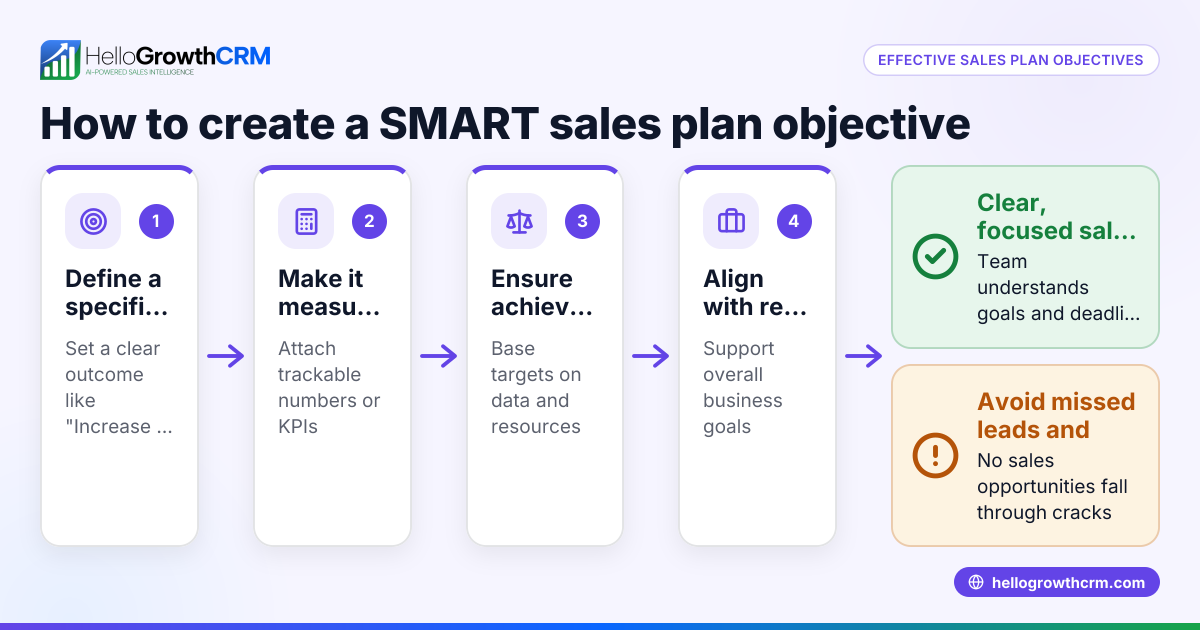
- Set clear objectives for each phase: Define what success looks like at 30, 60, and 90 days. For example, the first 30 days might focus on learning product features and identifying key prospects; the next 30 days on qualifying leads and starting conversations; and the final 30 days on closing deals and improving conversion rates.
- Map out key activities: List daily and weekly tasks for each phase such as training sessions, outreach calls, email campaigns, and pipeline reviews. Make sure these activities support your objectives.
- Assign measurable targets: Attach numbers to your goals like calls made, meetings set, proposals sent, and deals closed. This makes progress trackable.
- Schedule regular check-ins: Plan weekly reviews to assess progress, adjust strategies, and address any roadblocks. This keeps momentum and accountability.
- Use tools to track and automate: Manage your leads, deals, and follow-ups with a CRM that fits your workflow. For example, HelloGrowthCRM’s Deals (pipeline) feature shows quotations as deals with follow-up dates, so nothing is forgotten.
- Review and refine at 90 days: Analyze what worked and what didn’t, then adjust your sales plan for the next quarter based on real data.
Example (fictional figures)
Imagine a B2B software reseller in Denver, Colorado, starting a 30 60 90 day sales plan on 04/01/2026.
- First 30 days (04/01 to 04/30):
- Objective: Learn product and identify 100 target businesses.
- Activity: Research 5 businesses per day × 20 workdays = 100 businesses.
- Next 30 days (05/01 to 05/30):
- Objective: Qualify 40 leads and schedule 30 demos.
- Activity: Call 10 leads per day × 4 days/week × 4 weeks = 160 calls.
- Expected conversion: Assume 25% of calls lead to demos. 160 calls × 0.25 = 40 leads qualified.
- Schedule 30 demos from these qualified leads.
- Last 30 days (06/01 to 06/30):
- Objective: Close 10 deals worth $1,000,000 total.
- Average deal size: $100,000.
- Activity: Follow up on demos and send proposals.
Calculations:
Calls per week = 10 calls/day × 4 days = 40 calls
Total calls in 4 weeks = 40 calls/week × 4 weeks = 160 calls
Qualified leads = 160 calls × 25% = 40 leads
Total deal value = 10 deals × $100,000 = $1,000,000
This example breaks down large sales goals into focused monthly targets and activities, making it easier to track and adjust.
Common mistakes
- Setting vague goals: Avoid unclear objectives like "increase sales." Instead, specify "close 10 deals worth $1,000,000." This helps measure success.
- Ignoring follow-up: Leads can go cold without timely follow-up. Use CRM tools like HelloGrowthCRM’s pipeline to track deals and set follow-up reminders.
- Overloading tasks: Trying to do too much too soon leads to burnout. Break activities into manageable daily chunks.
- Skipping reviews: Without regular check-ins, you can lose sight of progress. Schedule weekly reviews to stay on track.
- Not adapting the plan: Sales environments change. Use insights from your 90-day review to refine your approach.
Doing this in HelloGrowthCRM
HelloGrowthCRM helps you manage your 30 60 90 day sales plan with features designed for small and mid-sized businesses. Its Deals (pipeline) feature lets you track open opportunities from first contact through close, showing quotations at the 'quote sent' stage with follow-up dates so nothing is forgotten. If you have field reps, the Territories, field operations and commissions tools enable logging visits from mobile devices and let managers monitor daily field activity. For founders without a sales manager, Managed RevOps offers done-for-you revenue operations support, including weekly follow-up execution and pipeline hygiene to keep your sales plan on track. Learn more about HelloGrowthCRM’s WhatsApp and SMS CRM and built-in CRM dialer features that support efficient sales communication.
Frequently asked questions
What is the main purpose of a 30 60 90 day sales plan? It breaks down sales goals into manageable monthly phases, helping salespeople focus on learning, building pipelines, and closing deals in a structured way.
How detailed should the plan be? Your plan should include clear objectives, specific activities, measurable targets, and scheduled reviews. Avoid vagueness to track progress effectively.
Can a 30 60 90 day plan be used for existing sales teams? Yes, it helps any sales team or small business owner organize efforts, especially when launching new products, entering new markets, or improving sales processes.
How often should I update the plan? Review and adjust your plan at least every 90 days based on results, market changes, and team feedback to keep it relevant.
What tools help implement this plan? A CRM like HelloGrowthCRM helps track deals, schedule follow-ups, manage territories, and ensure no lead is forgotten, making the plan easier to execute. You can explore more about HelloGrowthCRM for the United States at /usa.
Key takeaways
- A 30 60 90 day sales plan breaks sales goals into three clear monthly phases with specific objectives.
- Setting measurable targets and scheduling regular reviews keeps sales efforts focused and accountable.
- Avoid common mistakes like vague goals, poor follow-up, and lack of plan adaptation.
- Use tools like HelloGrowthCRM to track deals, manage follow-ups, and support field operations.
- Review and refine your plan every 90 days to improve sales performance.
Start organizing your sales efforts with a clear 30 60 90 day sales plan and track it efficiently with HelloGrowthCRM. Start on the Free Forever plan (200 leads, no credit card) today to keep every deal moving forward.
Ready to put this into practice?
Set up your pipeline, WhatsApp follow-ups, and AI lead scoring in minutes — free, no credit card.
Try HelloGrowthCRM freeGet CRM tips in your inbox
Join thousands of sales professionals who get weekly insights on CRM strategy, AI automation, and pipeline optimization.

The HelloGrowthCRM team publishes guides on CRM strategy, AI sales tools, and revenue operations for small business sales teams.