HelloGrowthCRM software
Built for real small-business sales teams
HelloGrowthCRM helps reps qualify faster, follow up on time, and close more deals—with practical automation in one place.
- AI lead scoring and pipeline visibility
- Built-in dialer, WhatsApp, and email automation
- Sales forecasting and RevOps-ready reporting
An AI implementation plan is a structured approach to integrating artificial intelligence tools into your business processes to improve efficiency and sales outcomes. It involves identifying goals, selecting the right AI tools, training your team, and measuring results. This article explains why small businesses need an AI plan, outlines step-by-step actions, highlights common mistakes, and provides a practical example to help you get started.
Why this comes up / what goes wrong
Many small-business owners in the US feel overwhelmed by the variety of AI tools available and unsure how to begin using AI effectively. Without a plan, investments in AI can lead to wasted time and money, poor team adoption, and unclear benefits. Business owners often lose leads due to slow follow-up or rely on scattered tools like text messages, email, and spreadsheets, which makes managing sales inefficient. An AI implementation plan helps you focus on the right tools and processes that fit your business size and goals.
Step-by-step
- Define your business goals for AI: Decide what you want AI to improve, such as faster lead follow-up, better lead qualification, or more accurate sales forecasting. Check that your goals align with measurable outcomes.
- Assess your current sales and marketing process: Map out how leads come in, how your team follows up, and where delays or inefficiencies occur. Check for tools you already use, like email or WhatsApp, that could integrate with AI.
- Research AI tools that fit your needs: Look for AI solutions designed for small to mid-sized businesses that support your communication channels (e.g., WhatsApp, SMS) and sales processes. Check their features, ease of use, and integration options.
- Plan team training and adoption: Prepare your sales team for AI by explaining benefits and providing training on new tools. Check their comfort level and readiness to use AI-driven features.
- Pilot the AI tools with a small group or segment: Start with a limited rollout to test how AI improves lead scoring, follow-up, and forecasting. Check results regularly and gather team feedback.
- Measure and analyze outcomes: Use AI insights and reports to track improvements in lead conversion, sales cycle time, and forecasting accuracy. Check if goals are met or need adjustment.
- Scale and optimize: Expand AI use across your sales team, automate repetitive tasks, and refine processes based on data. Check for ongoing training needs and tool updates.
Example (fictional figures)
Phoenix Residential Realty, a 10-person real estate team in Phoenix, Arizona, wants to implement AI to improve lead follow-up and sales forecasting.
- They define the goal: increase lead conversion by 20% within 6 months.
- Current monthly leads: 500. Current conversion rate: 10% (500 × 10% = 50 sales).
- Target sales: 50 + (50 × 20%) = 60 sales.
- They select an AI CRM that offers AI lead scoring and pipeline forecasting.
- Pilot phase: test AI lead scoring on 100 leads.
- After 3 months, conversion on scored leads rises to 15% (100 × 15% = 15 sales vs. 10 expected).
- They calculate revenue impact assuming average sale price $300,000: $300,000 × 5 extra sales = $1,500,000 additional revenue.
- Based on results, they train the full team and automate follow-ups using AI agents.
Common mistakes
- Skipping goal definition: Without clear goals, AI adoption lacks direction. Prevent this by setting specific, measurable objectives.
- Choosing tools not suited for small teams: Avoid complex or enterprise-only AI solutions. Prevent this by researching tools designed for SMBs with familiar interfaces.
- Neglecting team training: Resistance or misuse happens without proper training. Prevent by involving the team early and providing hands-on sessions.
- Ignoring data quality: AI depends on accurate data. Prevent by cleaning and standardizing your lead and sales records before AI use.
- Not measuring results: Without tracking, you can’t know if AI helps. Prevent by setting KPIs and reviewing AI reports regularly.
Doing this in HelloGrowthCRM
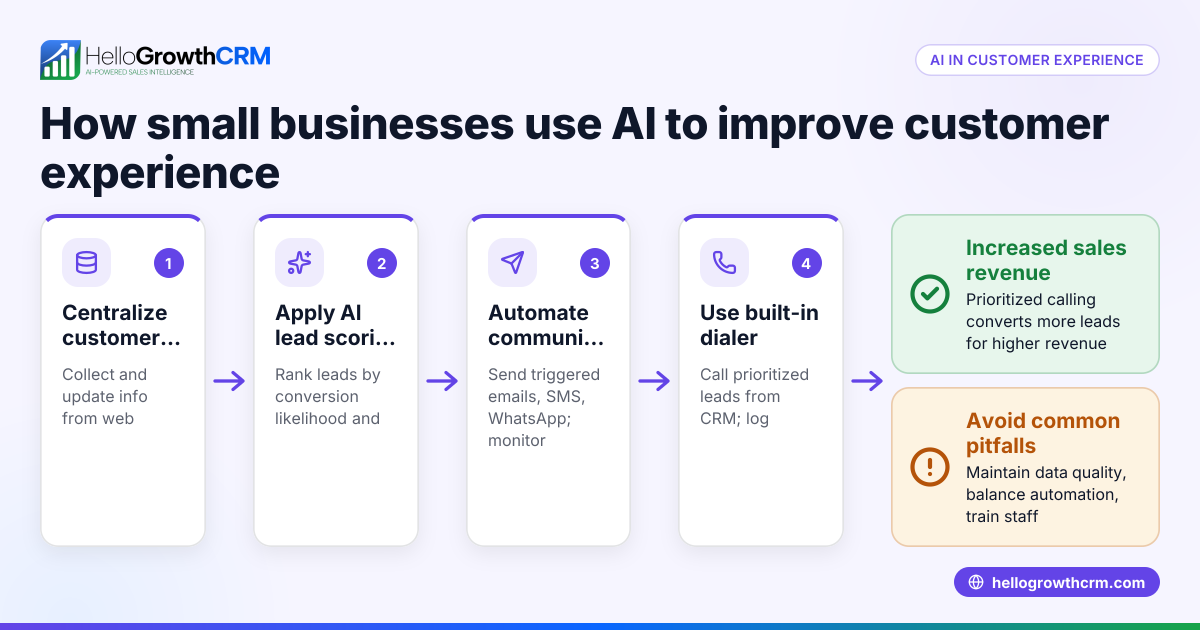
HelloGrowthCRM helps small and mid-sized US businesses implement AI with features like AI lead scoring, which lets telecallers prioritize calling leads most likely to convert first. Its pipeline forecast and AI insights enable business owners to see which deals are stalling without building complex spreadsheets. Additionally, AI agents (in beta) draft follow-up messages after calls, so sales reps only need to review and send, saving time and improving consistency. Learn more about HelloGrowthCRM’s AI CRM capabilities here.
Frequently asked questions
What is an AI implementation plan? An AI implementation plan is a detailed strategy for adopting AI technologies in your business. It outlines goals, selects tools, trains staff, pilots solutions, and measures performance to ensure AI delivers value.
How long does it take to implement AI in a small business? Implementation time varies but typically takes weeks to a few months. Starting with a pilot phase helps you test AI on a small scale before full rollout, allowing adjustments based on early results.
What are common AI tools for small businesses? Common AI tools include lead scoring systems, chatbots, automated follow-up agents, and sales forecasting software. Tools that integrate with WhatsApp, SMS, and email are especially useful for small sales teams managing leads across these channels, like HelloGrowthCRM’s WhatsApp and SMS CRM features (/product/whatsapp-sms-crm).
How do I measure AI success? Measure AI success by tracking KPIs such as lead conversion rates, sales cycle duration, and forecast accuracy. Use AI-generated reports and pipeline health insights to analyze performance and identify bottlenecks.
Can AI replace salespeople? AI assists sales teams by automating repetitive tasks and prioritizing leads but does not replace the human relationship-building essential in sales. It empowers reps to focus on high-value interactions.
Is AI implementation expensive for small businesses? Costs vary based on tools and scale. Many AI CRM solutions offer plans tailored to small businesses, balancing features and affordability. Starting with free or low-cost plans can reduce upfront investment.
Key takeaways
- Define clear, measurable goals before adopting AI.
- Choose AI tools designed for small to mid-sized businesses and your communication channels.
- Train your team thoroughly to ensure adoption.
- Pilot AI solutions on a small scale and measure results.
- Use AI insights to improve lead follow-up and sales forecasting.
- Avoid common pitfalls like poor data quality and lack of tracking.
Start your AI journey today with an easy-to-use CRM that integrates AI lead scoring, pipeline forecasting, and AI agents. Start on the Free Forever plan (200 leads, no credit card).
Ready to put this into practice?
Set up your pipeline, WhatsApp follow-ups, and AI lead scoring in minutes — free, no credit card.
Try HelloGrowthCRM freeGet CRM tips in your inbox
Join thousands of sales professionals who get weekly insights on CRM strategy, AI automation, and pipeline optimization.

The HelloGrowthCRM team publishes guides on CRM strategy, AI sales tools, and revenue operations for small business sales teams.