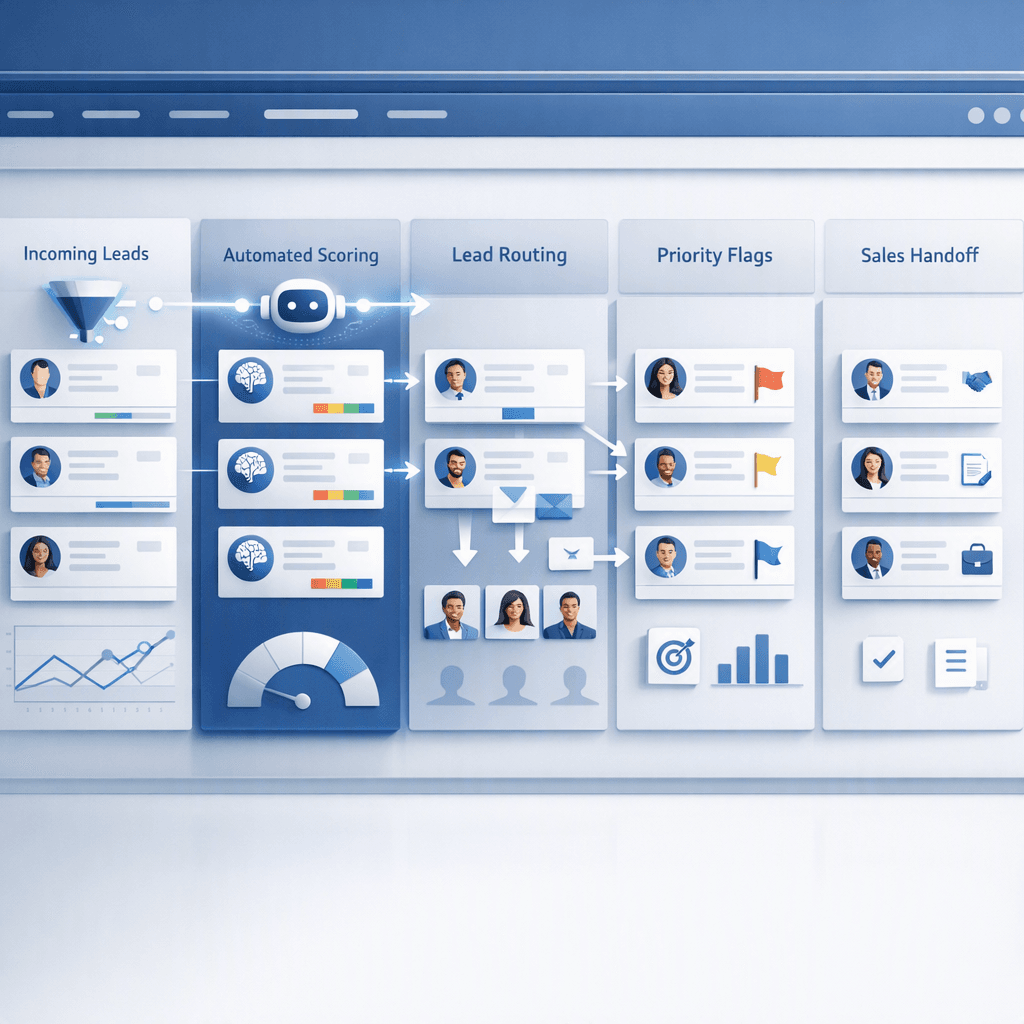
HelloGrowthCRM software
Built for real small-business sales teams
HelloGrowthCRM helps reps qualify faster, follow up on time, and close more deals—with practical automation in one place.
- AI lead scoring and pipeline visibility
- Built-in dialer, WhatsApp, and email automation
- Sales forecasting and RevOps-ready reporting
AI lead qualification workflows in a B2B CRM are automated rules, scoring models, and AI-driven actions that evaluate inbound and outbound leads, rank sales readiness, route records to the right owner, trigger follow-up, and control handoffs so revenue teams respond faster without adding manual triage work.
Key Takeaways
- Start automation with lead scoring, routing, and first-touch follow-up before tackling complex nurture logic.
- The best AI qualification workflows combine firmographic fit, buying intent, and behavioral signals in one score.
- Clear handoff rules matter as much as scoring rules. Bad routing can cancel out good AI.
- B2B teams should track speed-to-lead, MQL-to-SQL conversion, meeting rate, and stage velocity in days.
- HelloGrowthCRM works best when AI CRM workflows are paired with process design, reporting, and Managed RevOps.
What are AI lead qualification workflows in a B2B CRM?
AI lead qualification workflows in a B2B CRM are automated sequences that score, prioritize, route, and follow up with leads using data and predictive logic, so sales teams spend less time triaging records and more time working the accounts with the highest chance to convert.
At a practical level, these workflows sit inside your CRM and answer four questions:
- Is this lead a fit?
- Is this lead active right now?
- Who should own it?
- What should happen next?
In most B2B teams, qualification breaks because these decisions live in rep heads, spreadsheets, and Slack messages instead of system rules. An AI CRM changes that. It can combine page views, form fills, firmographic data, email replies, meeting activity, and rep notes into one operating flow. With tools like AI CRM, AI Lead Scoring, and AI Pipeline Management, teams can move from reactive lead handling to consistent, measurable qualification.
In one rollout we did with a 12-person sales team, the biggest issue was not lead volume. It was uneven judgment. Two reps would call almost every lead. Three reps ignored mid-fit accounts. The manager kept re-routing records by hand. Once we defined fit thresholds, territory logic, and first-response automation inside the CRM, the team stopped debating each lead and started working from the same rules.
That is the real point of workflow automation. It does not just save clicks. It standardizes judgment.
Why should B2B teams automate lead qualification first?
B2B teams should automate lead qualification first because qualification sits at the top of the funnel and affects response time, rep capacity, conversion quality, and forecast accuracy; if the wrong leads get worked slowly or assigned poorly, every downstream sales metric gets worse.
Qualification is one of the highest-leverage places to apply AI because it happens often, follows patterns, and depends on data that already exists in the CRM. When a team still reviews every lead manually, three problems show up fast:
- Response times get longer as lead volume grows
- Reps cherry-pick based on gut feel
- Managers cannot see why one lead got attention and another did not
According to Harvard Business Review, companies that tried to contact potential customers within an hour were nearly seven times as likely to qualify the lead as those that tried even an hour later and more than 60 times as likely as companies that waited 24 hours or longer (HBR).
That is why speed-to-lead should be designed into the CRM, not left to rep discipline.
Where manual qualification usually breaks
Most teams do not fail because they lack a lead score. They fail because the score is disconnected from action. I see the same gaps in audits:
- Scores exist, but routing still happens manually
- MQL rules are defined, but follow-up is not enforced
- SDRs and AEs disagree on what “qualified” means
- Channel responses live outside the CRM
- Managers cannot inspect handoff quality by source or segment
If you already use Smart Inbox, Meeting Scheduler, and Email Automation, you have the building blocks to automate the first layer of qualification without a major process reset.
What should you automate first in AI lead qualification workflows?
You should automate lead qualification in this order: scoring triggers, routing logic, first-touch follow-up, and handoff rules, because these four layers create the fastest gains in response speed and consistency while keeping the workflow simple enough to manage and improve over time.
This order matters. Many teams jump straight to complicated nurture branches. That creates noise before the basics are stable. Start with the decisions that occur on every lead.
1. Scoring triggers
Scoring triggers tell the CRM when a lead becomes more or less important. Good models combine three signal groups:
- Fit signals: industry, employee count, revenue band, geography, tech stack
- Intent signals: pricing page visits, demo requests, repeat sessions, high-value content
- Engagement signals: opens, clicks, replies, meetings booked, calls answered
A strong setup often weights fit first, then overlays recent activity. That keeps the team from overreacting to low-fit leads with high activity.
When I have audited pipelines like this, the most common mistake is overweighting email clicks and underweighting account fit. A student or competitor can click five emails. That does not make them pipeline.
2. Routing logic
Once a score crosses a threshold, the lead should route automatically based on ownership rules such as:
- Territory
- Named account list
- Segment size
- Product line
- Language or region
- Existing account ownership
If you sell across regions or use specialist teams, Territory Management keeps this logic visible and enforceable. If routing depends on enrichment or external events, Zapier and All Integrations help connect the workflow.
3. First-touch follow-up
The first-touch sequence should fire instantly after qualification, not after a rep remembers to send it. For many B2B teams, that means:
- An immediate email confirmation
- Task creation for the assigned rep
- Optional SMS or WhatsApp alert for high-intent leads through WhatsApp & SMS CRM
- Meeting-booking option using Meeting Scheduler
4. Handoff rules
Handoff rules define when a lead becomes sales accepted, when it returns to nurture, and when ownership changes. This is where most MQL-to-SQL leaks happen.
Which scoring signals matter most for B2B lead qualification?
The scoring signals that matter most for B2B lead qualification are company fit, buyer role, recency of engagement, buying-stage behavior, and account context, because these signals predict whether a lead belongs in your market and whether there is a real chance to start a sales conversation now.
For most B2B sellers, you do not need dozens of variables at first. You need a model reps trust. Keep the first version explainable.
A practical lead scoring framework
Use a three-layer model:
#### Fit score
Measures if the account and contact match your ICP.
Examples:
- +20 if employee count fits target range
- +15 if industry matches top-performing verticals
- +10 if role is director level or above
- -20 if student, consultant, or competitor domain
#### Intent score
Measures whether the buyer is showing commercial interest.
Examples:
- +25 for demo request
- +15 for pricing page visit
- +10 for repeat visit in seven days
- +10 for product comparison content
#### Engagement score
Measures current responsiveness.
Examples:
- +10 for email reply
- +8 for meeting booked
- +5 for call connected through CRM Dialer
- -10 for 30 days of inactivity
With AI Lead Scoring, teams can automate this model and refine thresholds as conversion data accumulates.
Keep your score auditable
A lead score should answer “why now?” at a glance. Reps should be able to open a record and see the top contributing signals. This is one place where AI needs guardrails. If the model is a black box, adoption drops.
Gartner notes that poor data quality costs organizations an average of $12.9 million per year (Gartner). In lead qualification, bad data creates false urgency, bad routing, and wasted rep time.
How should routing and handoff rules work inside the CRM?
Routing and handoff rules in a CRM should assign qualified leads based on ownership, segment, and urgency, then move records between SDR, AE, and nurture states using explicit acceptance, timeout, and recycle conditions so no lead sits unworked or gets touched by the wrong person.
A clean routing model reduces internal friction. It also makes response-time reporting honest.
Core routing rules to define
Set these rules before launch:
- Primary owner rule: territory, segment, or named account owner
- Fallback owner rule: round robin if no primary owner exists
- Urgency rule: hot leads trigger faster SLAs
- Capacity rule: avoid overloading one rep
- Duplicate rule: existing open opportunity keeps ownership
Core handoff rules to define
Your handoff rules should cover:
- When a lead becomes MQL
- When sales must accept or reject it
- Why a lead can be rejected
- When a rejected lead returns to nurture
- When an AE takes over from an SDR
- What fields are required before handoff
In one SaaS implementation I ran, we reduced routing disputes by forcing three required fields before SDR-to-AE handoff: problem statement, use case, and next-step date. That one rule improved pipeline review quality more than any dashboard.
If your team wants AI support after the first meeting, AI Sales Copilot, AI Deal Insights, and the Post-Call Agent can carry qualification context deeper into the pipeline.
AI qualification vs manual triage: which works better?
AI qualification works better than manual triage for speed, consistency, and scale, while manual review still matters for exceptions, strategic accounts, and early-stage process design; the best B2B teams automate repetitive qualification decisions and reserve human judgment for edge cases.
Here is the tradeoff in simple terms.
| Area | AI qualification workflow | Manual triage |
|---|---|---|
| Response speed | Immediate | Delayed by queue and rep availability |
| Consistency | High if rules are clear | Varies by rep judgment |
| Scale | Handles volume easily | Breaks as lead volume rises |
| Auditability | Rules and triggers are visible | Decisions often live in inboxes or Slack |
| Strategic nuance | Needs exceptions built in | Strong for named accounts |
| Process improvement | Easy to test thresholds | Hard to diagnose patterns |
This is also where I should be clear: HelloGrowthCRM is our product, so we naturally believe an AI-first CRM is the better operating model for many B2B teams. That said, manual qualification can still work well for low-volume enterprise sales motions with a small set of named accounts. For teams under 50 reps, structured automation usually creates fast gains. Above that, expect more territory, governance, and integration work.
How to build AI lead qualification workflows in your B2B CRM: Step-by-Step
Building AI lead qualification workflows in your B2B CRM means defining your qualification criteria, translating them into scores and routing rules, automating first response and handoff actions, and then improving the system using conversion and speed data instead of rep opinion alone.
- Define your qualification standard
- Map the lead states
- Choose scoring inputs
- Set routing logic
- Automate first-touch actions
- Define handoff criteria
- Add dashboards and SLAs
- Review and tune monthly
What metrics prove your AI qualification workflow is working?
The metrics that prove an AI qualification workflow is working are speed-to-lead, contact rate, meeting-booked rate, MQL-to-SQL conversion, recycle rate, and stage velocity, because they show whether the workflow improves both efficiency and opportunity quality rather than just increasing activity.
Start with a short scorecard:
- Median speed-to-lead
- Qualified lead acceptance rate
- Meetings booked per qualified lead
- MQL-to-SQL conversion
- SQL-to-opportunity conversion
- Recycled lead rate
- Pipeline created per source
- Stage-1 to stage-2 velocity in days
If you want a quick baseline before making changes, use the Pipeline Health Score, CRM ROI Calculator, or RevOps Maturity Assessment.
One warning: do not judge success by score inflation. I have seen teams celebrate higher average lead scores while meeting rates stayed flat. Better qualification should create better sales outcomes, not just prettier dashboards.
For B2B teams that need both software and operating support, HelloGrowthCRM combines Features, AI automation, and Managed RevOps so you can build workflows, enforce handoffs, and improve response speed without hiring extra ops headcount. If you want to see how this would work in your funnel, start a Free Trial or book a Demo.
About the author
Ronan Hale is a Revenue Operations Lead at HelloGrowthCRM with 9 years of experience building CRM, lifecycle, and sales automation systems for B2B SaaS teams. He has led pipeline audits, routing redesigns, and AI qualification rollouts across inbound and outbound revenue motions. One project that informed this article was a multi-region lead routing rebuild for a 12-person sales team that needed faster response times without adding SDR headcount. His work focuses on practical RevOps design that sales managers can actually run.
Frequently Asked Questions
Q: What is an AI lead qualification workflow in a B2B CRM?
A: An AI lead qualification workflow in a B2B CRM is an automated system that scores, routes, and follows up with leads based on fit and intent signals. It helps revenue teams prioritize the right accounts and reduce manual triage inside the CRM.
Q: What should B2B teams automate first in lead qualification?
A: B2B teams should automate scoring, routing, first-touch follow-up, and handoff rules first in lead qualification. These four steps create the fastest impact on response speed, rep consistency, and lead coverage without making the workflow too complex.
Q: How is AI lead scoring different from traditional lead scoring?
A: AI lead scoring is different from traditional lead scoring because it can adapt to more signals and automate actions from those scores inside the CRM. Traditional models are often static and rely on manual review before anything happens.
Q: Can AI replace SDR lead triage completely?
Frequently Asked Questions
Ready to put this into practice?
Set up your pipeline, WhatsApp follow-ups, and AI lead scoring in minutes — free, no credit card.
Try HelloGrowthCRM freeGet CRM tips in your inbox
Join thousands of sales professionals who get weekly insights on CRM strategy, AI automation, and pipeline optimization.

The HelloGrowthCRM team publishes guides on CRM strategy, AI sales tools, and revenue operations for small business sales teams.