HelloGrowthCRM software
Built for real small-business sales teams
HelloGrowthCRM helps reps qualify faster, follow up on time, and close more deals—with practical automation in one place.
- AI lead scoring and pipeline visibility
- Built-in dialer, WhatsApp, and email automation
- Sales forecasting and RevOps-ready reporting
AI lead qualification workflows for B2B teams are CRM-based automation systems that use fit data, buying signals, scoring models, routing rules, and instant follow-up to identify sales-ready leads faster, reduce lead leakage, and send each inquiry to the right rep or sequence without adding manual admin.
Key Takeaways
- AI lead qualification works best when scoring, routing, and first response happen in one connected CRM workflow.
- B2B teams should combine explicit fit signals and implicit behavior signals instead of relying on form fills alone.
- The biggest gains usually come from faster speed-to-lead, cleaner handoffs, and fewer unworked inbound leads.
- Good workflows need clear thresholds, ownership rules, and regular model reviews to avoid bad routing.
- HelloGrowthCRM helps teams operationalize this with AI CRM, AI Lead Scoring, automation, and Managed RevOps.
What are AI lead qualification workflows for B2B teams?
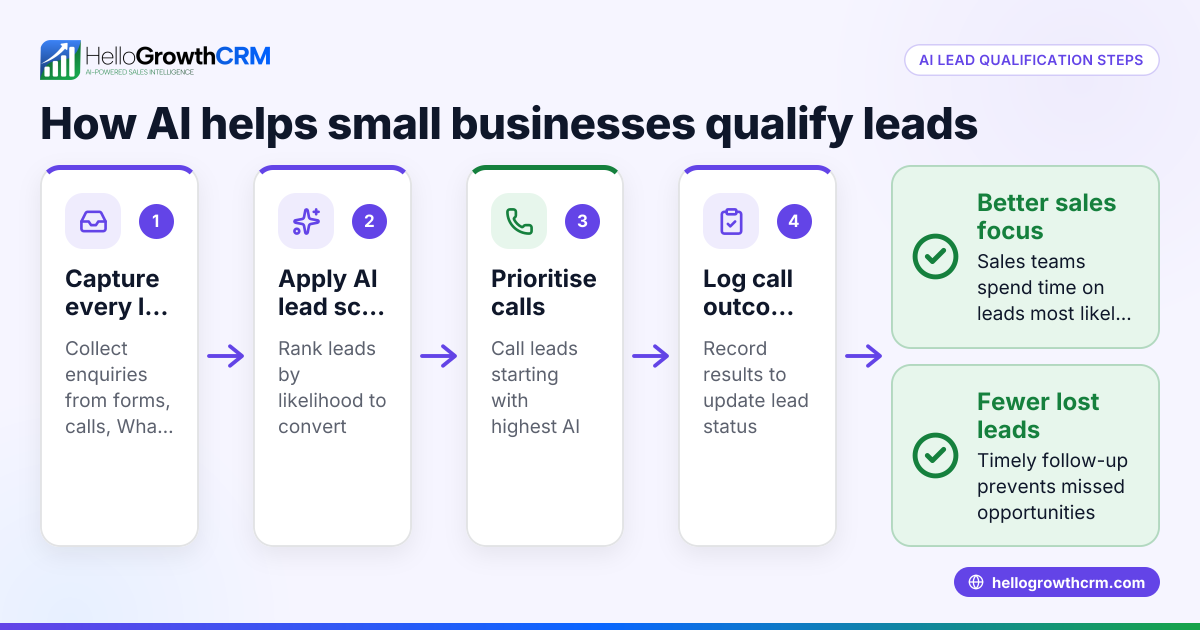
AI lead qualification workflows for B2B teams are automated CRM processes that collect lead signals, score readiness and fit, assign owners, and trigger first-touch actions in real time. They help revenue teams decide who to prioritize, who to nurture, and who to route elsewhere without relying on spreadsheets or delayed manual review.
In practice, these workflows connect four jobs that often sit in different tools:
- Capture inbound data
- Score lead quality
- Route leads by rules
- Launch fast follow-up
That matters because most teams do not lose leads from bad intent alone. They lose them in the gap between form submission and first action. A rep is busy. A field is missing. A territory rule is unclear. The SDR queue is overloaded. By the time someone checks the lead, the buyer has moved on.
In HelloGrowthCRM, this workflow can live inside one system with AI Lead Scoring, Meeting Scheduler, Email Automation, Smart Inbox, and AI Pipeline Management. That lowers handoff friction because qualification signals and actions stay attached to the same record.
What AI qualification actually scores
A strong B2B qualification workflow usually scores two broad categories:
- Fit signals: company size, industry, region, tech stack, use case, role, budget proxy
- Behavior signals: page views, pricing visits, repeat sessions, demo requests, email replies, meeting bookings, content depth
I have audited inbound funnels where teams only scored fit. Those models looked neat on paper but missed active buyers at smaller accounts. I have also seen behavior-only models flood SDRs with students, competitors, and low-value freebie seekers. The best workflows balance both.
Why B2B teams need a workflow, not just a score
A score alone does not create pipeline. The workflow does.
A practical qualification workflow should answer these questions:
- Is this lead worth a rep touch now?
- Which rep or queue owns it?
- What should happen in the first five minutes?
- What happens if the rep does not act?
- What happens if the lead is high intent but low fit?
That is why teams evaluating software should look beyond a scoring widget. They should review the full stack of Features, routing options, integrations, and service support, especially if they lack in-house RevOps.
Why do AI lead qualification workflows matter for speed-to-lead and revenue efficiency?
AI lead qualification workflows matter for speed-to-lead and revenue efficiency because they turn raw inbound volume into prioritized action within seconds, not hours. That reduces unworked leads, improves rep focus, and helps sales teams respond while intent is still high, which is often the difference between a conversation and a miss.
That finding is old, but the operating truth is still current. Speed matters because intent decays. Inbound buyers compare options quickly. If your process waits for an SDR to clean fields, check territory, and pick a sequence, you have already introduced avoidable delay.
Where lead leakage actually happens
In one rollout we did with a 12-person sales team, the issue was not lead volume. It was workflow fragmentation. Marketing captured the lead. A rep manager checked a spreadsheet. SDRs reassigned records in batches twice a day. High-intent demo requests sat untouched for 90 minutes on average. Once we automated scoring, routing, and first response inside the CRM, response times dropped sharply and queue arguments disappeared.
Common leakage points include:
- Form fills with incomplete firmographic data
- No ownership rule for named accounts or territories
- Manual SDR review queues
- No fallback action when a rep does not respond
- Separate tools for score, assignment, and outreach
- No nurture path for non-MQL but high-interest leads
Why AI helps more than rule-only automation
Traditional if/then logic still has value. But AI helps when signal volume grows and patterns become less obvious. For example, AI can weigh combinations of signals like:
- Three pricing-page visits within five days
- A director title from a target industry
- An email reply after webinar attendance
- A prior closed-lost association from the same account
That said, there is a limit. For teams under 50 reps, you do not need an overly complex model. Keep the first version explainable. If sellers cannot understand why a lead was scored or routed a certain way, trust drops fast.
Which signals should B2B teams use in an AI lead qualification workflow?
B2B teams should use a mix of fit, behavior, engagement, and operational signals in an AI lead qualification workflow because no single data type predicts readiness well enough on its own. The strongest models combine who the lead is, what the account looks like, and what buying actions they have taken.
A simple framework I use is Fit + Intent + Timing + Ownership.
Fit signals
Fit tells you whether the account belongs in your ideal customer profile.
Typical fit inputs include:
- Employee count
- Annual revenue band
- Industry
- Geography
- Job title and seniority
- Existing tools or integrations needed
- Use case match
- Segment tier
If your team sells across regions or product lines, add Territory Management rules early. That keeps “good” leads from landing with the wrong rep.
Behavior and intent signals
Intent tells you whether interest is active enough for a live touch.
Useful behavior signals include:
- Demo request submission
- Pricing page visits
- Return visits within a short window
- High-value content views
- Email click depth
- Chat engagement
- Calendar booking attempts
- Form completion speed and completeness
If your marketing and sales systems are disconnected, behavior signals arrive too late. That is why native workflows and All Integrations matter.
Operational and negative signals
Good qualification models also include suppressors and exclusions.
Examples:
- Existing customer or open opportunity
- Student or competitor domain
- Region outside coverage
- Duplicate lead under same account
- Spam patterns
- Free email domain if not accepted
- Low-value source tags
This protects rep time. It also keeps your Sales Task Boards and queues cleaner.
How should scoring, routing, and first response work together?
Scoring, routing, and first response should work together as one continuous workflow where score determines urgency, routing determines ownership, and automation determines the first action. When those steps live in separate tools or teams, delays grow, duplicate work increases, and conversion rates usually suffer.
Think of the workflow as three connected layers.
| Workflow layer | Main question | Example logic | Recommended action |
|---|---|---|---|
| Scoring | Is this lead worth attention now? | ICP fit + pricing visit + demo form | Mark as high priority |
| Routing | Who should own it? | Region + segment + named account | Assign to SDR or AE |
| First response | What happens immediately? | Score above threshold and owner assigned | Send personalized email, alert rep, offer meeting slot |
Layer 1: Scoring
Use weighted scoring with clear ranges. For example:
- 80-100: sales-ready
- 50-79: nurture plus SDR review
- 0-49: marketing nurture or disqualify
If you need a starting point, the Lead Scoring Calculator helps teams build a baseline before they automate.
Layer 2: Routing
Routing rules should be deterministic where ownership is critical. AI can recommend, but final routing should still follow clear business logic.
Good routing rules often use:
- Geography
- Segment
- Product line
- Named account ownership
- Existing contact owner
- Language
- Capacity balancing
Layer 3: First response
This is the most neglected layer. Many teams assign leads but do not automate the first touch. That wastes the speed advantage.
A strong first-response workflow can:
- Send a fast but personalized email
- Create a call task
- Trigger a Slack alert via Slack
- Offer booking links through Calendly or native scheduling
- Push urgent leads into a dialer queue with CRM Dialer
- Send a WhatsApp or SMS touch using WhatsApp & SMS CRM where appropriate
How to build AI lead qualification workflows for B2B teams: Step-by-Step
To build AI lead qualification workflows for B2B teams, start by defining your ideal lead, map the signals you already collect, set scoring thresholds, automate routing, and trigger immediate follow-up inside the CRM. Then review outcomes weekly so the model stays accurate as volume and segments change.
- Define your qualification goal
Decide what “qualified” means. Use a real sales outcome like meeting booked, opportunity created, or MEDDPICC-aligned acceptance by sales. - List fit and behavior inputs
Map firmographic, demographic, and engagement fields. Separate required inputs from nice-to-have inputs so missing data does not break the workflow. - Create a simple score model first
Start with weighted rules before adding advanced AI logic. For many teams, 8-12 strong signals are enough for a useful first version. - Set thresholds and actions
Define what happens at each score band. For example, high scores go to SDRs instantly, mid-range leads enter nurture, and low scores are suppressed or enriched. - Build routing rules inside the CRM
Use territory, segment, product, or account-owner logic. Keep exceptions documented so reps trust the assignment outcome. - Automate the first response
Trigger email, call tasks, alerts, and scheduler links immediately. Use Email Automation and Meeting Scheduler to remove manual delay. - Add fallback and SLA logic
If no rep acts within a set window, reassign or escalate the lead. This is one of the easiest ways to reduce leakage. - Review conversion by score band
Measure meeting rate, acceptance rate, stage progression, and time-to-first-touch. Use Sales Forecasting and reporting to spot whether the model is helping pipeline quality.
What to measure after launch
Track these metrics every week:
- Median speed-to-lead
- Lead-to-meeting conversion
- MQL-to-SQL acceptance rate
- Routing error rate
- No-owner lead count
- First-touch SLA attainment
- Opportunity creation by score band
When I have audited pipelines like this, the biggest warning sign is a pretty dashboard with no threshold review. If the 80+ score band converts no better than the 50-79 band, the model is not helping enough.
Where does HelloGrowthCRM fit in for B2B teams adopting AI qualification?
HelloGrowthCRM fits B2B teams adopting AI qualification by combining lead scoring, workflow automation, routing logic, outreach actions, and RevOps support in one operating system. That lets teams move faster without stitching together multiple apps or adding admin work as inbound volume grows.
This is where many teams get stuck. They can buy software, but they still need to design the workflow. They need field hygiene, ownership rules, lifecycle definitions, SLAs, and reporting. That is why the combination of platform plus service matters.
HelloGrowthCRM supports this operating model with:
- AI CRM for connected records and workflows
- AI Lead Scoring for prioritization
- AI Sales Copilot for rep guidance
- Revenue Attribution for source and conversion analysis
- Managed RevOps for teams that need help designing and maintaining the system
Gartner notes that CRM software supports sales, marketing, and customer service processes and helps manage customer interactions and data throughout the lifecycle. For B2B teams, the practical value is not just data storage. It is coordinated action.
Why managed RevOps matters
Managed RevOps is especially useful if:
- You do not have an in-house RevOps leader
- Marketing and sales disagree on MQL definitions
- Lead ownership rules are inconsistent
- Reporting is unreliable
- Tool sprawl has created handoff delays
HelloGrowthCRM is our product, so this is a disclosed point of view. It is a strong fit for SMB and mid-market B2B teams that want one platform plus workflow support. Larger enterprises with deeply customized legacy stacks may need a longer migration path.
If you want to evaluate the workflow design before changing systems, start with the RevOps Maturity Assessment, review Pricing, or book a Demo. If you want to test quickly, start a Free Trial.
If your B2B team wants faster qualification, cleaner routing, and instant first response without adding admin overhead, HelloGrowthCRM is built for that. Explore the Features, see AI CRM in action, or book a Demo to map your lead qualification workflow with our team.
About the author
Arjun Mehta is a Revenue Operations Lead at HelloGrowthCRM with 9 years of experience in B2B SaaS sales operations, CRM architecture, and automation design. He has led CRM and routing redesign projects for growth-stage sales teams across SaaS, services, and technology-enabled businesses. One project that shaped this article involved rebuilding inbound qualification and rep assignment for a 12-person sales team, cutting response delays caused by manual queue review and fragmented tools.
Frequently Asked Questions
Q: What is an AI lead qualification workflow for B2B teams?
A: An AI lead qualification workflow for B2B teams is an automated CRM process that scores leads, routes them to the right owner, and triggers first response actions based on fit and intent. It helps sales teams focus on the best opportunities faster and reduces manual review work.
Q: How is AI lead qualification different from traditional lead scoring?
A: AI lead qualification is different from traditional lead scoring because it uses more signals and can adapt weighting based on observed patterns, not just fixed point rules. Traditional scoring still works, but AI often improves prioritization when lead volume and complexity grow.
Q: What signals should go into a B2B AI qualification model?
A: The signals that should go into a B2B AI qualification model include company fit, buyer role, engagement behavior, buying intent, and exclusion criteria. The best models balance firmographic data with real actions like pricing visits, reply behavior, and meeting requests.
Q: Can small B2B teams use AI lead qualification workflows?
A: Small B2B teams can use AI lead qualification workflows if they keep the model simple and explainable. Most small teams do not need advanced data science first. They need clear thresholds, routing rules, and automated first-touch actions inside the CRM.
Q: How fast should sales respond to inbound leads?
Frequently Asked Questions
Ready to put this into practice?
Set up your pipeline, WhatsApp follow-ups, and AI lead scoring in minutes — free, no credit card.
Try HelloGrowthCRM freeGet CRM tips in your inbox
Join thousands of sales professionals who get weekly insights on CRM strategy, AI automation, and pipeline optimization.

The HelloGrowthCRM team publishes guides on CRM strategy, AI sales tools, and revenue operations for small business sales teams.