HelloGrowthCRM software
Built for real small-business sales teams
HelloGrowthCRM helps reps qualify faster, follow up on time, and close more deals—with practical automation in one place.
- AI lead scoring and pipeline visibility
- Built-in dialer, WhatsApp, and email automation
- Sales forecasting and RevOps-ready reporting
If you are searching for an ActiveCampaign alternative, the real question is usually bigger than email automation. Many US B2B teams need a system that combines CRM, pipeline, outreach, lead scoring, and reporting in one place so sales and marketing can actually work from the same record.
Key takeaways
- ActiveCampaign can work well for email marketing, but many B2B teams outgrow it when sales pipeline management becomes the priority.
- The best activecampaign alternative for a US B2B company should combine CRM, lead capture, outreach, pipeline, and forecasting.
- A single system reduces manual updates, duplicate records, and reporting gaps between marketing and sales.
- AI can help with lead scoring, follow-ups, and next-step recommendations, but only if the data lives in one place.
- For growing teams, adoption matters as much as features. A CRM only helps if reps use it every day.
Why US B2B teams start looking for an ActiveCampaign alternative
Many companies start with ActiveCampaign because they want email automation. That makes sense early on. It helps with forms, lists, campaigns, and basic follow-up.
The problem shows up when the sales process gets more complex. A founder in Chicago may start with one pipeline and a few email sequences. Six months later, the team has SDRs, account executives, multiple lead sources, call activity, and weekly forecast meetings. At that point, email automation alone is not enough.
B2B sales teams in the United States usually need more than campaign logic. They need a full system for:
- capturing inbound leads
- routing leads to the right rep
- managing deals through stages
- logging calls and emails
- tracking follow-ups
- forecasting revenue
- reporting on conversion by source, rep, and stage
When these functions sit across multiple tools, teams often create extra admin work. Reps update one system. Marketing checks another. RevOps exports spreadsheets to build a report leadership can trust.
That is why many companies start searching for an activecampaign alternative. They do not just want another automation platform. They want one system that can support the whole revenue process.
What should a US B2B company look for instead?
Look for one platform that combines CRM, pipeline, communication, automation, and reporting. The goal is fewer handoffs, cleaner data, and better rep adoption.
In practice, that means your next system should support the daily work of both sales and RevOps. It should not just send emails. It should help your team move deals forward.
Core capabilities that matter most
A strong replacement should include these basics:
- CRM with one contact and company record
Your team should not have to piece together activity from separate systems. - Sales pipeline management
Reps need clear stages, task reminders, and visibility into what is stuck. - Lead capture and routing
New leads from forms, ads, referrals, and outbound responses should land in the right queue fast. - Email, phone, and messaging in one workflow
US B2B teams still rely heavily on email and phone. If outreach lives outside the CRM, activity gets lost. - Automation built around the sales process
Good automation should trigger tasks, alerts, assignment rules, and follow-ups. It should not stop at marketing nurture. - Reporting and forecasting
Leaders need to see stage conversion, source performance, and likely revenue without rebuilding reports every week. - Easy integrations with the US business stack
Most growing companies already use tools like QuickBooks, Stripe, and common lead sources. Strong integrations matter.
Why this matters in the United States
US B2B teams often face buying processes that involve several stakeholders, long sales cycles, and strict procurement reviews. Buyers may ask about SOC 2. Your outreach must respect CAN-SPAM for email and TCPA rules for calls and texts where applicable. Finance may want sales data to align with the tools they already use.
That means your CRM cannot just be a campaign tool. It needs to be the operational system behind revenue.
Is ActiveCampaign enough for B2B sales teams?
For simple email nurture, maybe. For a growing B2B sales team that needs reliable pipeline management, usually not.
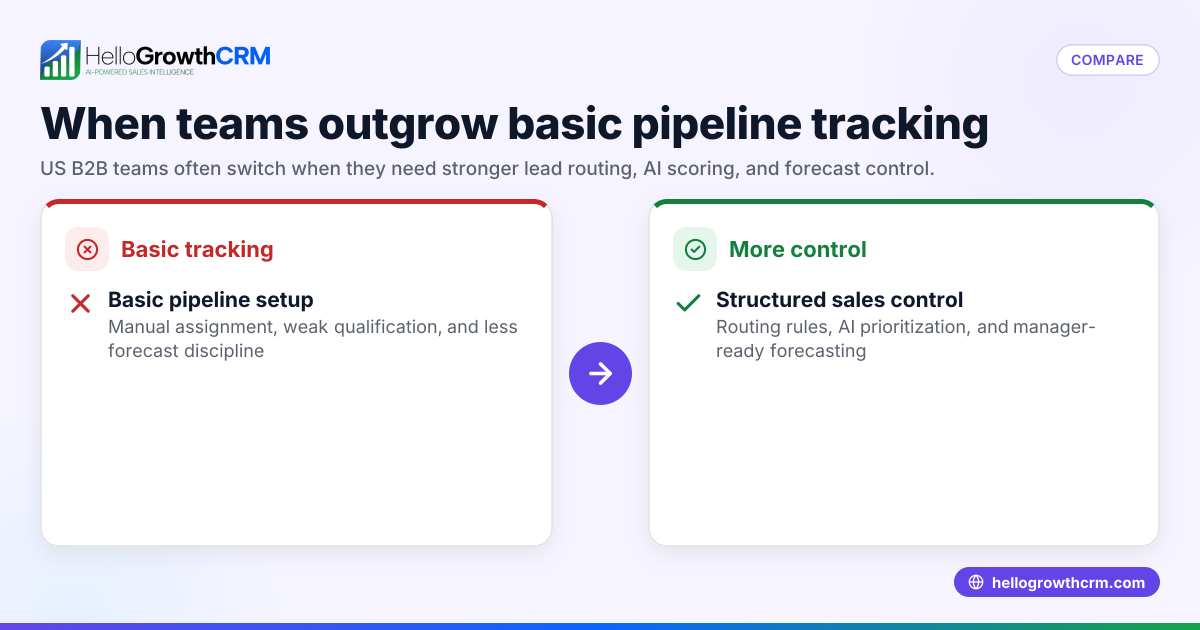
The gap is not that ActiveCampaign lacks all automation. The gap is that many B2B companies need a CRM-first workflow, not an email-first workflow. When a rep opens their system each morning, they need to see accounts, deals, tasks, recent activity, next steps, and forecast impact in one place.
Common signs your team has outgrown an email-first setup
You may need a better-fit platform if any of these are true:
- Reps manage opportunities in a separate CRM or spreadsheet.
- Marketing and sales disagree on lead status.
- Managers ask for pipeline reports that take hours to build.
- Follow-up tasks are missed after handoff.
- Lead scoring exists, but reps do not trust it.
- Calls and emails are not logged on the same record.
- Forecast meetings depend on manual rep updates.
These issues are common in small and mid-sized B2B companies. A manufacturer near Detroit, for example, may have leads from trade shows, website forms, distributors, and outbound lists. If those leads land in different places, no one has a clean view of pipeline health.
That is the point where an all-in-one system becomes much more valuable than another layer of automation.
What makes an ai activecampaign alternative better?
An ai activecampaign alternative is better when AI helps sales teams act on live CRM data, not just send smarter campaigns. The value comes from better prioritization, next steps, and cleaner pipeline visibility.
AI is useful, but only when attached to the right workflow. If your customer and deal data are spread across different systems, AI tends to produce more noise than value.
Where AI actually helps B2B revenue teams
The most practical AI use cases are simple:
- scoring leads based on fit and behavior
- highlighting deals at risk
- suggesting next actions
- surfacing stalled opportunities
- helping reps prioritize accounts
- automating repetitive admin work
For example, a Houston software company may get demo requests, webinar sign-ups, partner referrals, and outbound replies. Not every lead deserves the same urgency. AI can help rank those leads, but only if it can see activity, source, company data, and pipeline context together.
That is why many teams now want an AI CRM rather than a standalone automation tool. They want AI to support the whole funnel, from first touch through closed deal.
HelloGrowthCRM as an ActiveCampaign alternative
HelloGrowthCRM is built for growing B2B sales teams that want one place to run revenue operations. It combines CRM, lead capture, AI lead scoring, pipeline management, email, WhatsApp, calling, automation, forecasting, and reporting.
This matters because the real pain for many teams is not a missing feature. It is fragmentation. One tool stores contact data. Another runs campaigns. Another tracks deals. Another holds call notes. Leaders then spend Fridays trying to reconcile everything.
HelloGrowthCRM is designed to reduce that problem.
Where it fits best
HelloGrowthCRM is a strong fit if your business has:
- a dedicated sales process
- multiple lead sources
- a need for clear pipeline stages
- managers who care about forecast accuracy
- reps who need simple daily workflows
- a RevOps or founder-led need for better reporting
Teams can use it to capture and score leads, assign them automatically, run outreach, manage deals, and track performance from one system.
Features that matter in this comparison
Compared with an email-first platform, HelloGrowthCRM gives B2B teams a more complete operating system for sales.
That includes:
- central CRM records
- pipeline and deal tracking
- built-in communication workflows
- automation for tasks and follow-up
- AI lead scoring
- email automation
- sales forecasting
- support through managed RevOps
If your team wants to spend less time stitching together tools and more time closing deals, those features matter more than another set of campaign triggers.
How do you choose the best activecampaign alternative?
Choose the platform that matches how your sales team actually works each day. If pipeline, rep adoption, and revenue visibility matter most, pick a CRM-first system.
A simple evaluation framework
Use these five questions before you switch.
- Where does the truth live today?
If the answer is “it depends,” you already have a data problem. - Can reps run their day from one screen?
If they need several tools to find leads, tasks, emails, and deals, adoption will suffer. - Can managers trust the forecast?
If reports depend on manual exports, your system is not doing enough. - Can the platform handle both inbound and outbound?
Many B2B teams need both. Your system should support website leads and rep-driven prospecting. - Will implementation become another burden?
A feature-rich platform only helps if your team can deploy it cleanly and keep it maintained.
What to test in a demo
When you evaluate options, ask each vendor to show:
- lead capture to assignment
- a rep's daily task and deal view
- automated follow-up after a form fill
- email and call activity on one record
- stage-based reporting
- forecast roll-up by owner and month
- integration options with your current stack
Do not just ask for a feature checklist. Ask to see the workflow end to end.
Why does “all in one” matter so much?
All in one matters because every extra system creates more admin work and weaker reporting. A single platform gives sales, marketing, and RevOps one shared view of the customer and pipeline.
When systems are disconnected, small issues multiply fast. A lead comes in through a form. It syncs late. A rep calls before qualification is complete. A deal gets opened under the wrong company. Marketing reports one conversion rate. Sales reports another.
This is not just annoying. It affects revenue decisions.
The hidden cost of split systems
Many teams focus on software subscription cost alone. That is too narrow. The larger cost often comes from:
- missed follow-up
- duplicate records
- poor handoff
- low rep adoption
- manual reporting time
- weak forecast confidence
A sales leader in Chicago may think they have enough tooling because campaigns are running. But if they still need a spreadsheet to understand the quarter, the stack is not truly working.
That is why a platform with broad features can be more valuable than several separate tools. It reduces complexity where it hurts most: in daily execution.
Migration tips for switching from ActiveCampaign
Switching platforms does not need to be painful, but it does require planning. The best migrations start by cleaning process problems before moving data.
1. Map your current funnel
List every major stage from first touch to closed won. Include who owns each stage and what should happen next.
2. Define your core records
Decide what fields matter for contacts, companies, deals, and activities. Remove fields no one uses.
3. Clean up automation
Do not move every old workflow. Keep the sequences, alerts, and routing rules that still support the current sales motion.
4. Set clear ownership rules
Decide how leads are assigned. Write down rules for territories, inbound forms, and account ownership.
5. Build reports before launch
Create the dashboards leadership needs first. That usually includes pipeline by stage, lead source performance, win rate, and forecast.
6. Train reps on the daily workflow
Training should focus on what reps do each day, not every admin setting. Show them where to find tasks, update deals, and log activity.
7. Review compliance basics
If your team sends outbound email or uses calling and texting, make sure your workflows align with applicable US rules such as CAN-SPAM and TCPA requirements. Keep the process simple and documented.
A good migration is not just a data transfer. It is a chance to simplify the revenue process.
Who should choose HelloGrowthCRM over ActiveCampaign?
HelloGrowthCRM is best for US B2B companies that need CRM and pipeline management to be the center of the system. It is especially useful for teams that want sales execution, automation, and reporting in one place.
That includes:
- founder-led sales teams adding structure
- companies hiring their first SDRs and AEs
- RevOps leaders cleaning up a fragmented stack
- teams that need better lead prioritization
- managers who want cleaner forecasting
- businesses that want support, not just software
If your main need is basic email campaigns, you may not need to switch yet. But if your business depends on moving deals through a pipeline with clear ownership and reliable reporting, a CRM-first platform is usually the better fit.
HelloGrowthCRM also stands out for companies that want hands-on operational help, not just a login. That is where managed support can make a big difference.
Final verdict
The best activecampaign alternative for most growing US B2B sales teams is not just another marketing automation tool. It is a CRM-first platform that brings lead capture, outreach, pipeline, automation, and forecasting together.
HelloGrowthCRM fits that need well because it is designed around how B2B revenue teams actually operate. Instead of forcing your team to patch together separate systems, it gives you one place to manage the process from lead to revenue. If you want to explore the setup in more detail, review the pricing page and compare it to the cost of your current stack.
Start a free trial or book a demo to see how HelloGrowthCRM can help your team manage leads, pipeline, and forecasting in one place.
Frequently asked questions
Is HelloGrowthCRM only for sales teams?
No. It is most valuable when sales, marketing, and RevOps need to work from shared data. That helps with lead handoff, pipeline visibility, and reporting accuracy.
Can HelloGrowthCRM replace email automation tools?
For many B2B teams, yes. It includes outreach and automation features that support lead follow-up and sales workflows. The difference is that those actions sit inside a broader CRM and pipeline system.
Is HelloGrowthCRM a good fit for small businesses in the United States?
Yes, especially for small and mid-sized B2B companies that want structure without building a complicated stack. It can help founder-led teams mature their process while keeping reporting and follow-up organized.
Does AI lead scoring really help?
It can help when the scoring is tied to real CRM and engagement data. On its own, scoring is not enough. It becomes useful when reps can see scores, context, and next actions in the same workflow.
What is the biggest reason companies switch from ActiveCampaign?
Usually, it is not email performance. It is the need for stronger CRM, pipeline management, and reporting. As teams grow, those needs become harder to manage in separate systems.
Read next
This article covers one part of a bigger topic. For the complete picture, read our guide to activecampaign alternative.
Frequently Asked Questions
Ready to put this into practice?
Set up your pipeline, WhatsApp follow-ups, and AI lead scoring in minutes — free, no credit card.
Try HelloGrowthCRM freeGet CRM tips in your inbox
Join thousands of sales professionals who get weekly insights on CRM strategy, AI automation, and pipeline optimization.

The HelloGrowthCRM team publishes guides on CRM strategy, AI sales tools, and revenue operations for small business sales teams.