HelloGrowthCRM software
Built for real small-business sales teams
HelloGrowthCRM helps reps qualify faster, follow up on time, and close more deals—with practical automation in one place.
- AI lead scoring and pipeline visibility
- Built-in dialer, WhatsApp, and email automation
- Sales forecasting and RevOps-ready reporting
If you run a small business in Delaware and sell B2B, the best CRM for Delaware small business using QuickBooks and Stripe is one that keeps sales, payments, follow-up, and reporting in one simple workflow. It should help you capture leads, track deals, sync clean customer data, and give your team a clear next step without adding admin work.
Key takeaways
- Delaware small-business owners need a CRM that fits daily B2B sales work, not just contact storage.
- QuickBooks and Stripe matter most when your CRM helps sales and finance stay aligned.
- The best setup reduces manual entry, speeds up follow-up, and improves cash visibility.
- AI works best when it supports lead scoring, task reminders, and cleaner forecasting.
- A CRM your team actually uses should be simple, mobile-friendly, and easy to manage.
- HelloGrowthCRM can help if you want an AI CRM with sales tools and managed support.
Why Delaware small businesses need a different kind of CRM
A Delaware small-business owner usually wears several hats. You may lead sales in Wilmington in the morning, review invoices after lunch, and chase overdue payments before the day ends. That is why a basic contact database is not enough.
For B2B sales, your CRM should connect sales activity to the money side of the business. If you already use QuickBooks for accounting and Stripe for payments, your CRM should support that operating rhythm. You need your team to know who bought, who still needs a quote, who is late on payment, and which accounts are most likely to close this month.
This matters even more in Delaware because many small businesses here sell across state lines, work with service contracts, and rely on lean teams. A missed email, a stale quote, or a forgotten renewal can cost real revenue. A cluttered system also creates problems when you need accurate records for taxes, customer support, or year-end bookkeeping.
The right CRM should help you:
- capture new leads fast
- qualify them consistently
- move deals through the pipeline
- log emails, calls, and notes in one place
- hand clean billing data to QuickBooks
- keep payment status visible when Stripe is involved
- forecast revenue with less guesswork
A lot of tools promise this. Fewer actually make it easy for a small business owner in Delaware.
What should Delaware small-business owners look for first?
Start with ease of use, QuickBooks and Stripe fit, and strong pipeline visibility. If your team cannot update deals quickly, the CRM will fail. If payments and customer records stay disconnected, your reporting will stay messy.
Once those basics are covered, look for automation, AI lead scoring, and clear forecasting.
Start with the daily workflow, not the feature list
Many owners buy software by comparing long feature grids. That often leads to overbuying. A better approach is to map the actual sales process your business uses every week.
For example, a small industrial supplier near Newark may run this path:
- Website form comes in.
- Sales rep calls the prospect.
- Quote gets sent.
- Follow-up email goes out.
- Deal closes.
- Invoice is created in QuickBooks.
- Customer pays through Stripe.
- Account moves to renewal or repeat order follow-up.
Your CRM should make each step visible. It should also reduce duplicate work. If the rep enters contact details in one place, those details should not need to be typed again in three other systems.
Why QuickBooks and Stripe matter in B2B sales
QuickBooks and Stripe are not just finance tools. For a small business owner, they affect sales operations every day.
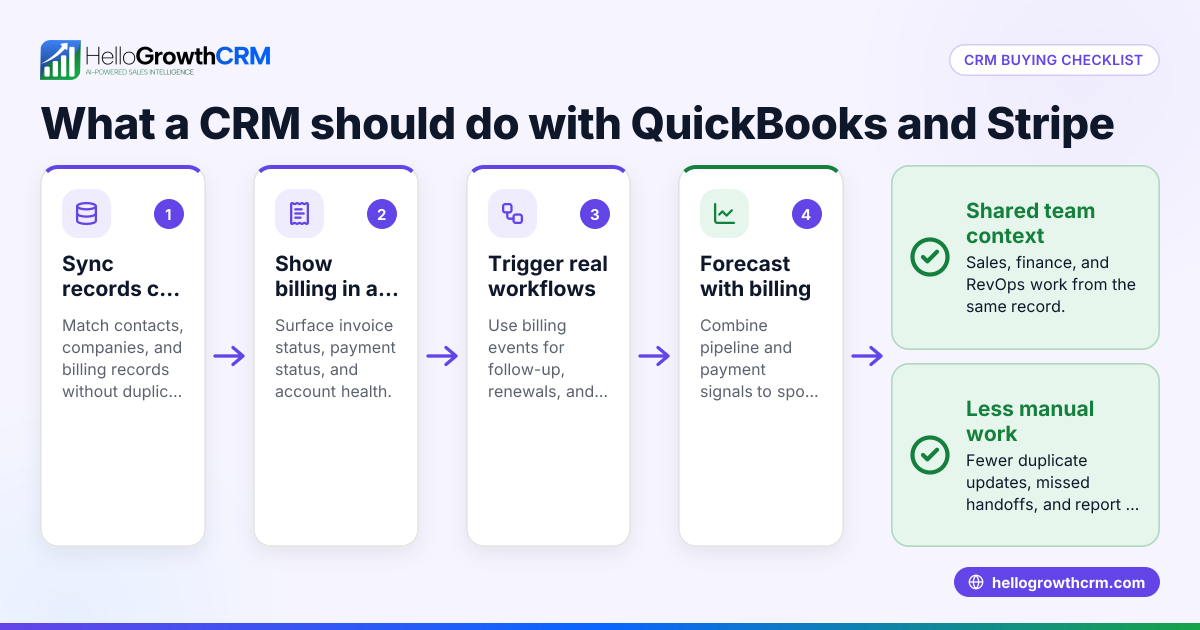
QuickBooks often holds the source of truth for invoices, payments, and customer balances. Stripe often handles payment collection, especially for deposits, online invoices, subscriptions, or service retainers. If your CRM does not align with that setup, your sales team works in the dark.
That causes common problems:
- sales promises made without seeing payment issues
- duplicate customer records
- closed deals that never become clean invoices
- weak renewal follow-up
- inaccurate month-end sales reporting
A CRM should help bridge the gap between the sales side and the revenue side. That is where the best tools stand out.
What makes the best CRM for Delaware small business using QuickBooks and Stripe?
It combines simple pipeline management, reliable customer records, and useful automation. It should help you sell faster and keep finance aligned. For Delaware owners, the best fit is the one your team updates every day without friction.
1. Clean lead capture and contact management
Every CRM claims to store contacts. That is the minimum. What you really need is clean intake from forms, referrals, email replies, and manual entry.
Good lead capture means:
- no lost website inquiries
- no duplicate records
- required fields for industry, deal size, or service type
- automatic owner assignment
- fast task creation for follow-up
For a Delaware IT services firm, that may mean routing leads by county or company size. For a manufacturer outside Dover, it may mean assigning leads based on product line or territory.
The point is simple. Your CRM should help you respond quickly and consistently.
2. A pipeline that matches how your business sells
A small B2B business does not need a giant enterprise setup. It needs a pipeline that reflects its actual sales stages.
Typical stages might include:
- New lead
- Qualified
- Discovery scheduled
- Proposal sent
- Negotiation
- Closed won
- Closed lost
That sounds basic, but many CRMs make this harder than it should be. Too many fields. Too many menus. Too many clicks. Small teams stop using the system when updates feel like homework.
A useful pipeline should show:
- deal value
- expected close date
- next activity
- last contact date
- lead source
- payment status or billing handoff notes
If you can open the dashboard and understand your week in under five minutes, the CRM is doing its job.
3. Automation that saves time without breaking your process
Automation should reduce repetitive work. It should not force your business into a rigid setup.
Useful automation for a Delaware small business includes:
- reminder tasks after calls
- follow-up emails after a quote
- alerts when a deal stalls
- handoff tasks when a deal closes
- renewal reminders before contract end dates
This is where email automation becomes practical. It helps you follow up at the right time without relying on memory alone.
The key is moderation. Start with a few automations that save time each week. Then expand once the team trusts the system.
Is AI actually useful in a CRM for a Delaware small business?
Yes, if it helps you prioritize leads, spot stalled deals, and forecast better. The value is in practical help, not flashy features. Good AI should save time for owners and reps, not create more system management.
Where AI helps most in day-to-day sales
AI can be helpful when it improves decisions that owners already make manually. That includes:
- scoring incoming leads
- identifying deals with weak follow-up
- suggesting next actions
- highlighting pipeline risk
- improving forecast confidence
This is where the phrase ai best crm starts to mean something useful. The ai best crm is not the one with the longest feature list. It is the one that helps a small business owner know where to focus today.
For example, if ten leads came in this week, AI can help surface which ones look most likely to convert based on source, company type, activity, and response behavior. That saves time and gives a small team a better shot at fast follow-up.
HelloGrowthCRM includes AI lead scoring, which is useful when you want your team to spend more time on the best-fit opportunities instead of sorting spreadsheets.
AI should support the owner, not replace judgment
In Delaware small businesses, sales decisions often rely on local knowledge and direct experience. You know your best buyers. You know when a prospect sounds serious. AI should support that judgment.
A good CRM will let you combine owner insight with system guidance. If a lead has strong engagement but falls outside your ideal customer profile, you should be able to see that and decide quickly. The system should not lock you into a black box process.
How do QuickBooks and Stripe fit into the CRM decision?
They matter because they affect customer records, payment visibility, and reporting. If your CRM works separately from QuickBooks and Stripe, your team wastes time reconciling information. That creates slow follow-up and weak forecasting.
Why integration matters to a small-business owner in Delaware
As an owner, you want one version of the truth. You do not want sales saying a deal is won while accounting is still missing billing details. You also do not want finance chasing payment questions without context from the sales conversation.
When QuickBooks and Stripe are part of your workflow, your CRM should help answer practical questions like:
- Did the deal actually close?
- Was the invoice created?
- Has the customer paid?
- Is the account ready for onboarding?
- Should sales follow up on expansion or renewal?
This is where integrations matter. The exact setup depends on how your business sells, but the goal stays the same. Keep customer, deal, and payment data aligned enough to drive action.
Common setup mistakes to avoid
Small businesses often run into the same issues:
- They buy a CRM before mapping the sales process.
- They import messy contacts without cleanup.
- They overbuild custom fields from day one.
- They fail to define what counts as a qualified deal.
- They leave finance handoff outside the CRM.
These mistakes do not just create admin problems. They slow revenue.
If your team cannot tell whether a deal is still active, billed, paid, or stuck, you lose control of the pipeline. For a small business owner, that can affect hiring, inventory decisions, and cash planning.
What features matter most for Delaware B2B owners?
Focus on pipeline visibility, contact history, follow-up automation, and forecasting. If you use QuickBooks and Stripe, also look for a clean finance handoff. Small businesses need clarity and speed more than endless customization.
Forecasting and reporting for real business decisions
Forecasting is not just for large sales teams. A Delaware small business owner needs to know what is likely to close this month and what is at risk.
That helps with:
- hiring timing
- cash planning
- commission tracking
- inventory or capacity planning
- owner confidence in monthly targets
The best CRM should make this simple. You should be able to see weighted pipeline, deal stage movement, and rep activity without exporting reports every Friday.
This is where sales forecasting can become valuable. It helps turn pipeline activity into a clearer revenue picture.
Communication tracking matters more than owners think
B2B sales still run heavily on email and phone. In some industries, text and WhatsApp also matter. If those conversations stay outside the CRM, your team loses context fast.
Your CRM should track:
- who contacted the prospect last
- when follow-up is due
- which deals have gone quiet
- what was promised
- what the next step is
This protects the business when a rep is out, a deal gets reassigned, or an owner jumps into a late-stage conversation.
It also matters for compliance. If your sales team uses outreach at scale, your process should respect rules like CAN-SPAM for email and TCPA considerations for phone and text outreach where applicable.
How should a Delaware small business choose a CRM step by step?
Define your sales process, list your must-have workflows, test the CRM with real deals, and check if your team will actually use it. For Delaware owners, simple adoption matters more than a long feature checklist.
A practical buying process
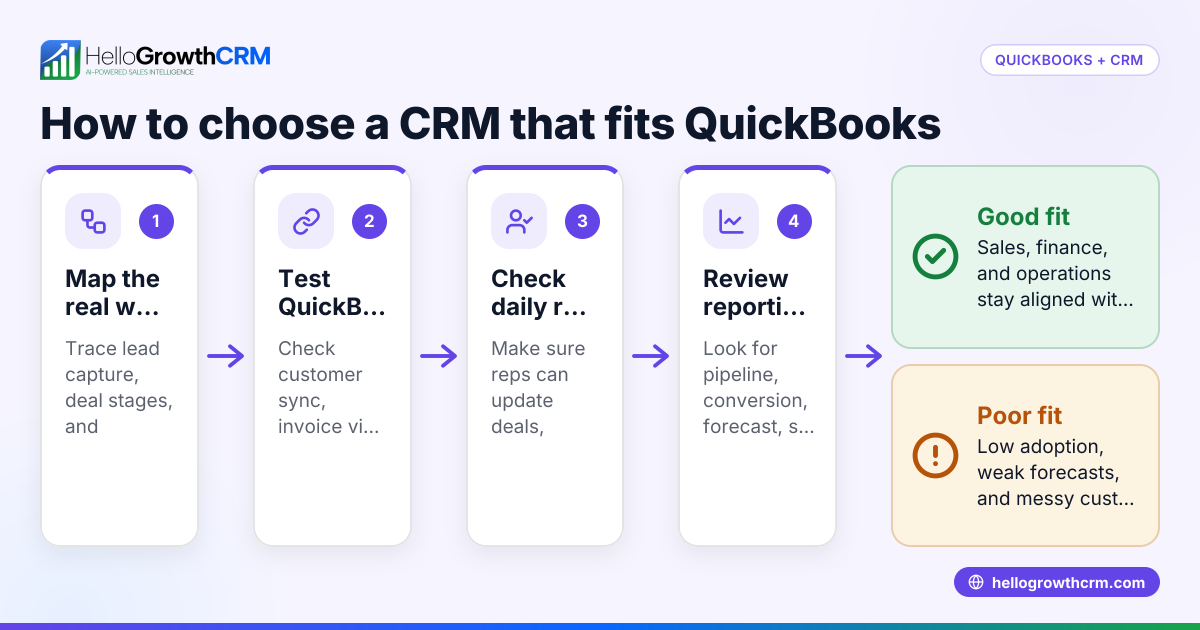
Use this process before you commit:
- Map your sales stages
Write down each stage from new lead to closed deal to billing handoff. - List must-have data fields
Keep this tight. Industry, company size, lead source, deal value, close date, and owner are enough to start. - Define QuickBooks and Stripe touchpoints
Decide when finance needs information and what sales should see inside the CRM. - Test with five real opportunities
Do not rely on a demo alone. See how the CRM handles your actual sales motion. - Check follow-up speed
Can a rep log a note, send an email, assign a task, and update a stage in under two minutes? - Review reporting
Make sure the owner can quickly see pipeline health and expected revenue. - Plan onboarding
A CRM rollout fails when no one owns setup, cleanup, and process enforcement.
For many small businesses, this last point is the hardest. You may know what you want, but not have the time to build and maintain it. That is where managed RevOps can help if you need both software and hands-on support.
Why HelloGrowthCRM fits this use case
HelloGrowthCRM is built for growing B2B sales teams that need a CRM people actually use. For a Delaware small-business owner using QuickBooks and Stripe, that means one place to manage leads, pipeline, outreach, automation, and reporting without adding more overhead.
It helps with:
- lead capture
- AI lead scoring
- pipeline management
- email, calling, and WhatsApp activity
- automation
- forecasting and reporting
It is especially useful if you want a system that supports sales execution, not just contact storage. You can review the core features if you want to compare it to your current setup.
The real question is not whether a CRM has enough features. The real question is whether it helps your business close deals faster and operate with less friction.
How Delaware owners can make CRM adoption stick
The biggest CRM problem is not software. It is adoption. If your team does not update the system, the reports become useless. Then the owner stops trusting the CRM.
To avoid that, keep the process simple:
- Require only the fields people actually need.
- Make next step and close date mandatory for every open deal.
- Review pipeline in the CRM every week.
- Tie coaching and accountability to what is in the system.
- Clean data monthly.
For a small business in Delaware, this can be the difference between a CRM that helps growth and one that becomes shelfware.
If your sales cycle is fast, simplicity matters even more. If your deals are longer and involve proposals, contracts, or repeat billing, consistency matters most. Either way, the CRM should reduce confusion, not add to it.
A good system gives the owner better visibility into revenue, team activity, and customer status. That makes it easier to grow without relying on memory, sticky notes, and inbox searches.
If you want to see whether HelloGrowthCRM fits your Delaware sales process, start a free trial or book a demo.
Frequently asked questions
Ready to put this into practice?
Set up your pipeline, WhatsApp follow-ups, and AI lead scoring in minutes — free, no credit card.
Try HelloGrowthCRM freeGet CRM tips in your inbox
Join thousands of sales professionals who get weekly insights on CRM strategy, AI automation, and pipeline optimization.

The HelloGrowthCRM team publishes guides on CRM strategy, AI sales tools, and revenue operations for small business sales teams.