HelloGrowthCRM software
Built for real small-business sales teams
HelloGrowthCRM helps reps qualify faster, follow up on time, and close more deals—with practical automation in one place.
- AI lead scoring and pipeline visibility
- Built-in dialer, WhatsApp, and email automation
- Sales forecasting and RevOps-ready reporting
The best CRM with AI lead scoring and automation helps small and mid-sized US businesses prioritize leads and automate follow-ups to boost sales efficiency. This article guides you through why you need AI in your CRM, step-by-step evaluation, a practical example, common pitfalls to avoid, and how HelloGrowthCRM supports these features.
Why this comes up / what goes wrong
Small-business owners and sales leaders often lose leads or waste time chasing low-potential prospects because their sales processes rely on manual follow-up via text, email, and spreadsheets. Without AI lead scoring, sales reps may call leads in the wrong order, reducing conversion rates. Without automation, the team risks slow follow-up, missed tasks, and inconsistent communication. Choosing the best CRM with AI lead scoring and automation can fix these issues by prioritizing leads and automating repetitive tasks, but small businesses need to evaluate options carefully to find a system that fits their team size, sales process, and budget.
Step-by-step
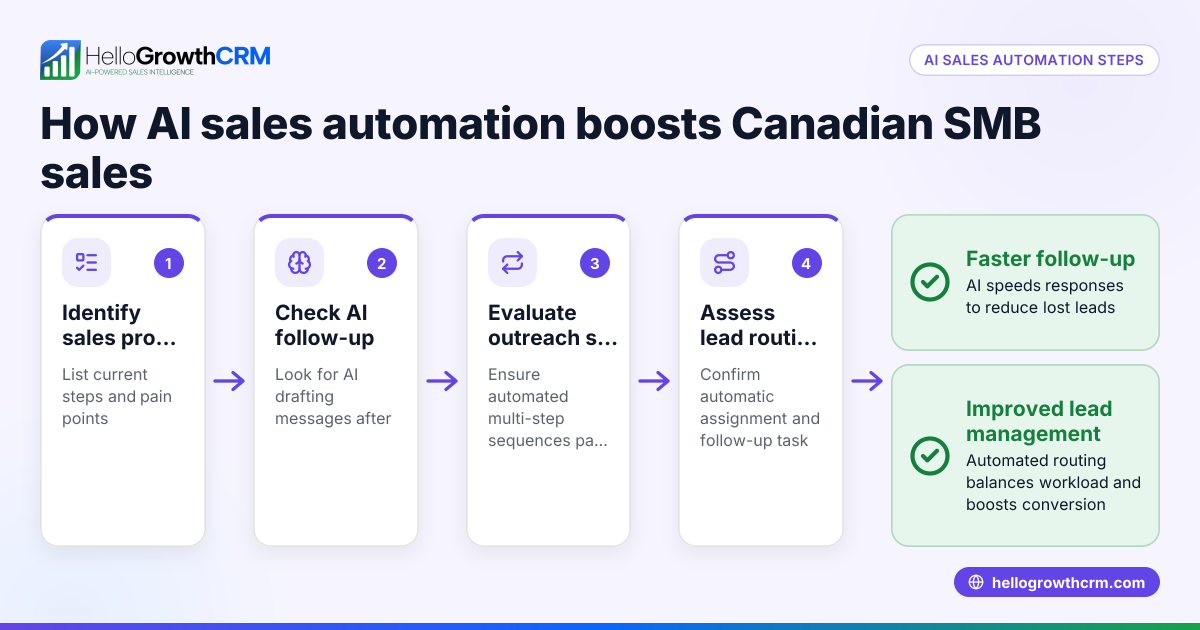
- Identify your sales process and pain points: List where leads come from, how your team follows up, and current bottlenecks like slow response or lost leads.
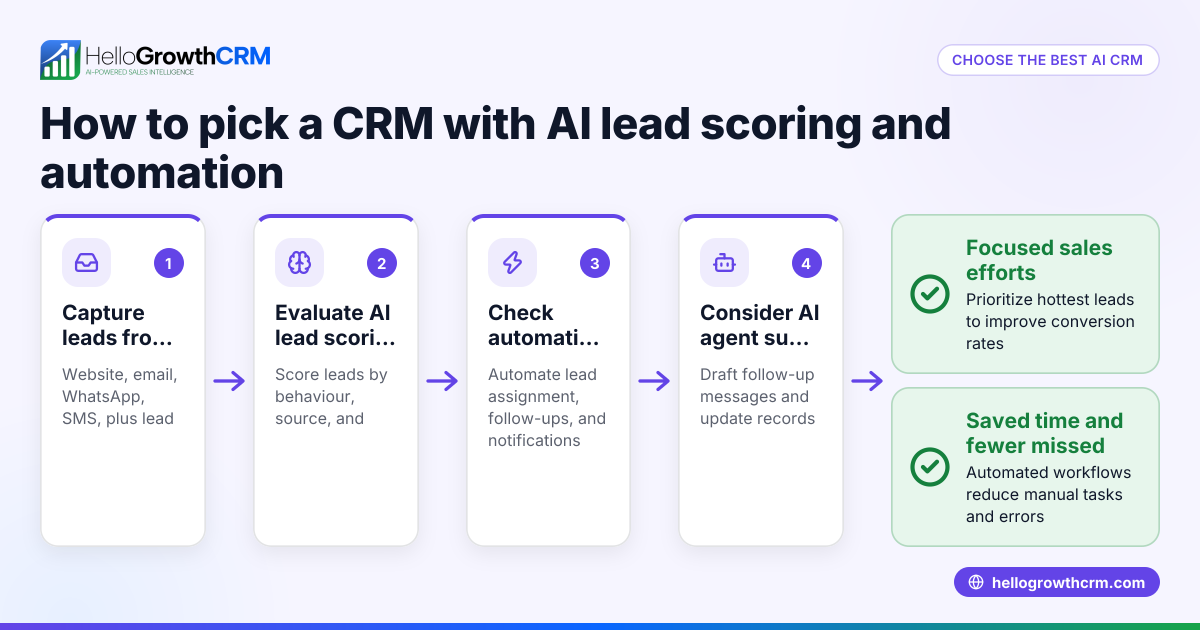
- Check AI lead scoring capabilities: Ensure the CRM uses AI to rank leads based on likelihood to convert, so reps call the hottest leads first. Ask if the scoring updates dynamically as new data arrives.
- Assess automation features: Look for workflow builders that automate lead assignment, task creation, and follow-up messages without manual input.
- Evaluate communication channels: Confirm the CRM supports your main channels—email, SMS, WhatsApp—and automates sequences across them.
- Test user experience and adoption: The CRM should be easy for your sales team to use daily, with AI agents that assist rather than complicate their work.
- Consider integration and lead capture: Verify the CRM can capture leads from your web forms and integrate with your existing tools.
- Review reporting and forecasting: Check if the CRM provides sales forecasts and reports to track the impact of AI scoring and automation.
- Trial and compare pricing: Use free trials or demos to see the AI lead scoring and automation in action. Compare plans based on features and scalability.
- Ask about support and updates: AI features evolve quickly, so ensure your CRM provider offers ongoing support and improvements.
Example (fictional figures)
A residential real-estate team in Phoenix, Arizona, receives 1,000 leads monthly from web forms and referrals. They want to use AI lead scoring to prioritize calls and automate follow-ups.
- Total monthly leads: 1,000
- Average conversion rate without AI: 5% = 50 sales
- Average sale value: $350,000
They implement a CRM with AI lead scoring and automation:
- AI lead scoring helps telecallers call the top 200 leads first, increasing conversion rate on those to 12% = 24 sales
- Automation reduces follow-up delays, boosting overall conversion rate to 7% = 70 sales
Calculations:
Without AI: 1,000 leads × 5% = 50 sales 50 sales × $350,000 = $17,500,000 total sales
With AI lead scoring (top leads): 200 leads × 12% = 24 sales
With automation increasing overall conversion: 1,000 leads × 7% = 70 sales
Sales increase: 70 sales − 50 sales = 20 additional sales 20 additional sales × $350,000 = $7,000,000 more in sales
This example shows how AI lead scoring and automation can significantly improve sales outcomes.
Common mistakes
- Ignoring team adoption challenges: Prevent this by choosing a CRM with intuitive AI agents that draft follow-ups for reps to review rather than forcing complex workflows.
- Overlooking integration needs: Avoid by confirming the CRM captures leads automatically from your web forms and integrates with your communication tools.
- Relying on static lead scoring: Prevent by selecting a CRM where AI lead scoring updates dynamically as new data arrives.
- Not testing automation workflows before full rollout: Avoid by piloting workflows with a small team to fix issues early.
- Neglecting multi-channel communication: Prevent by ensuring the CRM supports WhatsApp, SMS, and email sequences to reach leads on their preferred platforms.
- Failing to track ROI on AI and automation: Avoid by using CRM reporting and forecasting features to monitor sales impact.
Doing this in HelloGrowthCRM
HelloGrowthCRM offers AI lead scoring that helps telecallers call the leads most likely to convert first. Its workflows, lead routing, and validation rules automate lead assignment and task creation, such as assigning a new enquiry round-robin and automatically creating a first-call task. Additionally, AI agents draft follow-up messages after calls so reps only need to review and send them. These features work together to prioritize leads and automate sales processes efficiently. Learn more about AI lead scoring and the AI CRM capabilities. See how HelloGrowthCRM fits for the United States.
Frequently asked questions
What is AI lead scoring in a CRM? AI lead scoring uses artificial intelligence to analyze lead data and predict which leads are most likely to convert. It helps sales teams prioritize calls and follow-ups to improve efficiency.
How does automation improve sales follow-up? Automation creates tasks, sends messages, and assigns leads without manual work, reducing delays and ensuring consistent communication with prospects.
Can AI lead scoring adapt to my business? Good AI lead scoring updates dynamically as new lead data arrives, adapting to changes in lead behavior and improving over time.
What communication channels should a CRM support? For small and mid-sized US businesses, a CRM should support email, SMS, and WhatsApp to cover the most common ways customers prefer to be contacted.
How do AI agents help sales reps? AI agents can draft follow-up messages and update records automatically, saving reps time and reducing administrative burden.
Is it hard to switch to a CRM with AI features? Switching requires planning and training, but choosing a CRM with intuitive AI features and good support can ease adoption.
Key takeaways
- The best CRM with AI lead scoring helps prioritize leads based on conversion likelihood.
- Automation streamlines follow-ups, lead assignment, and task creation.
- Evaluate CRMs for dynamic AI scoring, multi-channel communication, and ease of use.
- Avoid common mistakes like poor team adoption and neglecting integration.
- HelloGrowthCRM offers AI lead scoring, workflows, and AI agents to support small business sales teams.
Choosing the right CRM with AI lead scoring and automation can transform your sales process and increase conversions. To explore options tailored to US small businesses, see US pricing.
Ready to put this into practice?
Set up your pipeline, WhatsApp follow-ups, and AI lead scoring in minutes — free, no credit card.
Try HelloGrowthCRM freeGet CRM tips in your inbox
Join thousands of sales professionals who get weekly insights on CRM strategy, AI automation, and pipeline optimization.

The HelloGrowthCRM team publishes guides on CRM strategy, AI sales tools, and revenue operations for small business sales teams.