HelloGrowthCRM software
Built for real small-business sales teams
HelloGrowthCRM helps reps qualify faster, follow up on time, and close more deals—with practical automation in one place.
- AI lead scoring and pipeline visibility
- Built-in dialer, WhatsApp, and email automation
- Sales forecasting and RevOps-ready reporting
A call center agent performance improvement plan (PIP) is a formal, structured approach to help agents who are not meeting performance expectations. It sets clear, measurable goals, provides resources and coaching, monitors progress regularly, and documents everything to ensure improvement or make informed decisions.
Why this comes up / what goes wrong
Small-business owners running call centers or sales teams often face challenges with agent performance. Agents may struggle with handling call volume, following up on leads promptly, or converting contacts into customers. These issues can cause lost revenue, poor customer experience, and frustration among managers and the team. Without a clear plan, underperformance can persist unnoticed or unaddressed, harming business outcomes. A performance improvement plan provides a focused path to help agents improve while protecting the business.
Step-by-step
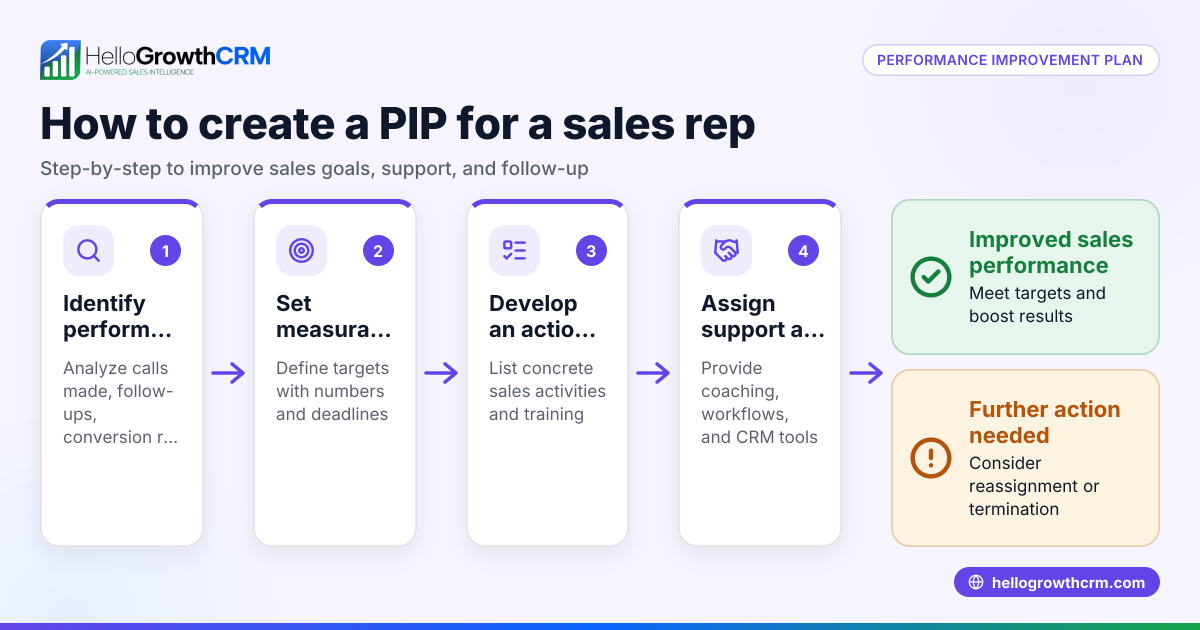
- Identify Performance Issues: Start by reviewing key performance indicators (KPIs) such as number of calls made, average handle time, conversion rates, and customer satisfaction scores. Pinpoint specific areas where the agent is underperforming.
- Set Clear, Measurable Goals: Define specific targets for improvement. For example, increase calls handled per day by 20%, reduce average call duration by 30 seconds, or improve conversion rate by 10% within 30 days.
- Develop an Action Plan: Outline concrete steps the agent should take, such as attending training sessions, shadowing experienced agents, or using updated call scripts to handle objections.
- Provide Support and Resources: Ensure the agent has access to coaching, updated CRM tools, and any materials needed to improve skills. Offer regular feedback and encouragement.
- Monitor Progress Regularly: Schedule weekly check-ins to discuss progress, review call outcomes, and adjust the plan if necessary. Use CRM tools to track calls and outcomes automatically.
- Document Everything: Keep detailed records of goals, actions taken, feedback given, and progress made. This transparency helps accountability.
- Evaluate Results After the Plan Period: At the end of the defined period (typically 30 to 90 days), assess whether the agent has met the goals. Decide if further action, such as additional training or reassignment, is needed.
Using tools like the built-in CRM dialer can simplify monitoring by logging call outcomes automatically. AI features can also help draft follow-up messages to maintain consistent communication.
Example (fictional figures)
A two-location dental practice in Columbus, Ohio, employs three call center agents. One agent, John, handles appointment scheduling but has a low call-to-appointment conversion rate of 15%, compared to the team's average of 30%. The practice sets a 60-day improvement plan.
- Current conversion rate: 15%
- Target conversion rate: 30%
- Daily calls handled: 50
- Current appointments booked per day: 50 × 15% = 7.5
- Target appointments booked per day: 50 × 30% = 15
Action Plan:
- John attends weekly customer engagement training.
- Uses updated call scripts for common objections.
- Manager reviews call outcomes weekly and provides feedback.
Progress after 30 days:
- Conversion rate improves to 22%
- Appointments booked per day: 50 × 22% = 11
Progress after 60 days:
- Conversion rate reaches 30%
- Appointments booked per day: 50 × 30% = 15
John meets the goal, and the practice concludes the plan successfully.
Common mistakes
- Setting vague goals: Avoid unclear or general targets. Make goals specific and measurable to track progress effectively.
- Lack of regular follow-up: Prevent this by scheduling consistent progress reviews, ideally weekly, to keep the agent on track.
- Ignoring agent feedback: Engage agents in the process to understand their challenges and adjust the plan accordingly.
- Failing to provide training or resources: Ensure agents have access to coaching, updated scripts, and CRM tools that support their work.
- Not documenting the process: Keep detailed records of goals, actions, and outcomes to maintain accountability.
- Overlooking technology tools: Use CRM features like the AI CRM to automate follow-ups and save time, ensuring consistent communication.
Doing this in HelloGrowthCRM
HelloGrowthCRM offers features that support managing call center agent performance effectively. The built-in dialer lets agents call leads directly from the CRM and logs call outcomes automatically, simplifying performance tracking. Its AI agents can draft follow-up messages after calls so reps only need to review and send, saving time and ensuring consistent communication. For small teams, the Free Forever plan allows managing pipelines with up to 200 leads at no cost, making it easy to start improving agent workflows without upfront investment. Learn more about HelloGrowthCRM for the United States at hellogrowthcrm.com/usa.
Frequently asked questions
What should be included in a call center agent performance improvement plan? A good plan includes clear identification of performance issues, measurable goals, a detailed action plan with training or resources, regular progress reviews, and thorough documentation of all steps.
How long does a performance improvement plan usually last? Typically, a PIP lasts between 30 and 90 days, depending on the complexity of the issues and the goals set. This timeframe allows enough time to observe measurable improvements.
Can technology help improve call center agent performance? Yes, CRM tools with built-in dialers and AI features can streamline calling, automate follow-ups, and provide managers with data to guide coaching and decisions.
What happens if an agent doesn’t improve after the plan? If goals are not met by the end of the plan, businesses may need to consider additional training, reassignment, or other HR actions based on company policies.
How often should I review an agent’s performance during the plan? Weekly check-ins are recommended to provide timely feedback, address challenges, and adjust the plan as needed.
Key takeaways
- Identify specific performance issues using clear, measurable metrics.
- Set measurable, time-bound goals to guide improvement.
- Provide targeted training, coaching, and resources to agents.
- Use CRM tools like the built-in dialer and AI CRM to support agents and track progress.
- Monitor progress regularly and document every step for accountability.
- Engage agents in the process to improve buy-in and results.
Start improving your call center agent performance today by managing your pipeline and tasks with HelloGrowthCRM’s Free Forever plan. You can start on the Free Forever plan (200 leads, no credit card) to organize your team’s work and track progress efficiently.
Ready to put this into practice?
Set up your pipeline, WhatsApp follow-ups, and AI lead scoring in minutes — free, no credit card.
Try HelloGrowthCRM freeGet CRM tips in your inbox
Join thousands of sales professionals who get weekly insights on CRM strategy, AI automation, and pipeline optimization.

The HelloGrowthCRM team publishes guides on CRM strategy, AI sales tools, and revenue operations for small business sales teams.