HelloGrowthCRM software
Built for real small-business sales teams
HelloGrowthCRM helps reps qualify faster, follow up on time, and close more deals—with practical automation in one place.
- AI lead scoring and pipeline visibility
- Built-in dialer, WhatsApp, and email automation
- Sales forecasting and RevOps-ready reporting
A campaign template is a structured plan that guides your sales or marketing outreach, including the timing and content of messages sent to prospects or customers. It ensures consistent follow-up and helps you manage leads effectively.
Why this comes up / what goes wrong
Small business owners often search for a campaign template when they want to streamline their outreach but don’t know where to start. Many run campaigns manually using WhatsApp, email, or spreadsheets, which leads to slow follow-ups and lost leads. Without a clear template, messages can be inconsistent, poorly timed, or irrelevant, resulting in low response rates. A ready-to-use campaign template helps by providing a clear format and schedule for contacting prospects, improving chances of engagement.
Step-by-step
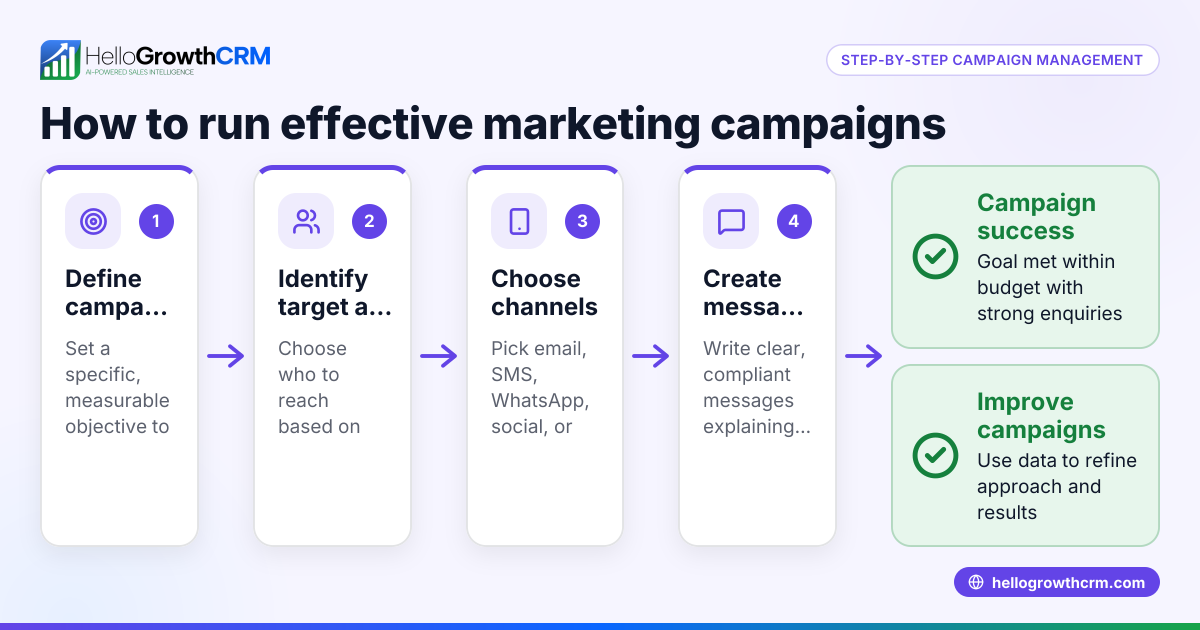
- Define your campaign goal: Decide what you want to achieve, such as booking meetings, promoting a new service, or re-engaging inactive leads. Check that your goal is clear and measurable.
- Segment your audience: Group your leads by relevant criteria like industry, location, or previous engagement. This ensures your messages are targeted and relevant.
- Create message content: Write short, clear messages for each step in your campaign. Each message should have one purpose and a clear call to action. Check for spelling and tone appropriate to your audience.
- Set the sequence schedule: Plan when each message will be sent, typically over 1-2 weeks. For example, send an initial message, a reminder after 3 days, a follow-up after 7 days, and a final check-in on day 14. Ensure the timing is not too frequent to avoid annoying prospects.
- Prepare tracking and follow-up rules: Decide how you will record responses and stop the campaign once a prospect replies. Check your system can pause or remove contacts automatically.
- Test your campaign: Run the sequence with a small group or internally to check message delivery, timing, and links. Adjust based on feedback.
- Launch and monitor: Start your campaign and track responses daily. Be ready to respond quickly when prospects engage.
For downloadable follow-up cadence or pipeline templates, see our free sales tools and calculators.
Example (fictional figures)
A recruitment consultancy in Bristol plans a campaign to book discovery calls with HR managers. They want to send five messages over two weeks starting 01/05/2026.
- Goal: Book 10 discovery calls.
- Audience: 100 HR managers in Bristol.
Message schedule:
- Day 1 (01/05/2026): Initial message offering a free consultation.
- Day 4 (04/05/2026): Reminder with a case study link.
- Day 7 (07/05/2026): Follow-up with client testimonial.
- Day 10 (10/05/2026): Offer to answer questions.
- Day 14 (14/05/2026): Final check-in with a limited offer.
Costs:
- Staff time per message: £20 per hour, 10 minutes per message per lead.
- Total time per lead: 5 messages × 10 minutes = 50 minutes = 0.83 hours.
- Cost per lead: 0.83 hours × £20 = £16.60.
- Total cost for 100 leads: £16.60 × 100 = £1,660.
If 10 discovery calls are booked, and each call leads to an average contract of £5,000:
- Revenue: 10 × £5,000 = £50,000.
- Profit before other costs: £50,000 − £1,660 = £48,340.
This example shows how a clear campaign template helps estimate costs and returns.
Common mistakes
- Sending messages too frequently: This can annoy prospects. Prevent by setting at least 2-3 days between messages.
- Using generic content for all leads: Irrelevant messages reduce engagement. Prevent by segmenting your audience and personalising messages.
- Not tracking responses properly: Leads may get multiple messages after replying. Prevent by using a system that stops follow-up when a reply is received.
- Skipping testing: Errors in links or timing can harm your campaign. Prevent by testing with a small group before launch.
- Ignoring follow-up after the campaign: Leads who reply need quick personal responses. Prevent by assigning team members to respond promptly.
For guidance on templates that help avoid these mistakes, check our sales templates.
Doing this in HelloGrowthCRM
HelloGrowthCRM offers sequences and campaigns that automate your outreach. A five-step follow-up over two weeks runs on its own and stops the moment the prospect replies, ensuring timely and relevant contact. You can also download free sales tools, templates and calculators, including follow-up cadence and pipeline templates, without needing an account. Visit our free sales tools and calculators to get started.
Frequently asked questions
What is a campaign template used for? A campaign template structures your outreach to prospects or customers, defining message content, timing, and follow-up steps. It helps maintain consistency and improves response rates.
How do I create a campaign template for my small business? Start by defining your goal, segmenting your audience, writing clear messages, scheduling the sequence, and setting tracking rules. Test your template before launching to catch errors.
Can I automate campaigns with WhatsApp and email? Yes, using tools like HelloGrowthCRM, you can automate multi-step campaigns across WhatsApp, email, and SMS, which saves time and stops follow-up once a prospect replies.
Where can I find free campaign templates? You can download free sales templates and follow-up cadence templates from HelloGrowthCRM’s free sales tools and calculators without signing up.
How long should a campaign run? Typically, 1-2 weeks with 4-5 messages spaced 2-4 days apart works well to keep prospects engaged without overwhelming them.
Key takeaways
- A campaign template organises your outreach into clear, timed steps.
- Segmenting your audience and personalising messages improves engagement.
- Automate follow-ups to save time and stop once a prospect replies.
- Test your campaign before launch to avoid errors.
- Use free sales templates and calculators to build your campaign plan.
Start your campaign planning with HelloGrowthCRM’s free tools and see how automation can help streamline your sales process. Start on the Free Forever plan (200 leads, no credit card).
Ready to put this into practice?
Set up your pipeline, WhatsApp follow-ups, and AI lead scoring in minutes — free, no credit card.
Try HelloGrowthCRM freeGet CRM tips in your inbox
Join thousands of sales professionals who get weekly insights on CRM strategy, AI automation, and pipeline optimization.

The HelloGrowthCRM team publishes guides on CRM strategy, AI sales tools, and revenue operations for small business sales teams.