HelloGrowthCRM software
Built for real small-business sales teams
HelloGrowthCRM helps reps qualify faster, follow up on time, and close more deals—with practical automation in one place.
- AI lead scoring and pipeline visibility
- Built-in dialer, WhatsApp, and email automation
- Sales forecasting and RevOps-ready reporting
Contact center QA (quality assurance) is the process of monitoring and evaluating customer interactions in a contact center to ensure service quality, compliance, and customer satisfaction. This article explains why contact center QA matters for small businesses, guides you through a step-by-step approach to set it up, shares a practical example, highlights common mistakes, and answers frequently asked questions.
Why this comes up / what goes wrong
Small-business owners with contact centers or customer support teams often face challenges like inconsistent service quality, slow response times, and lost leads. Without a formal QA process, it’s hard to know if your team follows best practices or if customers are satisfied. This leads to lost sales, negative reviews, and inefficiency. Many small businesses run sales and customer communications on text messages, email, and spreadsheets, which can make quality control tricky. Implementing contact center QA helps you catch issues early, coach your team effectively, and improve customer experience.
Step-by-step
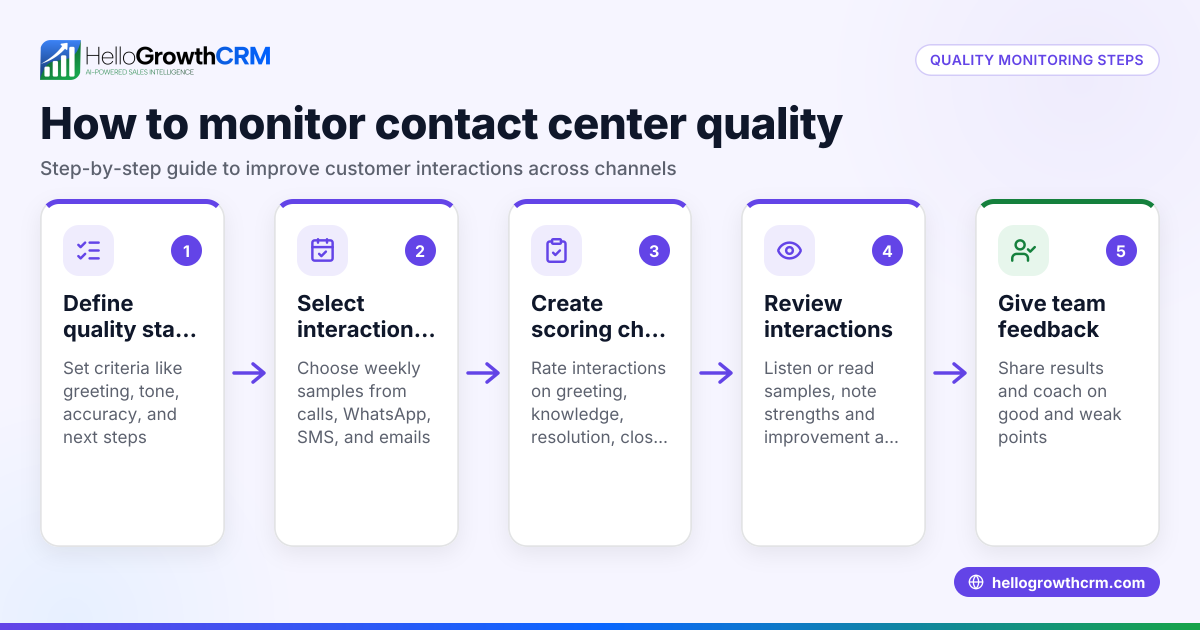
- Define quality standards: Decide what good customer service means for your business. Include tone, accuracy of information, response time, and compliance with policies.
- Select interactions to review: Choose a sample of calls, emails, or messages from WhatsApp or SMS to evaluate regularly. Random sampling ensures broad coverage.
- Create a scorecard: Develop a checklist or rubric to score each interaction against your quality standards. Include categories like greeting, problem resolution, and closing.
- Train QA evaluators: Assign team members or managers to review interactions using the scorecard. Ensure they understand the standards and scoring method.
- Conduct regular reviews: Schedule weekly or monthly QA sessions to assess interactions. Document scores and feedback for each agent.
- Provide feedback and coaching: Share results with agents promptly, highlighting strengths and areas for improvement. Offer training or role-playing exercises.
- Track trends and adjust: Analyze QA data over time to identify common issues or training needs. Update your standards and processes accordingly.
- Integrate tools for efficiency: Use CRM systems that support WhatsApp, SMS, and email communication to centralize interactions and make QA easier. For example, a WhatsApp and SMS CRM can streamline message tracking and review.
- Monitor lead follow-up speed: Ensure leads captured from web forms or other integrations are followed up quickly to avoid losing prospects. A CRM with a built-in dialer can help manage callbacks efficiently.
- Forecast and report on QA impact: Use sales forecasting and reporting features to see how QA improvements affect sales and customer retention.
Example (fictional figures)
A two-location dental practice in Columbus, Ohio, wants to improve its contact center QA. They receive about 500 patient inquiries monthly via phone and WhatsApp.
- They define quality standards focusing on greeting patients warmly, answering questions accurately, and booking appointments within 24 hours.
- They randomly select 50 interactions monthly for review.
- Using a scorecard, each interaction is scored out of 100.
- The average score last month was 75.
- After coaching, the average score improved to 85 the next month.
- Improved QA led to a 10% increase in booked appointments.
Calculations:
Initial average score = 75 Improved average score = 85 Improvement = 85 - 75 = 10 points
Monthly inquiries = 500 Increase in appointments = 500 × 10% = 50 appointments
If each appointment is worth $200 on average:
Additional revenue = 50 × $200 = $10,000
This shows how contact center QA can directly impact revenue by improving customer interactions.
Common mistakes
- Not defining clear quality standards: Leads to inconsistent evaluations. Prevent by documenting specific criteria.
- Reviewing too few interactions: Misses patterns and issues. Prevent by sampling enough interactions regularly.
- Delaying feedback to agents: Reduces coaching effectiveness. Prevent by providing timely, constructive feedback.
- Ignoring customer feedback: Misses real experience insights. Prevent by including customer surveys or reviews in QA.
- Using multiple disconnected tools: Makes tracking and QA harder. Prevent by adopting a centralized CRM that supports WhatsApp, SMS, and email communications, like HelloGrowthCRM’s WhatsApp and SMS CRM (/product/whatsapp-sms-crm).
- Failing to track follow-up speed: Causes lost leads. Prevent by using tools with built-in dialers to manage callbacks efficiently (/product/crm-dialer).
Frequently asked questions
What is contact center QA? Contact center QA is the process of assessing customer interactions to ensure they meet company standards for quality, compliance, and customer satisfaction. It helps improve service and sales outcomes.
How often should I review contact center interactions? Review frequency depends on call volume and team size but typically ranges from weekly to monthly. Regular reviews help catch issues early and track improvement.
Can I do contact center QA without special software? Yes, you can use spreadsheets and manual call listening, but it’s more efficient to use CRM tools that centralize communication channels like WhatsApp and SMS to streamline QA and lead follow-up.
How do I give effective feedback after QA? Be specific about what was done well and what needs improvement. Use examples from the interaction and offer actionable coaching tips.
What role does a CRM play in contact center QA? A CRM consolidates customer interactions across channels, making it easier to review conversations, track leads, and measure QA outcomes. For example, HelloGrowthCRM offers WhatsApp and SMS CRM (/product/whatsapp-sms-crm) and a built-in CRM dialer (/product/crm-dialer) that support efficient QA processes.
How can QA improve sales forecasting? By improving interaction quality and lead follow-up, QA increases conversion rates and customer retention, making sales forecasts more accurate and reliable.
Key takeaways
- Contact center QA monitors and improves customer interactions to boost service and sales.
- Define clear quality standards and use a scorecard for consistent evaluations.
- Regularly review a representative sample of interactions and provide timely feedback.
- Use centralized CRM tools that support WhatsApp, SMS, and email to streamline QA and lead management.
- Avoid common mistakes like unclear standards, infrequent reviews, and disconnected tools.
- QA improvements can directly increase revenue and improve sales forecasting.
Start improving your contact center quality today. Start on the Free Forever plan (200 leads, no credit card).
Ready to put this into practice?
Set up your pipeline, WhatsApp follow-ups, and AI lead scoring in minutes — free, no credit card.
Try HelloGrowthCRM freeGet CRM tips in your inbox
Join thousands of sales professionals who get weekly insights on CRM strategy, AI automation, and pipeline optimization.

The HelloGrowthCRM team publishes guides on CRM strategy, AI sales tools, and revenue operations for small business sales teams.