HelloGrowthCRM software
Built for real small-business sales teams
HelloGrowthCRM helps reps qualify faster, follow up on time, and close more deals—with practical automation in one place.
- AI lead scoring and pipeline visibility
- Built-in dialer, WhatsApp, and email automation
- Sales forecasting and RevOps-ready reporting
In Singapore, the right way to compare CRMs is to test whether each system can handle PDPA-sensitive data collection, local payment and invoicing habits, GST timing, and the channels your leads actually use.
That is a different exercise from reading a generic feature grid. A tuition centre in Tampines, an air-conditioning firm in Jurong, and a dental practice in Novena may all want lead tracking and follow-up, but they do not face the same risks. One may rely on WhatsApp enquiries from Google Business Profile, another may need clean job records tied to FAST transfers, and a regulated clinic has to think hard about what staff can send and what must be retained. A useful comparison asks how the CRM will behave inside Singapore’s operating environment, not whether it has the longest list of buttons.
PDPA and Do Not Call checks belong near the top of your shortlist
If your team collects mobile numbers in Singapore, your CRM choice has a compliance dimension from day one. The Personal Data Protection Act, enforced by the Personal Data Protection Commission, matters not just for storage but for what you collect, how you use it, and what outreach you send. The Do Not Call provisions sit inside that framework. For specified marketing messages to Singapore numbers, the sender must check the relevant Do Not Call Registry unless an exception applies or the person has given clear and unambiguous consent. That duty sits with the sender, not with the software vendor.
So when you compare CRMs, do not ask only whether they can send WhatsApp, SMS or email. Ask whether your team can keep a usable record of consent, message purpose and source of enquiry against the contact record. A system that blasts messages is not helpful if your staff cannot later show why that person was contacted.
Singapore businesses should also pay attention to forms. PDPC guidance is clear that organisations should not collect NRIC numbers by default unless the law requires it or the collection is necessary. If a CRM’s forms or templates encourage your team to ask for NRIC on a basic booking or enquiry, that is not efficiency; it is risk with no clear operational gain. This matters in clinics, tuition centres and service businesses alike.
If a vendor talks vaguely about compliance, check the actual controls you will need: role access, a clean contact history, and a practical way to separate transactional from promotional outreach. For a broader starting point, a CRM comparison page can help narrow the field, but your shortlist should then be tested against PDPA and PDPC guidance rather than against generic sales copy.
GST timing affects what your CRM should record when money arrives
Many CRM comparisons ignore tax because finance files the returns. In Singapore, that can be a costly omission. GST is administered by IRAS, and the current rules, registration position and reporting guidance are published by IRAS under the Goods and Services Tax framework. If your business takes deposits, progress payments or advance booking fees, your CRM needs to capture the commercial event clearly enough for the tax position to be understood later.
One practical local point is easy to miss: for a taxable supply, receiving payment can matter at the earlier point rather than waiting for final completion, so a deposit counts on the day it arrives. That means a booking taken today for work next month is not just an operational note. It may affect what invoice was issued, what payment came in, and what finance needs to reconcile. The exact treatment depends on the facts and the current IRAS rules, so check the official IRAS guidance for the current position, and get advice if your transactions are unusual.
This is where CRM comparison becomes concrete. If your business issues quotes, collects a booking amount, then converts that into a final invoice after the job, can the system show that chain without staff exporting three spreadsheets? A service firm in Jurong taking a S$300 deposit for an air-conditioning installation and the balance after completion needs a record that ties quote, payment received and job status together. A CRM that treats money as an afterthought often forces manual reconstruction later.
IRAS also publishes the current GST registration rules and the taxable turnover test. Do not rely on any article, including this one, for the current registration position; check IRAS directly because the official figure and conditions are what matter.
PayNow, FAST and bank transfers reveal whether a CRM reflects real Singapore cash flow
Singapore customers do not all pay by card. Depending on your business, you may be paid through PayNow, SGQR, GIRO, FAST, NETS, credit card or a plain bank transfer. That matters because several of these rails do not show up in a card processor dashboard. If your front desk, field team or finance staff cannot record a transfer against the right customer and invoice quickly, your pipeline and revenue view will drift away from reality.
This is especially visible in small and mid-sized firms. A logistics broker near Changi may receive bank transfers from long-standing business customers. A tuition centre may collect via PayNow after a parent confirms a class slot on WhatsApp. A clinic may take a booking amount now and settle the rest in person. In each case, the CRM has to let staff attach that payment event to the correct record without creating duplicate contacts or leaving deals marked open after money has landed.
When you test systems, use your own payment habits rather than the vendor’s demo assumptions. If your team lives on bank transfers and SGQR, a beautiful card-payment flow is not the point. What matters is whether the CRM can support the manual reconciliation work your staff actually do. If you want tooling around quotes, invoices and payments received connected to deal records, compare that explicitly rather than assuming every CRM handles it the same way.
Google Business Profile, Carousell and WhatsApp should shape your capture rules
Lead source is where many Singapore businesses quietly lose time. Local enquiries often arrive from Google Business Profile, Carousell, WhatsApp, Instagram, Facebook, LinkedIn, referrals, and for some firms, GeBIZ if public sector work is relevant. Those sources do not produce the same kind of lead. Someone messaging from a Google listing for same-day aircon servicing is not at the same stage as a B2B prospect who came through LinkedIn after a proposal request.
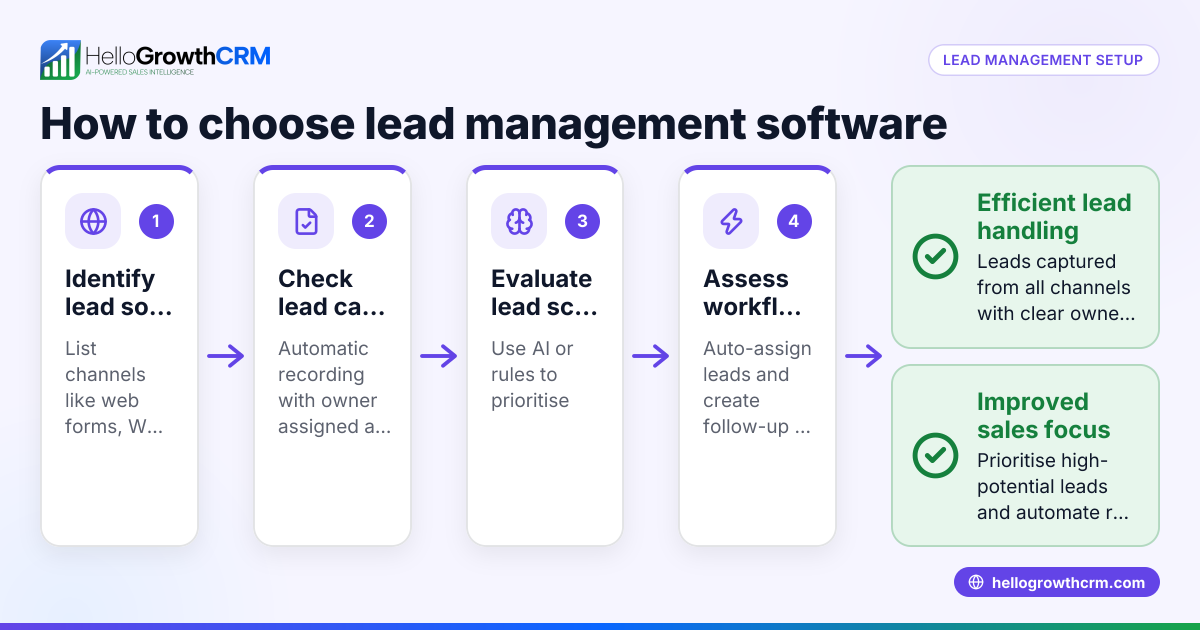
Your CRM comparison should therefore focus on intake discipline. Can the system capture the source, route the lead to the right person, and enter it into the right pipeline stage without staff free-typing everything? If not, reporting later will be cosmetic. You will know that “leads went up” but not whether Carousell brought price shoppers, whether Google Business Profile produced high-intent calls, or whether referrals closed faster.
Singapore also has language and segment realities. English is the working language, but some customer-facing flows need Mandarin or Malay to reduce drop-off in specific neighbourhoods or age groups. A heartland tuition centre may need forms and reminders phrased differently from a CBD B2B consultancy. That does not mean you need a complex multilingual platform; it means the CRM should not force one-size-fits-all capture and follow-up.
For public-sector selling, GeBIZ leads deserve their own handling because qualification, documentation and cycle length differ from inbound consumer enquiries. If a CRM cannot separate those paths cleanly, it will be hard to judge performance by source.
Scheduling gets exposed by public holidays, lunch peaks and mobile-first booking
Singapore has one time zone, which sounds simple until you look at actual demand patterns. Public holidays reflect several communities and some are based on lunar or Islamic calendars, so dates shift from year to year. Demand often clusters around lunch hour, after-work slots and Saturdays in a way that mid-morning does not. If you serve ASEAN clients, you may still need to coordinate across other time offsets even though your home base is on Singapore time.
This becomes a CRM comparison issue when booking is part of conversion. A dental practice in Novena and an aesthetic clinic in Orchard both need scheduling, but not in the same way. One may need short consultation slots with reminder discipline; the other may need a screening step before confirming a treatment discussion. A B2B logistics broker may simply need frictionless meeting booking for regional calls. The software should match the sales motion rather than forcing every enquiry into a generic calendar slot.
Look for whether a booking flow can respect staff availability, route by service or owner, and keep the meeting tied to the contact and deal history. Otherwise, sales and operations split apart: one system says “meeting booked”, another says “lead still open”, and no one trusts either. If scheduling is central to your funnel, compare it directly with a meeting scheduler test instead of treating it as a minor extra.
Regulated sectors in Singapore need cleaner records, not louder automation
Some Singapore businesses cannot judge a CRM mainly on speed. They need an audit trail. Healthcare-related organisations should review communications and marketing carefully because the Ministry of Health and relevant professional rules can constrain what may be advertised or sent. Dental and aesthetic practices in particular should not assume that a generic nurture sequence is acceptable just because the software can send it.
Here the buying question is narrower and more serious: can the CRM preserve a clear history of contact, notes, tasks and commercial documents so a manager can review what happened and why? That matters in regulated clinics, but it also matters in any business where handoffs are common. If a front-desk employee, a coordinator and a practitioner all touch the same customer, the record needs to make sense without relying on memory.
For companies dealing with government services, business setup or regulated filings, another local norm matters: Corppass and SingPass are how organisations and individuals authenticate with government services in Singapore. Your CRM does not replace those identity systems. If a vendor implies that customer records inside the CRM somehow stand in for official authentication, treat that as confusion, not convenience.
Security language should also be read carefully. If your shortlist includes tools that will hold personal data, review the vendor’s security materials and your own obligations under PDPA. A general overview such as security information is useful, but it is not a substitute for deciding what your staff collect and who can access it.
A worked Singapore comparison: two CRMs can cost the same and still produce different outcomes
The arithmetic below is illustrative; the figures are made up to show the shape of the decision.
Assume a tuition centre in Tampines handles about forty new enquiries a month. Average first payment per new student is S$480. The centre spends S$1,200 a month on ads and listing upgrades across Google and social channels. It is comparing CRM A and CRM B, both at roughly S$300 a month for the team.
CRM A has decent contact storage but no practical way to track WhatsApp-origin enquiries separately, and staff record PayNow receipts in a spreadsheet. CRM B routes enquiries by source, keeps tasks against each lead, and lets staff mark payments received against the record after finance confirms the transfer.
In one month, suppose five parents pay by PayNow but two of those payments are not matched promptly in CRM A. Staff keep chasing one parent who has already paid and fail to confirm another child’s place until late. One family drops. Lost first payment: S$480. Add one staff member spending four hours across the month reconciling messages and transfers at an internal cost estimate of S$120. Effective monthly drag: S$600.
Now suppose CRM B avoids that by keeping the enquiry, follow-up tasks and payment note in one place. Even if the subscription is the same, the comparison is no longer about licence cost. It is about whether local operating friction turns into lost revenue and avoidable admin.
This simple arithmetic leaves out several things: GST treatment, longer-term retention value, no-show rates, and the effect of holiday periods on class scheduling. But it shows why a Singapore CRM decision should be tested against actual payment and enquiry behaviour rather than abstract feature counts.
The best shortlist is built from live scenarios, not a giant spreadsheet
By the time you reach a final comparison, you should have no more than a few realistic options. The test is to run your own scenarios through each system. Use the channels and records your team actually handles in Singapore.
- Can a lead from Google Business Profile, Carousell or WhatsApp enter the right pipeline without manual cleanup?
- Can your team record whether an outreach message is promotional or transactional, and retain consent context where needed under PDPA?
- Can deposits, booking fees or bank transfers be tied back to the customer record clearly enough for finance and operations to agree on what happened?
- Can bookings be scheduled around local demand peaks, staff rosters and moving public-holiday dates?
- If your sector is regulated, does the contact and activity history read like a usable audit trail?
If you need a compact starting point, a free CRM option is useful for testing live data flow before a wider rollout. If your evaluation hinges on enquiry handling more than broad marketing features, the strongest product questions are usually around lead capture and qualification, pipeline discipline, and whether your team can keep follow-up work attached to the same record through tasks and notes.
Where HelloGrowthCRM fits in a Singapore-focused comparison
HelloGrowthCRM is worth considering if your priority is operational control from first enquiry through follow-up. Its lead capture, qualification and pipeline entry tools support getting new enquiries organised quickly; its pipeline management handles stage movement, probability and expected value; and its task boards keep calls, meetings, notes and handoffs tied to the same record. If your Singapore team relies heavily on mobile messaging, it also offers WhatsApp and SMS workflows, and if booking speed matters, it includes scheduling pages that shorten the path from interest to conversation. You can review these areas through the CRM product overview and the related product pages before deciding.
The right CRM for Singapore is the one that fits your consent rules, payment habits, lead sources and scheduling reality without forcing staff into side spreadsheets; HelloGrowthCRM should be judged on exactly that basis.
Ready to put this into practice?
Set up your pipeline, WhatsApp follow-ups, and AI lead scoring in minutes — free, no credit card.
Try HelloGrowthCRM freeGet CRM tips in your inbox
Join thousands of sales professionals who get weekly insights on CRM strategy, AI automation, and pipeline optimization.

The HelloGrowthCRM team publishes guides on CRM strategy, AI sales tools, and revenue operations for small business sales teams.