HelloGrowthCRM software
Built for real small-business sales teams
HelloGrowthCRM helps reps qualify faster, follow up on time, and close more deals—with practical automation in one place.
- AI lead scoring and pipeline visibility
- Built-in dialer, WhatsApp, and email automation
- Sales forecasting and RevOps-ready reporting
In Australia, a CRM for financial advisors should help you capture consent properly, keep ASIC-relevant records in one place, and run follow-up without creating privacy, spam or scheduling headaches.
The hard part is not finding software with a pipeline view. It is choosing a system that fits how advice businesses here actually operate: enquiries from referrals, LinkedIn and Google Business Profile; meetings across states with different daylight saving rules; fee documents that may include GST depending on the service; and compliance expectations around what was said, sent, agreed and reviewed. If the CRM cannot hold that operating reality together, advisers end up running client relationships from scattered inboxes, calendars and spreadsheets.
Advice records need to survive ASIC scrutiny, not just help you chase leads
Australian financial advice businesses have a record-keeping problem before they have a sales problem. A decent CRM needs to show a clean timeline of who contacted the firm, what service they asked for, what documents were sent, when meetings were booked, and what follow-up happened after that. That matters operationally, but it also matters because financial services businesses live under ASIC oversight and must be able to evidence their processes.
This is where generic contact managers often fall short. They store names and notes, but they do not make it easy to tie enquiries, meetings, tasks, document sends and deal stages into one readable history. For a practice principal, that creates two risks: poor handover between staff, and weak evidence if a complaint or file review asks how a prospect became a client and what they were told along the way.
When you assess a CRM, look at whether a contact record can carry the full journey from first enquiry to signed engagement. You want one place to see the source, service interest, adviser owner, meeting history, next action and internal notes. If a paraplanner or client service manager has to search across email folders and personal calendars to reconstruct a timeline, the system is not doing enough.
The Privacy Act and Spam Act shape how advisers should store and use prospect data
Financial advisors handle personal and often sensitive financial information, so Australia’s Privacy Act 1988 and the Australian Privacy Principles are central, not peripheral. The CRM you choose should support disciplined collection and use of data: clear fields for consent status, source of the enquiry, and why the practice is holding that information. The Office of the Australian Information Commissioner is the regulator to check for current guidance on APP obligations.
Marketing and follow-up also have their own legal frame. The Spam Act 2003 requires consent, sender identification and a functional unsubscribe for commercial electronic messages, and ACMA enforces it. For an advice practice, that means the system should let you distinguish between a warm referral who asked for a call, a webinar contact who opted into updates, and an old prospect who never gave usable permission for ongoing promotions.
A practical test is whether your CRM can separate service messages from marketing activity. A meeting reminder is one thing. A promotional newsletter about retirement planning is another. If staff cannot tell those apart inside the system, they will eventually send the wrong message to the wrong person.
Questions worth checking in a demo:
- Can you record when and how consent was obtained?
- Can marketing contacts be segmented away from service-only contacts?
- Can staff see the original lead source, such as referral, LinkedIn or Google Business Profile?
- Can notes, tasks and messages stay attached to one client or prospect record?
- Can the firm control who sees sensitive information inside the practice?
Australian lead sources reward fast triage, especially referrals and Google Business Profile
Many Australian advice firms do not rely on one lead channel. They pick up enquiries from referrals, LinkedIn, Google Business Profile and sometimes local partnerships with accountants, mortgage brokers or employers. These sources behave differently. A referral usually expects a prompt, high-context response. A Google enquiry may need faster qualification because the person could still be comparing multiple firms.
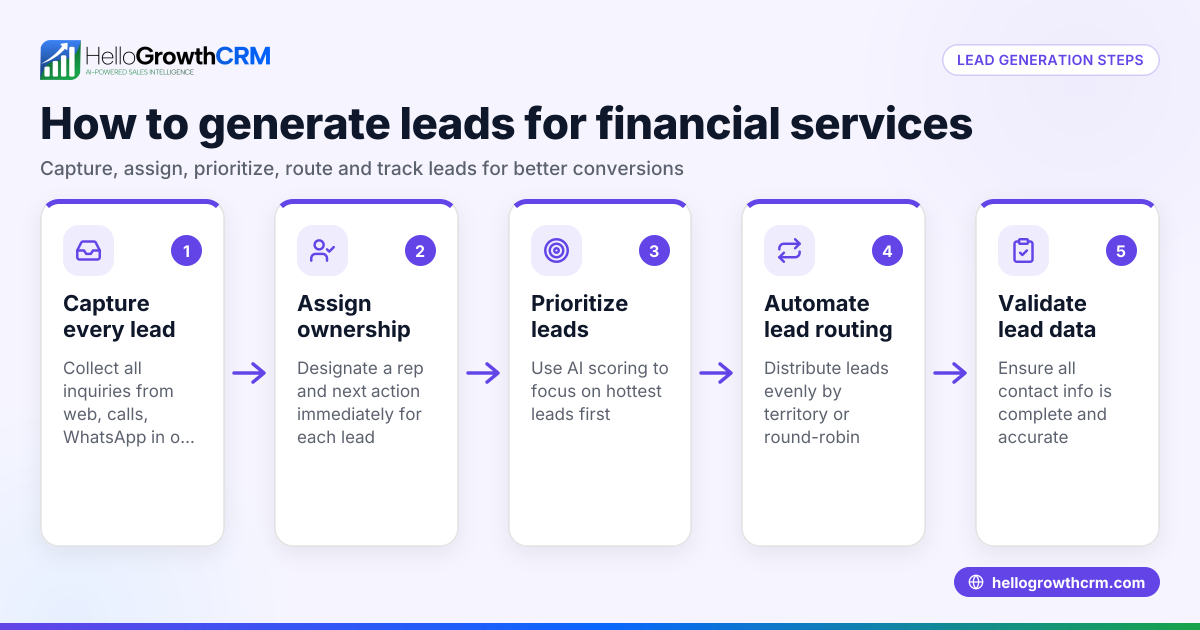
That is why lead capture and qualification matter more than a long feature checklist. If a new enquiry lands and sits unassigned until the next morning, the practice loses momentum. A useful setup gives each inbound lead a source field, an owner, a service category and an immediate next step. If the prospect wants insurance advice, superannuation review or retirement planning, those should not live as free-text notes only; they should drive routing and follow-up.
HelloGrowthCRM’s lead capture and qualification tools and pipeline management are relevant here because they keep new enquiries organised from first contact through close. The point is not automation for its own sake. It is making sure the practice can see which new matters need a call now, which need nurturing, and which are not a fit.
If your firm serves different adviser specialisations, routing rules matter even more. A business owner asking about succession planning should not drop into the same queue as a first-home buyer seeking a basic insurance conversation. A CRM that can validate fields and route work based on service type will save more time than one with a prettier dashboard.
Multi-state appointments are harder in Australia than most software demos admit
Australia’s geography creates scheduling friction that overseas software demos rarely show. Financial advisors may speak with clients in Sydney, Melbourne, Brisbane, Adelaide and Perth in the same week. Two Australian time zones are offset by half an hour, and daylight saving applies in some states and not others. On top of that, public holidays differ by state and territory, and some are regional rather than statewide.
That becomes a real CRM issue when advisers offer online booking. A client in Brisbane can be shown a time that looks normal to the adviser in Sydney but lands awkwardly once daylight saving shifts. If your system does not handle booking logic cleanly, staff end up fixing appointments manually and trust in the booking page drops.
Look for a CRM with booking pages that shorten the path from interest to conversation, but test it using real Australian scenarios: interstate appointments, state public holidays and adviser availability across office and work-from-home days. If your practice also does in-person meetings, long travel times between appointments are not a side issue; they are part of capacity planning. A CRM that ties scheduling to a clear task history helps the office spot when an adviser is fully committed before another review meeting is promised.
For firms that need this, meeting scheduling and booking should be checked using Australian locations and calendars before rollout, not after.
Fee agreements, GST and BAS timing affect what the CRM must capture
Not every CRM buying decision for advisors starts with tax, but in Australia your commercial records still need to match how the business invoices and reports. GST is administered by the ATO. Whether the practice is registered for GST turns on turnover, and the ATO publishes the current registration threshold. BAS reporting cycles also shape when the paperwork has to be right. If the CRM lets advisers send quotes, proposals or invoices, the firm needs those records to line up with how it actually reports and reconciles revenue.
An ABN is also part of ordinary business dealings in Australia, and withholding can apply where one is not quoted. That matters if the practice works with contractors or referral partners in arrangements where proper business details must be held. Even if your accounting system remains elsewhere, the CRM should capture the business identity details the office repeatedly needs.
The arithmetic below is illustrative; the figures are made up to show the shape of the decision. Imagine an advice practice wins a new annual service package at A$4,400 and a one-off strategic advice engagement at A$6,600 in the same month. It also invoices A$1,250 for a separate consulting piece to a business client. The office manager wants the CRM to show which amounts have been quoted, accepted, invoiced and marked as paid, while the finance team later checks GST treatment and BAS reporting in the proper system. What this leaves out is the detailed tax treatment of each service, trust accounting issues, and any product-specific compliance documents. The point is simpler: if the CRM cannot keep commercial documents and payment status attached to the client record, finance and advice teams will each maintain their own version of events.
For this reason, do not ask only whether the CRM can generate an invoice. Ask whether the accepted proposal, the related deal, the invoice status and the payment received can all be viewed from one record, so your staff are not reconciling client history by memory.
Australian payment rails create reconciliation work that a CRM should not hide
In Australia, clients may pay by direct debit, credit card, EFTPOS, BPAY or bank transfer using PayID or Osko. Those are normal rails, but they do not all behave the same from an operations perspective. PayID and BPAY payments arrive in the bank, so staff often need to record them against the correct client or invoice manually. If the CRM shows money as received without a disciplined matching step, you can end up with tidy screens and messy books.
This is especially relevant for advice firms that collect fixed fees, review fees or implementation fees outside a single standard payment method. The office should be able to see when a payment has been reported by the client, when it has actually landed, and who reconciled it against the record. That reduces awkward follow-up with clients who insist they already paid.
HelloGrowthCRM can be considered on this point because it supports quotes, proposals, invoices and payment reconciliation tied to invoice records. That is useful if you want the client-facing commercial trail attached to the deal, while still leaving final tax treatment and formal accounting processes to the finance stack.
Follow-up should fit Australia’s messaging habits without turning into spam
Australian prospects will often reply faster to SMS than to a long email, especially after a referral introduction or a website enquiry outside office hours. That makes multi-channel follow-up practical for advice firms, but only if the system reflects consent and message purpose. A CRM that blasts everyone with the same nurture sequence is a liability in a regulated, trust-based profession.
What tends to work better is a measured structure: immediate acknowledgement, prompt human contact, and then channel-specific follow-up based on the prospect’s last action. Someone who booked a consultation may need a confirmation and reminder. Someone who downloaded a guide may only be suitable for slower educational outreach. Someone referred by an existing client may need a direct call task for the adviser, not an automated campaign.
If your team wants this inside one system, sequences and shared inbox tools, plus mobile messaging workflows, can reduce channel switching. The benefit is not volume. It is keeping each message, response and next action attached to the prospect record so staff know what happened before they contact the person again.
Implementation matters more than the feature sheet for small advice firms
Many Australian advice practices are not large enough to carry a full internal operations team. The practical issue is not whether a CRM has sophisticated options; it is whether the firm can configure fields, pipeline stages, routing rules and tasks without the setup drifting into neglect after the first month.
For a small practice, the most useful rollout is narrow and disciplined. Start with the live path from enquiry to first meeting, then from engagement to fee document, then from active client to review cycle. Do not begin by trying to model every possible advice service and edge case. Build the minimum process that matches how the office already works well, then tighten it.
If you need to compare what is included before committing, the free CRM plan is a sensible way to test core usage with real enquiries, and managed RevOps support is relevant for firms that need help keeping lead follow-up and pipeline hygiene on track. The software should reduce admin drag, but the real gain comes from deciding which data the practice must capture every time and making that non-optional.
For an Australian financial advice business, the right CRM is the one that can hold compliant communication, local scheduling realities, commercial paperwork and disciplined follow-up in one working record. If HelloGrowthCRM fits your process, test it against those Australian conditions first, not against a generic demo script.
Ready to put this into practice?
Set up your pipeline, WhatsApp follow-ups, and AI lead scoring in minutes — free, no credit card.
Try HelloGrowthCRM freeGet CRM tips in your inbox
Join thousands of sales professionals who get weekly insights on CRM strategy, AI automation, and pipeline optimization.

The HelloGrowthCRM team publishes guides on CRM strategy, AI sales tools, and revenue operations for small business sales teams.