HelloGrowthCRM software
Built for real small-business sales teams
HelloGrowthCRM helps reps qualify faster, follow up on time, and close more deals—with practical automation in one place.
- AI lead scoring and pipeline visibility
- Built-in dialer, WhatsApp, and email automation
- Sales forecasting and RevOps-ready reporting
In the United States, a CRM for financial advisors should do more than hold contact details: it should preserve consent records, organize household relationships, track advice-related follow-up, and fit the state-by-state realities of marketing, privacy, scheduling, and payment collection.
That matters because advisory firms in the US do not operate under one simple national rulebook. Federal securities obligations sit alongside state privacy laws, TCPA rules for texts and calls, CAN-SPAM for email, and practical issues such as ACH, check, and wire payments that never show up neatly in a card dashboard. A good CRM choice is therefore less about having the longest feature list and more about whether the system helps your firm create a clean, reviewable operating record.
SEC and state examination pressure changes what “organized client data” really means
For a US financial advisor, the CRM is part of the books-and-records story, not just a sales database. If you are registered with the Securities and Exchange Commission, your recordkeeping duties arise under the Investment Advisers Act and the SEC’s rules. If you are state-registered, your state securities regulator may review similar operational evidence during an examination. In both cases, the issue is not whether the CRM is itself a legal archive; it is whether your firm can show a coherent history of interactions, requests, disclosures, and follow-up.
That pushes you toward a CRM structure that ties notes, tasks, meetings, and communications to the right household, entity, and opportunity. Advisors often need to show why a recommendation discussion happened, when a review was scheduled, who attended, and whether the next action was completed. A system that scatters those details across inboxes and personal calendars creates avoidable risk during a compliance review.
The practical test is simple: if a regulator, chief compliance officer, or outside consultant asks how a prospect became a client and what happened between first inquiry and signed paperwork, can your team reconstruct the path quickly from one place? If the answer depends on searching email, asking staff, and opening several calendars, the CRM is not doing enough for a US advisory business.
TCPA, CAN-SPAM, and state privacy laws make consent history a core requirement
The United States has no single federal privacy baseline that solves this for every advisory firm. Instead, your communications approach is shaped by the Telephone Consumer Protection Act for calls and texts, CAN-SPAM for commercial email, the Federal Trade Commission’s enforcement role, state attorneys general, and in California the California Consumer Privacy Agency under CCPA and CPRA. Other states have their own privacy statutes, and the obligations vary.
For financial advisors, that means the CRM should record how a lead arrived, what they agreed to receive, and when that consent was captured. Under the TCPA, consent evidence is not merely a marketing preference; it can become a litigation issue because the law includes a private right of action. A lead record that says “interested” is weak. A record that shows the web form source, time stamp, opt-in wording version, and later unsubscribe or do-not-call instruction is far more defensible.
CAN-SPAM adds another operational demand: your email process needs a working opt-out and a way to stop future promotional mailings. If the CRM cannot separate service communications from marketing outreach, staff may keep contacting people who already opted out. That is not just untidy. It can become a compliance problem.
For firms serving retirees, physicians, business owners, or families, it is also worth asking whether any workflow touches health-related information. HIPAA does not apply to every advisor, but where protected health information is involved, vendor agreements and data handling standards change materially. Your CRM selection should therefore be checked against your actual data, not your assumptions about the industry.
US lead sources reward speed, but only if the CRM preserves source quality
Many advisory firms in the United States attract inquiries through Google Business Profile, LinkedIn, Facebook, Yelp, referrals from attorneys or accountants, and local networking. Some also use seminar registrations, landing pages, or niche directories. These sources do not produce leads of equal quality, and a CRM should help you see that difference without forcing staff to improvise tags.
A useful setup captures original source, campaign or referral partner, location, service interest, and any early qualification notes. That lets you distinguish a referral from an estate-planning lawyer from a casual social inquiry, and it helps management decide where response time matters most. Fast triage is important, but source integrity matters just as much. If every new contact lands in one undifferentiated bucket, you lose the context needed to prioritize the right households.
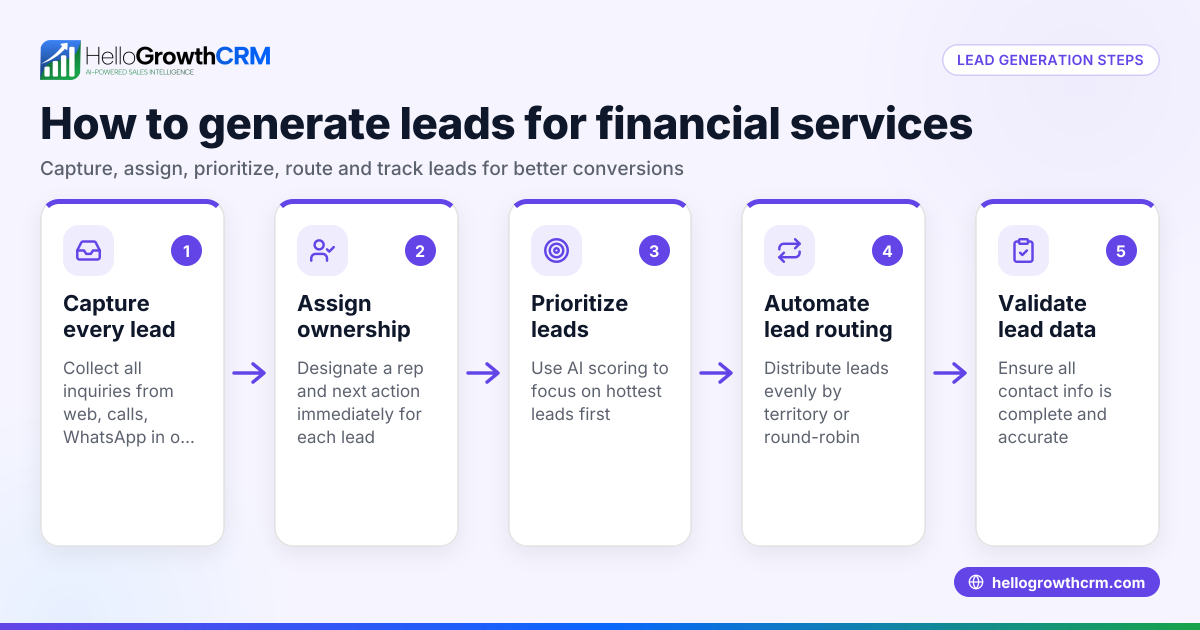
This is where automation can help if it is used carefully. HelloGrowthCRM includes lead capture and AI lead scoring, which can help organize new inquiries and move them into the pipeline with less manual sorting. It also has scheduling and booking and task boards for follow-up. For an advisory firm, that is useful only if the intake fields reflect your compliance and qualification needs, not generic sales stages copied from another industry.
Households, trusts, and business entities break simple contact-based CRM designs
Financial advice in the United States often centers on relationships that are more complicated than one person buying one service. You may deal with spouses, adult children with limited authority, trustees, beneficiaries, business owners, plan sponsors, and outside professionals such as CPAs or attorneys. A CRM built around isolated contacts can become misleading fast.
The better approach is to model the household or client relationship explicitly. The record should make clear who the primary relationship is, who can authorize what, and which opportunities or review tasks belong to the household rather than to an individual contact. That helps with ordinary service issues, but it also matters when a staff member needs to know who should receive a meeting invite, who signed prior documents, or who should not be copied on a sensitive message.
This is also where Spanish-language communication can become a business decision rather than an accommodation. In many US metro areas, Spanish-language marketing and service are mainstream. If your firm serves that market, the CRM should support language preference at the record level so intake, reminders, and follow-up do not rely on memory.
ACH, checks, wires, and advisory fee paperwork create reconciliation gaps
US advisory firms often deal with payment methods beyond cards. ACH, check, and wire transfer are common, and each creates a recordkeeping issue because the payment event may sit in a bank feed or custodian workflow rather than inside the same system that generated the invoice or agreement. If your CRM only looks complete when a card is charged through a connected processor, you will get a distorted view of receivables and onboarding progress.
This matters even more where the firm charges planning fees, collects one-time project fees, or invoices separate consulting work. The operational need is not just “send an invoice.” It is tying the fee agreement, invoice, payment received, and onboarding next steps together so staff can tell whether a client is waiting on paperwork, payment, or scheduling.
The tax backdrop is also distinctly American. There is no federal VAT or GST. Sales tax is imposed at the state and often local level, and treatment depends on the service, the state, and where the customer is. Economic nexus rules can affect whether an out-of-state seller must collect sales tax, and those rules differ by state. If your advisory firm sells adjacent services, educational products, or nontraditional consulting, ask your CPA or tax attorney to review the position under the relevant state law and check the current guidance from the state department of revenue and the IRS where relevant. Vendor setup can also bring US-specific paperwork such as Forms W-9, 1099 reporting considerations, and EIN collection into your operations.
The arithmetic in this paragraph is illustrative; the figures are made up to show the shape of the decision. Suppose an advisor bills an illustrative financial plan for $3,500, collects an illustrative deposit of $1,000 by ACH, and receives the illustrative remaining $2,500 by check after the review meeting. If the CRM only records the invoice and not the ACH and check receipts against that matter, staff may chase a client who has already paid or fail to start the next task because the system still shows money outstanding. This example leaves out custodian transfers, refunds, charge disputes, tax treatment, and banking cut-off issues.
Time zones and daylight saving can quietly damage meeting workflows
Financial advisors in the United States routinely serve clients across several time zones, and software demos often underplay how messy that becomes in practice. Eastern, Central, Mountain, Pacific, Alaska, and Hawaii time are the easy part. Arizona generally does not observe daylight saving time, and Hawaii does not either. A booking made months ahead can therefore shift unexpectedly if the CRM or scheduler handles offsets poorly.
For advisory firms, that is not a minor convenience issue. Missed or mis-timed meetings damage trust, slow account opening, and create a weak experience for high-value prospects. The problem is sharper for firms that market nationally, work with relocated retirees, or coordinate meetings involving a client, an advisor, and an outside professional in different states.
Before choosing a CRM, test the scheduler with a made-up appointment created in one season for a later meeting after the daylight-saving change. Also check whether reminders display the client’s time zone clearly and whether staff can see the meeting history tied back to the contact and deal record. This is one of those US operating details that rarely appears on a feature grid but shows up quickly in day-to-day client service.
Ask vendors about supervision, data access, and integrations before you migrate
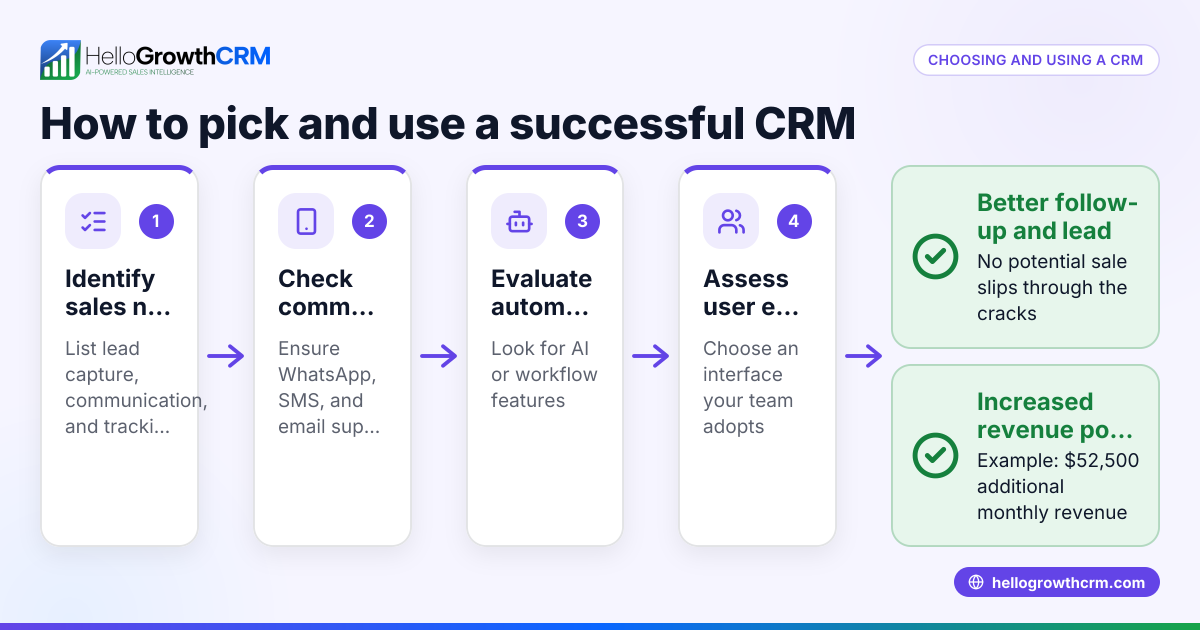
The best CRM decision usually comes from a short set of operational questions, not from a long comparison spreadsheet. For a US advisory firm, these are the checks worth making:
- How are notes, tasks, emails, texts, and calls tied to one client or household record for later review?
- Can you control who sees sensitive records, and can your compliance team review activity without borrowing user credentials?
- How does the system document consent, opt-out status, and communication history for TCPA and CAN-SPAM purposes?
- What happens when a payment arrives by ACH, check, or wire instead of card?
- Can the CRM sync with the rest of your operating stack through integrations, or will staff retype the same data into custodial, planning, or email systems?
- What is the vendor’s published position on security and privacy support, including CCPA data-subject rights support?
Those questions matter more than cosmetic features because migration is expensive in staff attention even when software pricing looks modest. If you are testing process design before committing, a free CRM plan can be useful for piloting intake fields, stages, and follow-up ownership with a small subset of leads. The important thing is to pilot with your real advisory workflow, not a generic sales script.
Implementation should mirror your advice process, not a software demo
A CRM starts paying off for a US advisory firm when the stages reflect actual work: inquiry received, introductory call scheduled, fit confirmed, disclosures sent, agreement pending, funding or transfer in progress, review due, and similar milestones that match your model. Generic stages such as “qualified” or “proposal sent” are often too vague for regulated advice businesses.
That is also why internal ownership rules matter. Intake may belong to one person, suitability follow-up to another, and paperwork chasing to an operations specialist. If the CRM cannot route tasks and keep one visible history, handoffs will slip. HelloGrowthCRM’s pipeline and workflow tools can support stage movement, task creation, and record updates, which can be useful if you map them to your firm’s real operating controls rather than turning on automation for its own sake.
Finally, treat implementation as policy work as much as software setup. Decide what must be logged, which communication channels are permitted, how language preference is captured, how referral sources are named, and when a record can be closed. In the United States, that discipline is what turns a CRM from a contact manager into an operating system your advisory firm can actually defend and use.
If you want a starting point, compare systems against your own compliance, consent, household, payment, and scheduling requirements before you compare design polish.
Ready to put this into practice?
Set up your pipeline, WhatsApp follow-ups, and AI lead scoring in minutes — free, no credit card.
Try HelloGrowthCRM freeGet CRM tips in your inbox
Join thousands of sales professionals who get weekly insights on CRM strategy, AI automation, and pipeline optimization.

The HelloGrowthCRM team publishes guides on CRM strategy, AI sales tools, and revenue operations for small business sales teams.