HelloGrowthCRM software
Built for real small-business sales teams
HelloGrowthCRM helps reps qualify faster, follow up on time, and close more deals—with practical automation in one place.
- AI lead scoring and pipeline visibility
- Built-in dialer, WhatsApp, and email automation
- Sales forecasting and RevOps-ready reporting
A CRM for Indian manufacturing SMEs is a sales and operations system that captures IndiaMART and JustDial RFQs, manages WhatsApp distributor follow-ups, tracks quotations and approvals, syncs customer and invoice data with finance tools, and helps collect INR payments in one auditable pipeline built for Indian teams.
Key Takeaways
- Manufacturing SMEs in Mumbai, Pune, and tier-2/tier-3 India need a CRM that handles RFQs, quotes, follow-ups, dispatch coordination, and collections together.
- HelloGrowthCRM fits this workflow by combining WhatsApp & SMS CRM, Email Automation, Revenue Attribution, and Razorpay workflows in one place.
- The best setup maps your real process: source inquiry, qualify requirement, send quote, collect advance, track production, dispatch, and repeat order.
- For Indian manufacturers, integration matters as much as contact management. Tally sync, WhatsApp usage, and distributor communication are not optional.
- DPDPA 2023 awareness should shape how you capture, store, and use buyer data across sales, finance, and support.
- Teams that standardize quoting and payment follow-ups usually reduce leakage faster than teams that only add more leads.
Why manufacturing SMEs in India need a specialized CRM
A CRM for Indian manufacturing SMEs needs to do more than store contacts because most factories sell through RFQs, dealer networks, repeat buyers, and payment follow-ups that span sales, production, dispatch, and finance across phone calls, WhatsApp, and field relationships.
Generic CRM advice often misses how Indian manufacturing actually runs. A pump maker in Pune, a fastener supplier in Mumbai, or an electrical panel fabricator in Rajkot may get leads from:
- IndiaMART RFQs
- JustDial enquiries
- WhatsApp distributor messages
- Website forms
- Trade fair scans
- Old customer repeat orders
- Field sales and channel partner referrals
Those leads do not move in a straight line. They go through technical clarification, price negotiation, internal approval, stock check, production slotting, dispatch planning, and payment collection.
In one rollout we did with a 12-person sales team serving industrial dealers across Maharashtra and Gujarat, the biggest issue was not lead volume. It was lead fragmentation. IndiaMART enquiries sat in one inbox. Dealer chats lived in phones. Quotations were in Excel. Finance tracked advances separately. The result was missed follow-ups and zero clean view of order status.
A manufacturing CRM should help you manage:
Lead source to order visibility
You need to see where enquiries came from and which source closes best. With Revenue Attribution and AI Lead Scoring, teams can compare IndiaMART against JustDial, website leads, and distributor referrals.
Multi-person buying and approvals
Many manufacturing deals involve purchase managers, plant heads, owners, and accounts teams. Your CRM should support multiple contacts per account, quote versions, and task ownership.
Sales-to-operations handoff
Once a quote converts, the work shifts to production, dispatch, and collection. That is why manufacturing teams often need a broader AI CRM, not just a lead tracker.
India has over 63 million MSMEs, according to the Government of India’s Udyam portal overview and MSME ecosystem materials at https://udyamregistration.gov.in/.
What workflow should a CRM cover for IndiaMART, WhatsApp, quotes, and collections?
The right workflow for IndiaMART, WhatsApp, quotes, and collections starts at enquiry capture and ends at repeat business, with each stage tied to clear next actions, owner accountability, expected value, and proof of customer intent such as drawings, samples, PO, advance, or dispatch readiness.
Most Indian manufacturing SMEs need a pipeline that mirrors how orders really happen. A simple version looks like this:
| Pipeline Stage | What happens | Owner | Exit criteria |
|---|---|---|---|
| New RFQ | Lead captured from IndiaMART, JustDial, website, or WhatsApp | Inside sales | Basic details verified |
| Qualified Requirement | Product spec, quantity, city, urgency, GST details checked | Sales coordinator | Requirement is complete |
| Quote Sent | Quotation shared by email or WhatsApp | Sales rep | Buyer confirms receipt |
| Negotiation | Price, MOQ, delivery, payment terms discussed | Sales rep / owner | Commercial terms aligned |
| Approval / PO Awaited | Buyer seeks internal approval or issues PO | Buyer + sales | PO or written approval received |
| Advance Pending | Advance requested via Razorpay or bank transfer | Accounts / sales | Advance received |
| In Production / Ready Stock | Plant or warehouse commits fulfillment | Ops | Dispatch date fixed |
| Dispatch / Invoice Raised | Material shipped and invoice shared | Ops / accounts | POD or invoice acknowledgement |
| Payment Follow-Up | Balance payment tracked | Accounts | Payment cleared |
| Repeat Order / AMC | Reorder, accessory, spare, or service opportunity | Account manager | Next order booked |
This matters because channel behavior in India is unique. Buyers often want the first quote on email but negotiate on WhatsApp. Dealers ask for dispatch updates on calls. Finance wants invoice and payment reference. Owners want one dashboard.
When I have audited pipelines like this, I usually find two hidden leaks:
- Quotes sent without a follow-up date
- Orders won without a structured collection workflow
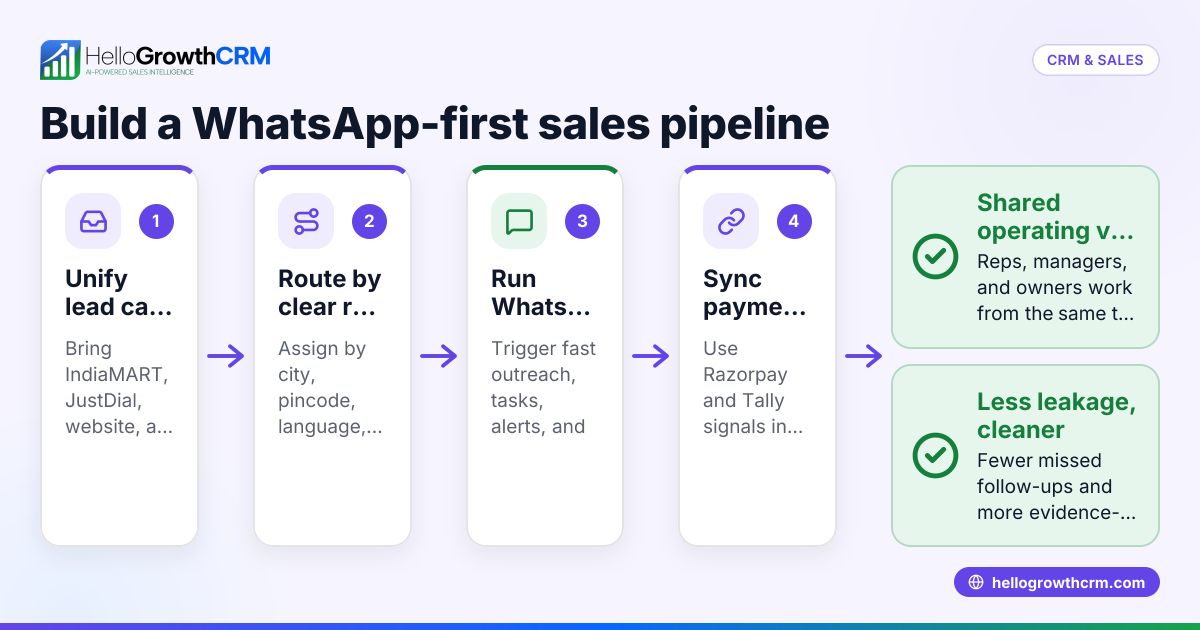
HelloGrowthCRM solves this with connected workflows across Smart Inbox, Meeting Scheduler, Sales Task Boards, and WhatsApp. A rep can receive an RFQ, create a quote task, send a follow-up reminder, and mark advance pending without switching tools.
Why WhatsApp matters in Indian manufacturing
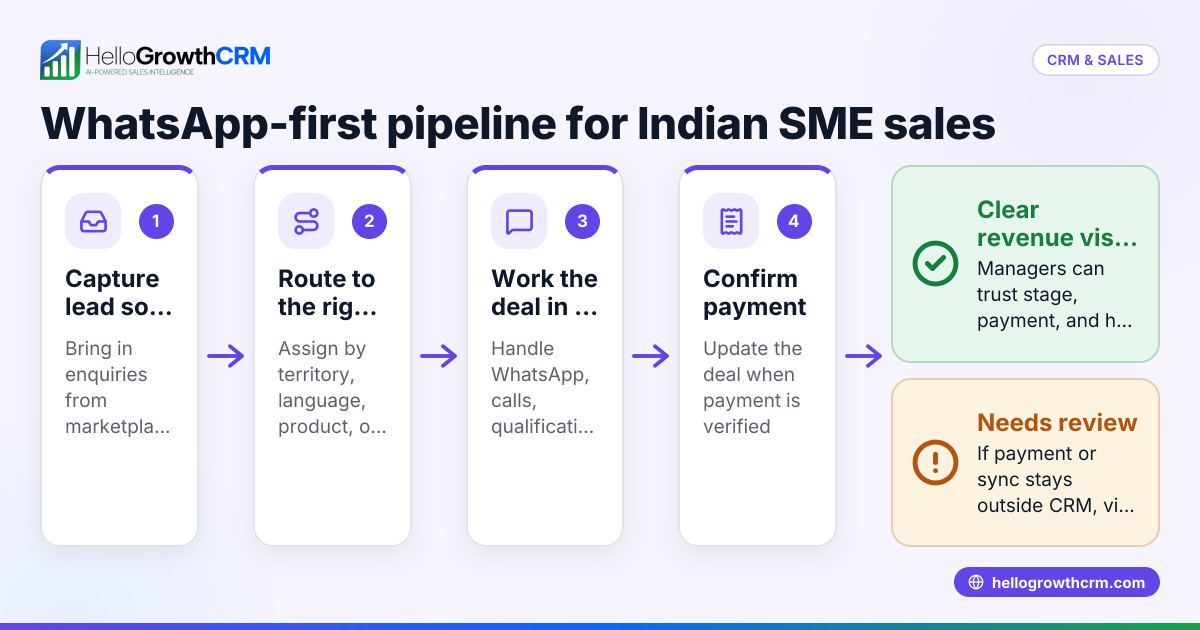
For many SME teams, WhatsApp is the real operating layer. Dealers send quantities, product photos, PO screenshots, and dispatch requests there. That is why a linked WhatsApp & SMS CRM is essential.
Why finance visibility matters
If sales does not know whether advance arrived, they keep chasing the wrong next step. The Razorpay integration helps tie payment status to the same customer record.
Which HelloGrowthCRM features fit Indian manufacturing SMEs best?
HelloGrowthCRM fits Indian manufacturing SMEs best by connecting enquiry capture, quote management, WhatsApp follow-ups, payment tracking, and repeat-order workflows in one system, so sales, operations, and accounts work from the same account record instead of separate spreadsheets, inboxes, and personal phones.
This is where an industry-specific setup beats a generic CRM deployment.
1. Capture leads from multiple Indian channels
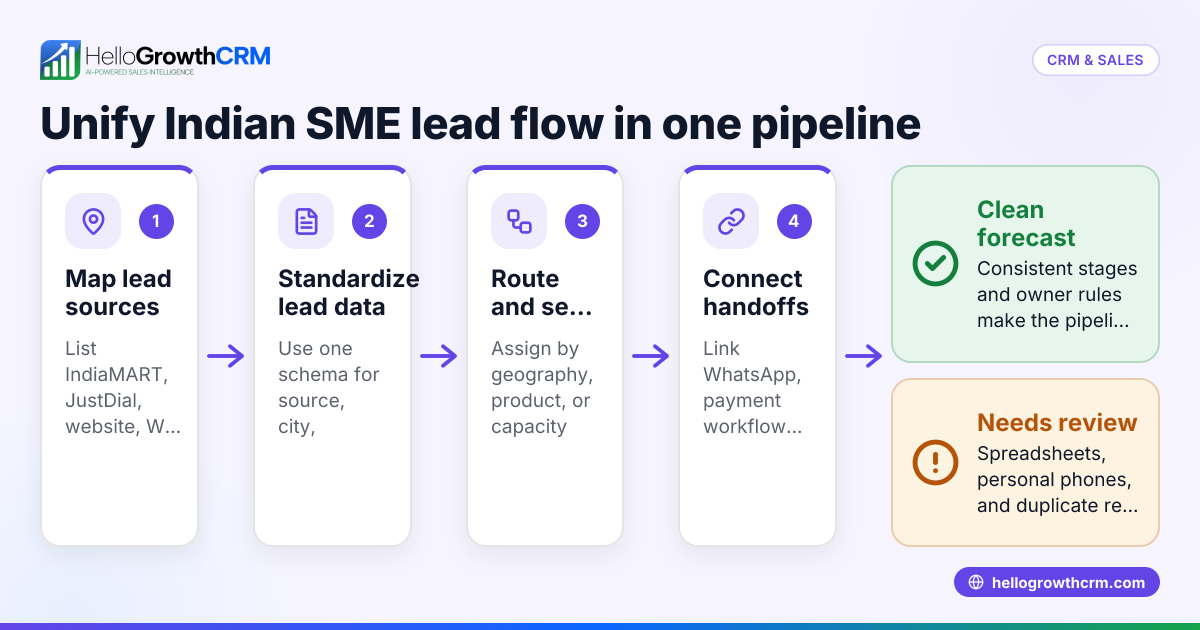
Manufacturing SMEs rarely depend on one source. HelloGrowthCRM can consolidate website forms, ad leads, referral imports, and connectors through Zapier and All Integrations. This helps when your RFQs come from IndiaMART exports, JustDial leads, trade shows, or distributor lists.
2. Run quote follow-ups on WhatsApp and email
Reps can use Email Automation for quote reminders and WhatsApp & SMS CRM for quick confirmations. That gives buyers the channel they prefer without losing conversation history.
3. Score serious buyers
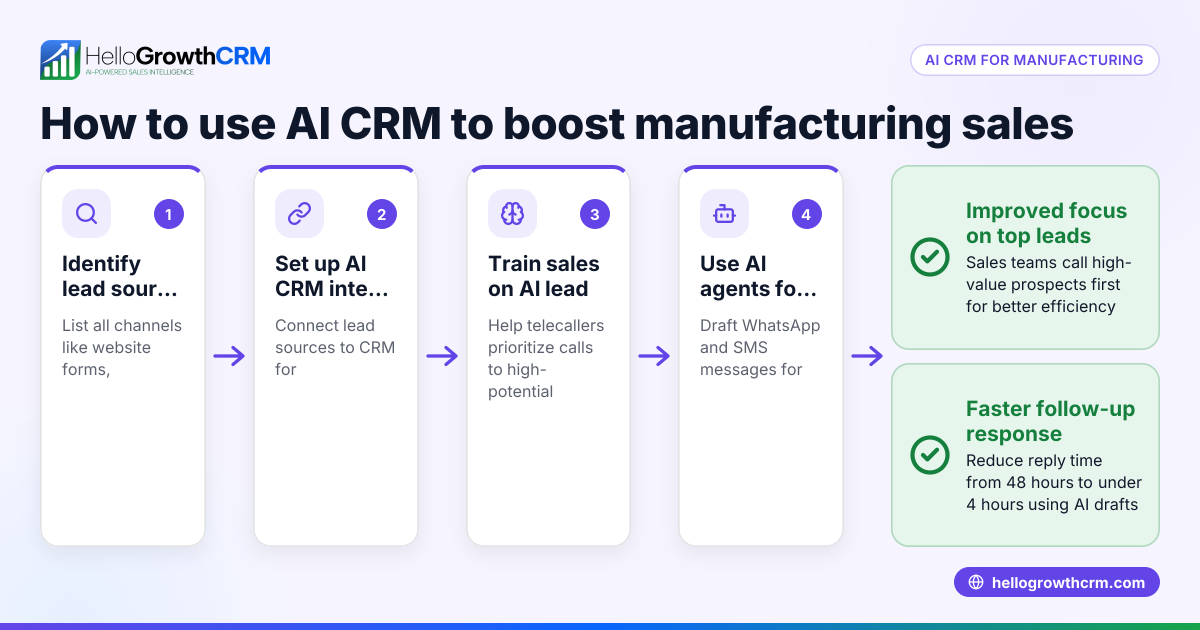
Not every RFQ deserves the same attention. AI Lead Scoring helps prioritize leads based on source, urgency, order size, repeat history, and response behavior. For a small team, this alone can improve daily focus.
4. Track pipeline health and deal risk
Manufacturing deals often stall at commercial approval or advance collection. AI Pipeline Management and AI Deal Insights help managers spot aging deals, weak follow-up patterns, and stage slippage.
5. Collect advances in INR
Advance payments are common in custom manufacturing, tooling, and made-to-order jobs. The Razorpay integration helps teams request and monitor INR collections inside the account workflow.
Razorpay is regulated within India’s payment ecosystem, and digital payments operate within RBI oversight frameworks published by the Reserve Bank of India.
6. Sync with accounting and back-office systems
Many Indian SMEs still work on Tally for accounting. HelloGrowthCRM can support structured handoffs and integration workflows so customer records, invoices, and collection status are easier to reconcile. If you also use QuickBooks or need custom flows, the platform’s integration layer helps.
7. Support management reviews
Owners and plant heads want answers fast:
- Which RFQ source is producing paid orders?
- Which reps are missing follow-ups?
- Which dealers reorder most often?
- Which accounts are overdue?
- Which city or product line is growing?
This is where Sales Forecasting and Pipeline Health Score become useful for weekly reviews.
How to set up a CRM for Indian manufacturing SMEs: Step-by-Step
Setting up a CRM for Indian manufacturing SMEs works best when you map your live order journey first, then configure lead sources, stages, quote and payment triggers, user roles, and reporting so the system reflects your factory’s actual sales, dispatch, and collection motion.
- Map your current enquiry flow
List every source of lead and every handoff. Include IndiaMART, JustDial, website, WhatsApp, distributors, repeat buyers, and field reps. - Define one shared pipeline
Create stages from RFQ to repeat order. Keep stage names operational, not vague. “Advance Pending” is better than “Almost Won.” - Set mandatory qualification fields
Capture product, quantity, city, GST status, expected delivery, payment terms, and application use case. This improves quote quality and prioritization. - Connect communication channels
Link email, WhatsApp, and calling tools. HelloGrowthCRM supports this through Gmail, WhatsApp, CRM Dialer, and Smart Inbox. - Standardize quote follow-up tasks
Every quote should trigger a next action. Use Sales Task Boards or the Follow-Up Cadence Builder to set reminders at 1 day, 3 days, and 7 days. - Add payment checkpoints
Create stages for PO received, advance pending, invoice raised, and payment follow-up. Connect Razorpay so advance status is visible. - Define handoff rules to ops and accounts
Decide when sales owns a deal and when operations or finance takes over. Record dispatch date, invoice number, transporter, and payment due date. - Create dashboards by role
Sales needs lead aging and quote conversion. Owners need source-wise revenue. Accounts needs outstanding collections. Start simple. - Train reps on data discipline
Personal phones and side spreadsheets break CRM value. Train on same-day logging for calls, WhatsApp notes, quote status, and promised follow-up dates. - Review pipeline weekly for 60 days
The first two months matter most. Use Managed RevOps if your team needs help fixing adoption, reports, and stage definitions.
How to stay DPDPA 2023-conscious while scaling manufacturing sales
To stay DPDPA 2023-conscious while scaling manufacturing sales, Indian SMEs should collect only necessary buyer data, document how it is used, restrict access by role, and keep communication and payment records inside controlled systems instead of scattered personal devices and spreadsheets.
Most manufacturing SMEs are not dealing with huge consumer datasets. Still, they collect personal data from proprietors, buyers, dispatch contacts, and finance managers. That means process discipline matters.
The Ministry of Electronics and Information Technology publishes India’s digital personal data protection framework information at https://www.meity.gov.in/data-protection-framework.
Practical steps for SME teams:
- Collect only business-relevant personal data
- Avoid storing sensitive documents in random WhatsApp groups
- Restrict finance visibility to approved users
- Use role-based access for sales, ops, and accounts
- Keep a clear record of consent and communication purpose where relevant
- Export and delete old data based on policy, not habit
This is also a trust issue with buyers. Larger OEMs and enterprise procurement teams increasingly ask vendors about process maturity. A controlled CRM setup helps you answer that confidently.
Limitation to note
This approach works especially well for teams under 50 reps and mixed inside-sales plus field-sales motions. Above that, you may need deeper ERP orchestration, custom approval hierarchies, and more advanced territory models like Territory Management.
What results should Indian manufacturing SMEs expect from a CRM rollout?
Indian manufacturing SMEs should expect a CRM rollout to improve response speed, quote follow-up consistency, collection visibility, and repeat-order management first, while revenue gains usually follow after the team adopts one shared process and managers review the pipeline with discipline every week.
Do not expect magic in week one. Expect clarity first.
In one Mumbai-based industrial supply rollout, the first visible win came from reducing quote leakage. Reps had been sending prices but not logging next actions. Once every quote had a due follow-up and account ownership was clear, conversion quality improved within one quarter.
Good early indicators include:
- Faster RFQ response time
- Higher quote-to-order conversion
- Better stage-velocity in days
- Fewer overdue advances
- Cleaner dispatch coordination
- More repeat business from existing dealers
If you want to estimate commercial impact before buying, use the CRM ROI Calculator or review Pricing. If you need a working walkthrough for your exact factory workflow, book a Demo or start a Free Trial.
For Indian teams selling through WhatsApp, distributor networks, and RFQ marketplaces, HelloGrowthCRM gives you a practical way to connect sales, operations, and collections without forcing a bloated enterprise stack. If you want one pipeline from enquiry to payment for your plant, dealer, and accounts teams, try HelloGrowthCRM for your India business.
About the author
Arjun Mehta is a Sales Operations Lead at HelloGrowthCRM with 11 years of experience in B2B SaaS, RevOps, and CRM rollouts for Indian SMEs. He has led pipeline redesign and CRM adoption projects across manufacturing, distribution, and service businesses in Mumbai, Pune, and Bangalore. One project that shaped this article involved standardizing RFQ-to-collection workflows for a 12-person industrial sales team handling dealer and OEM enquiries across western India. HelloGrowthCRM is the product he works on, and this article reflects both product knowledge and hands-on implementation experience.
Frequently Asked Questions
Q: What is the best CRM for Indian manufacturing SMEs?
A: The best CRM for Indian manufacturing SMEs is one that manages RFQs, quotes, WhatsApp follow-ups, dispatch coordination, and INR collections in one workflow. For Indian teams, HelloGrowthCRM is a strong fit because it supports channel-heavy sales motions, payment tracking, and operational handoffs.
Q: Can a CRM capture leads from IndiaMART and JustDial?
A: Yes, a CRM can capture leads from IndiaMART and JustDial if you set up imports, forms, or integration workflows correctly. Many SMEs start with structured lead imports and then automate routing, source tagging, and follow-up tasks inside the CRM.
Q: Why do manufacturing SMEs need WhatsApp CRM features?
A: Manufacturing SMEs need WhatsApp CRM features because many buyer conversations, quote confirmations, and dispatch updates happen on WhatsApp in India. If those messages stay on personal phones, teams lose visibility, continuity, and accountability.
Q: Can HelloGrowthCRM help with quote follow-ups and payment reminders?
A: Yes, HelloGrowthCRM can help with quote follow-ups and payment reminders by linking tasks, WhatsApp messages, email sequences, and payment-stage tracking in one account record. This helps sales and accounts avoid duplicate chasing and missed reminders.
Q: How does Razorpay fit into a manufacturing CRM workflow?
A: Razorpay fits into a manufacturing CRM workflow by helping teams request and track advance payments or balance collections in INR against active deals or orders. This is useful for custom jobs, distributor bookings, and dispatch-before-payment controls.
Q: Is a CRM useful for small factories in tier-2 and tier-3 India?
A: Yes, a CRM is useful for small factories in tier-2 and tier-3 India because it organizes scattered enquiries and repeat buyers into one system. Even a small team benefits when RFQs, dealer calls, and collection updates stop living in separate spreadsheets and phones.
Q: How should manufacturing SMEs think about DPDPA 2023 in CRM usage?
Frequently Asked Questions
Ready to put this into practice?
Set up your pipeline, WhatsApp follow-ups, and AI lead scoring in minutes — free, no credit card.
Try HelloGrowthCRM freeGet CRM tips in your inbox
Join thousands of sales professionals who get weekly insights on CRM strategy, AI automation, and pipeline optimization.

The HelloGrowthCRM team publishes guides on CRM strategy, AI sales tools, and revenue operations for small business sales teams.