HelloGrowthCRM software
Built for real small-business sales teams
HelloGrowthCRM helps reps qualify faster, follow up on time, and close more deals—with practical automation in one place.
- AI lead scoring and pipeline visibility
- Built-in dialer, WhatsApp, and email automation
- Sales forecasting and RevOps-ready reporting
Customer relationship management (CRM) for industrial equipment suppliers in India is a centralized system that captures RFQs from marketplaces like IndiaMART and JustDial, manages WhatsApp dealer conversations, converts enquiries into formal quotations, tracks orders and payments, and keeps compliant customer records in one sales pipeline built for B2B equipment distribution.
Key Takeaways
- Industrial equipment suppliers in India often lose deals because RFQs, dealer messages, and quotations live across WhatsApp, spreadsheets, and email.
- A purpose-built CRM centralizes IndiaMART leads, WhatsApp conversations, dealer orders, and payment tracking in one pipeline.
- Automated RFQ-to-quote workflows reduce manual follow-ups and help sales teams respond faster to enquiries.
- Integrations with Razorpay, Tally, and WhatsApp streamline payments, invoicing, and dealer communication.
- DPDPA 2023–compliant data management protects customer information while scaling sales across tier‑2 and tier‑3 dealer networks.
Why Industrial Equipment Suppliers in India Need a CRM
Industrial equipment suppliers in India need a CRM because their sales process involves multiple fragmented lead sources—IndiaMART RFQs, JustDial enquiries, WhatsApp dealer messages, and manual quotations—making it difficult to track opportunities, respond quickly, and manage dealer relationships without a centralized system that connects every stage from enquiry to payment.
Industrial distribution sales look simple on paper. In reality, the workflow is chaotic.
A typical equipment supplier in Pune or Mumbai may receive:
- 15–30 RFQs daily from IndiaMART
- Dealer enquiries on WhatsApp
- Direct calls from existing customers
- Email quotation requests from EPC contractors
- Repeat orders from regional distributors
Most SMEs manage these leads in a mix of Excel sheets and WhatsApp chats. The result is predictable:
- Missed follow‑ups
- Duplicate quotations
- Lost dealer relationships
- No visibility into pipeline value
When I audited the pipeline for a Pune-based pump distributor with a 10-person sales team, we discovered that nearly 28% of RFQs received from marketplaces never received a formal quote because enquiries were buried in email threads and WhatsApp chats.
A centralized platform like AI CRM fixes this by capturing every enquiry automatically and pushing it into a structured sales pipeline.
The Typical RFQ-to-Order Workflow for Industrial Equipment Suppliers
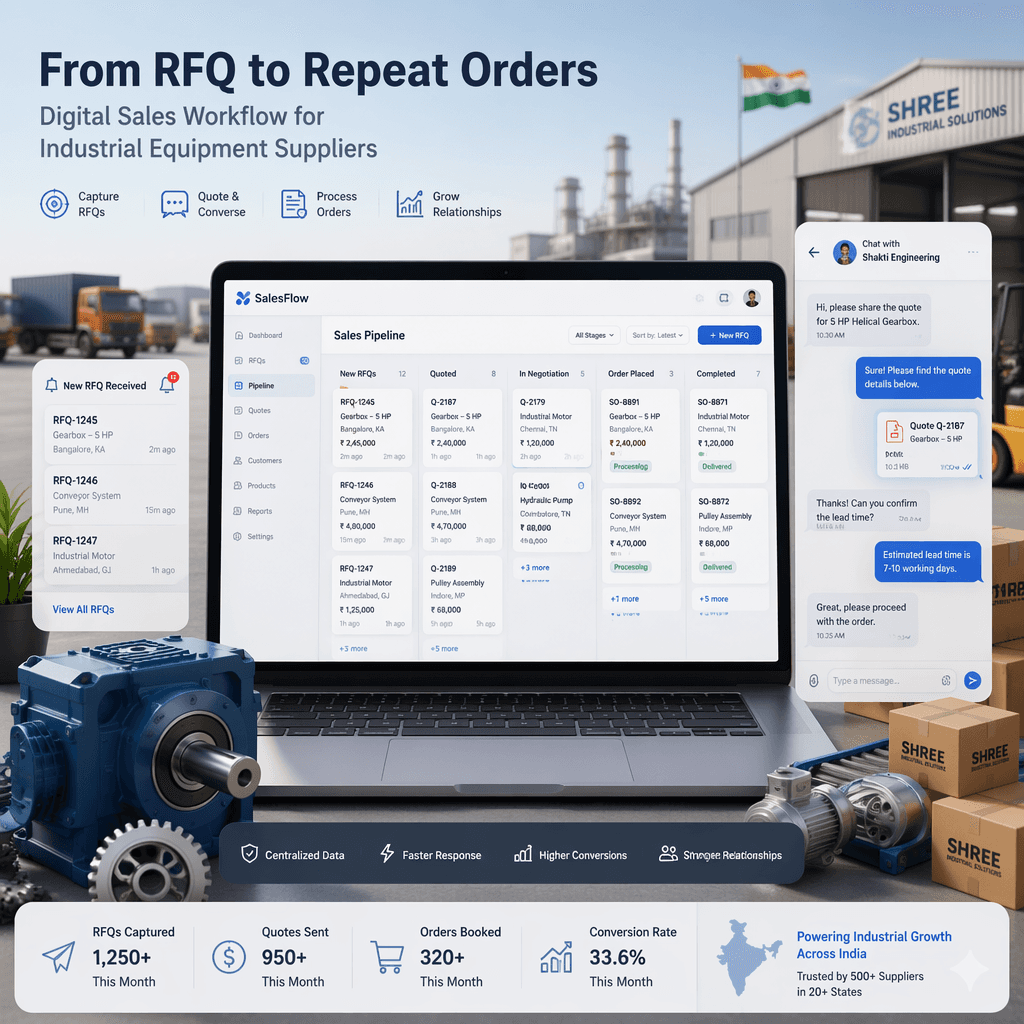
The RFQ-to-order workflow for industrial equipment suppliers typically begins with a marketplace enquiry, followed by qualification, quotation preparation, dealer negotiation, payment confirmation, and order processing; a CRM organizes each of these stages so suppliers can track deals, forecast revenue, and manage distributor relationships without losing leads.
Industrial sales cycles differ from typical SaaS or retail pipelines. Equipment deals often include:
- Technical specifications
- Custom pricing
- Dealer discounts
- Installation timelines
- Spare parts bundles
Common Stages in an Industrial Sales Pipeline
A structured CRM pipeline usually looks like this:
- New RFQ Received
- Qualification
- Technical Discussion
- Quotation Sent
- Dealer Negotiation
- Payment Received
- Order Fulfilled
With AI Pipeline Management, every stage becomes visible to management in real time.
Why Pipeline Visibility Matters
When I implemented this pipeline structure for a Mumbai-based compressor distributor, the biggest improvement came from simply tracking stage velocity in days.
Deals stuck in “Quotation Sent” for more than seven days triggered automatic reminders. Within two months, the team increased close rates because forgotten quotes were followed up systematically.
Managing IndiaMART and JustDial Leads Automatically
Managing IndiaMART and JustDial leads automatically means capturing RFQs the moment they arrive, creating contact records instantly, assigning them to sales reps, and triggering follow-up workflows so enquiries from marketplaces move into a structured CRM pipeline instead of being lost in email or spreadsheets.
Marketplace enquiries drive a huge share of demand for industrial equipment.
However, many suppliers handle them manually:
- Sales rep copies RFQ from email
- Adds it to Excel
- Sends a WhatsApp message
- Forgets to update the sheet
This breaks the sales process.
With All Integrations, HelloGrowthCRM automatically captures leads and routes them into the pipeline.
What Automated RFQ Capture Looks Like
When a new enquiry arrives:
- The RFQ becomes a new lead in CRM
- The system creates a deal in the pipeline
- A sales rep gets assigned automatically
- A follow-up task appears in their queue
- WhatsApp or email responses can be triggered
Using tools like Sales Task Boards, teams can track daily RFQ follow-ups without spreadsheets.
Lead Qualification with AI
Not every RFQ is serious.
Some are:
- Price checkers
- Competitor scouts
- Small quantity enquiries
Using AI Lead Scoring, suppliers can prioritize:
- Bulk buyers
- Repeat dealers
- High-value orders
This helps sales teams focus on revenue instead of chasing every enquiry.
Managing Dealer Communication on WhatsApp
Managing dealer communication on WhatsApp inside a CRM allows industrial suppliers to track conversations, share quotations, log order requests, and automate follow-ups without losing context, which is critical in India where WhatsApp is the dominant communication channel for B2B distributors and equipment resellers.
In India, WhatsApp is the default business channel.
Dealers use it to:
- Request price lists
- Ask for stock availability
- Send purchase orders
- Negotiate discounts
The problem is that these conversations live only on individual phones.
With WhatsApp & SMS CRM, WhatsApp chats become part of the CRM timeline.
Benefits of WhatsApp CRM Integration
- Shared team inbox for dealer messages
- Automatic contact creation
- Quote PDFs sent directly via chat
- Conversation history tied to deals
HelloGrowthCRM’s Smart Inbox ensures no dealer enquiry goes unanswered.
Example from a Real Deployment
In one rollout we did with a Bangalore-based machine tool supplier, the sales team handled more than 80 dealer conversations daily on WhatsApp.
Before CRM adoption, reps used personal phones.
After switching to a shared WhatsApp CRM:
- Response times dropped
- Dealer messages were visible to managers
- Quotes could be tracked by deal stage
The result was faster order confirmations.
Turning RFQs into Professional Quotations
Turning RFQs into professional quotations requires structured product catalogs, consistent pricing rules, and automated proposal generation so sales teams can quickly convert enquiries into formal quotes without rebuilding documents manually for every request.
Manual quotation creation wastes time.
Typical process:
- Copy product specs from old PDF
- Adjust price in Excel
- Export quote
- Email or WhatsApp the file
This can take 20–30 minutes per enquiry.
With a built-in Proposal Builder, teams can generate quotations instantly.
Features That Speed Up Quoting
- Product catalog templates
- Dealer discount rules
- GST calculations
- Delivery terms
- Quote validity tracking
This ensures quotes look professional and remain consistent.
AI-Powered Deal Insights
HelloGrowthCRM’s AI Deal Insights can flag deals where:
- Competitors appear
- Price negotiations stall
- Follow-ups are overdue
This gives managers visibility without reading every email.
Tracking Payments with Razorpay and Syncing with Tally
Tracking payments with Razorpay and syncing invoices with Tally ensures industrial suppliers can move from quotation to confirmed order quickly while keeping finance records accurate, reducing manual reconciliation, and connecting sales activity directly to revenue recognition inside the CRM pipeline.
Once a quote is accepted, payment tracking becomes critical.
Many suppliers still rely on:
- Bank transfer screenshots
- Manual accounting entries
- Email confirmations
This slows down order processing.
Razorpay Payment Links
Using the Razorpay integration, suppliers can:
- Send payment links
- Track payment status
- Trigger order confirmation automatically
Syncing Invoices with Accounting
Finance teams often use Tally or similar systems.
HelloGrowthCRM connects sales with accounting platforms like QuickBooks or payment platforms like Stripe for global customers.
This ensures:
- Invoice numbers stay consistent
- Payments match orders
- Revenue forecasting improves
India’s digital payment adoption has accelerated dramatically. The Reserve Bank of India reports that the Digital Payments Index has increased more than fourfold since its base value of 100 in 2018, reflecting rapid payment digitization across the economy.
Source: https://www.rbi.org.in/
For equipment suppliers, digital payment links reduce delays between quote acceptance and order processing.
Spreadsheet vs Generic CRM vs HelloGrowthCRM for Equipment Suppliers
Choosing the right CRM matters because industrial sales workflows involve RFQs, technical quotes, dealer networks, and payment tracking; generic CRMs or spreadsheets rarely support these workflows well, while a specialized system designed for equipment suppliers can automate marketplace leads, WhatsApp conversations, and distributor pipelines.
| Feature | Spreadsheets | Generic CRM | HelloGrowthCRM |
|---|---|---|---|
| IndiaMART RFQ tracking | Manual entry | Partial | Automated capture |
| WhatsApp dealer conversations | Personal phones | Limited | Shared WhatsApp CRM |
| RFQ-to-quote workflow | Manual | Basic | Automated with templates |
| Dealer network management | Hard to track | Limited | Territory & dealer pipelines |
| Payment links | Not available | Requires integrations | Built-in Razorpay integration |
| Revenue forecasting | Manual | Basic dashboards | AI sales forecasting |
| Compliance & data control | Weak | Moderate | DPDPA-ready data management |
Full platform capabilities are available on the Features page.
DPDPA 2023 Compliance for Industrial Sales Data
DPDPA 2023 compliance for industrial sales data means securely storing customer contact details, RFQs, payment information, and communication records while ensuring lawful consent, controlled access, and proper data protection practices required under India’s Digital Personal Data Protection Act.
Industrial suppliers collect sensitive information such as:
- Customer phone numbers
- Purchase orders
- Dealer financial details
- Payment records
These must be stored responsibly.
India’s Digital Personal Data Protection Act (DPDPA) 2023 defines obligations for organizations collecting personal data.
Official framework: https://www.meity.gov.in/data-protection-framework
CRM Data Protection Practices
HelloGrowthCRM helps teams stay compliant through:
- Role-based access control
- Secure cloud infrastructure
- Audit logs for customer data
- Centralized contact management
This is particularly important for suppliers working with large enterprises that require strict data policies.
How to Implement CRM for Industrial Equipment Suppliers in India: Step-by-Step
Implementing a CRM for industrial equipment suppliers involves capturing marketplace leads, centralizing dealer communication, structuring an RFQ-to-quote pipeline, integrating payment and accounting tools, and training the sales team so every enquiry—from IndiaMART to WhatsApp—moves through one standardized sales workflow.
- Capture Marketplace Leads
- Centralize Dealer Communication
- Create a Structured Sales Pipeline
- Automate Quotation Creation
- Enable Payment Links
- Track Revenue and Forecast Sales
- Train the Sales Team
This process works well for teams up to about 40–50 sales reps. Above that, suppliers usually need more advanced territory management and ERP integrations.
Start Managing RFQs, Quotes, and Dealer Orders in One Pipeline
Industrial equipment suppliers in India deal with complex sales workflows across marketplaces, dealers, and direct customers. A centralized CRM replaces scattered spreadsheets with a single pipeline that captures RFQs, tracks quotations, manages WhatsApp conversations, and connects payments and accounting.
HelloGrowthCRM is designed specifically for Indian B2B sales teams handling distributor networks and high-value quotations. You can connect IndiaMART leads, send quotes via WhatsApp, collect payments through Razorpay, and monitor pipeline health with AI insights.
Start with a Free Trial or schedule a live Demo to see how HelloGrowthCRM can streamline sales for your industrial equipment business.
About the author
Rahul Mehta is a Revenue Operations Lead at HelloGrowthCRM with 11 years of experience building sales systems for B2B manufacturing and industrial distribution companies. He has implemented CRM and RevOps frameworks for equipment suppliers across Pune, Mumbai, and Ahmedabad. One recent project involved restructuring RFQ pipelines for a 12-person pump distribution sales team handling IndiaMART and dealer leads.
Frequently Asked Questions
Q: What is the best CRM for industrial equipment suppliers in India?
A: The best CRM for industrial equipment suppliers in India is one that captures marketplace RFQs, manages WhatsApp dealer communication, tracks quotations, and connects payments and accounting. Platforms like HelloGrowthCRM are designed specifically for Indian B2B sales workflows involving distributors and equipment quotations.
Q: How can a CRM capture IndiaMART leads automatically?
A: A CRM can capture IndiaMART leads automatically by integrating with email or API-based lead feeds that convert RFQs into CRM contacts and deals. This automation ensures enquiries are assigned to sales reps instantly and tracked through a structured pipeline.
Q: Can WhatsApp conversations be managed inside a CRM?
A: Yes, WhatsApp conversations can be managed inside a CRM through official integrations that sync chats with contact records and deals. This allows sales teams to track dealer discussions, send quotations, and maintain conversation history in one system.
Q: Why do industrial suppliers struggle with spreadsheet lead tracking?
A: Industrial suppliers struggle with spreadsheet lead tracking because RFQs arrive from multiple channels such as IndiaMART, calls, WhatsApp, and email. Spreadsheets cannot track conversations or automate follow-ups, causing missed quotes and lost opportunities.
Q: How does CRM help manage dealer networks across tier‑2 and tier‑3 cities?
A: A CRM helps manage dealer networks across tier‑2 and tier‑3 cities by tracking distributor contacts, order history, communication logs, and sales territories in one platform. This gives regional sales managers visibility into dealer performance and pipeline activity.
Q: Is CRM data storage compliant with India’s DPDPA 2023?
A: CRM platforms can support DPDPA 2023 compliance by implementing secure data storage, access controls, and audit logs for customer data. Businesses must still follow lawful consent and responsible data usage policies defined by the Digital Personal Data Protection Act.
Q: How long does it take to implement a CRM for an industrial sales team?
A: Implementing a CRM for an industrial sales team usually takes two to six weeks depending on pipeline complexity, integrations, and training. Small teams can often migrate RFQs, contacts, and quotation workflows within a few weeks.
Frequently Asked Questions
Ready to put this into practice?
Set up your pipeline, WhatsApp follow-ups, and AI lead scoring in minutes — free, no credit card.
Try HelloGrowthCRM freeGet CRM tips in your inbox
Join thousands of sales professionals who get weekly insights on CRM strategy, AI automation, and pipeline optimization.

The HelloGrowthCRM team publishes guides on CRM strategy, AI sales tools, and revenue operations for small business sales teams.