HelloGrowthCRM software
Built for real small-business sales teams
HelloGrowthCRM helps reps qualify faster, follow up on time, and close more deals—with practical automation in one place.
- AI lead scoring and pipeline visibility
- Built-in dialer, WhatsApp, and email automation
- Sales forecasting and RevOps-ready reporting
For small businesses in the UK deciding between a CRM and a spreadsheet for customer tracking, the choice depends on business size, volume of leads, and communication needs. A CRM automates lead capture from web forms, calls, and WhatsApp, assigns owners, and logs communications, while spreadsheets require manual updates and lack automation. This article compares both options on important criteria, presents a practical example, outlines common mistakes, and explains how a WhatsApp-native AI CRM supports effective customer tracking.
Why this comes up / what goes wrong
Many small business owners start with spreadsheets because they are free and familiar tools. However, as enquiries increase, spreadsheets become harder to update, prone to errors, and lack real-time collaboration. This can cause leads to be lost or followed up too slowly, resulting in missed sales. Sales teams working across WhatsApp, email, and calls often struggle to keep information in sync. On the other hand, CRMs designed for small businesses organise leads automatically, assign owners, and remind the team about next steps — but some worry about complexity or cost.
Step-by-step
| Criteria | Spreadsheet | CRM |
|---|---|---|
| Lead Capture | Manual entry from calls, emails, forms | Automated capture from web forms, calls, WhatsApp |
| Collaboration | Limited; risk of overwriting or outdated info | Real-time updates, assigned owners |
| Follow-up Management | Manual reminders or separate calendar | Automated task boards, notifications |
| Communication Tracking | Notes in cells, no message logging | Logs WhatsApp and SMS conversations |
| Scalability | Difficult as leads grow, prone to errors | Designed for growth and multiple users |
| Reporting & Forecasting | Manual data analysis required | Built-in sales forecasting and reporting |
| Ease of Use | Familiar but manual and error-prone | Requires setup but streamlines sales processes |
If your business handles fewer than 20 leads a month with simple tracking needs, spreadsheets may suffice temporarily. For growing teams, multiple communication channels, and faster follow-up, a CRM is the better choice. For more on CRM options, see compare CRMs.
Example (fictional figures)
A recruitment consultancy in Bristol receives 50 new candidate and client enquiries monthly. They track leads in a spreadsheet but miss some due to slow follow-up, losing potential placements worth approximately £30,000 monthly.
- Monthly revenue from placements: £30,000
- Estimated missed leads: 5 (assumed figure for illustration)
- Average value per missed lead: £30,000 ÷ 50 = £600
- Potential lost revenue: 5 × £600 = £3,000 monthly
Switching to a CRM that automates lead capture and follow-ups reduces missed leads to 1.
- New missed leads: 1
- Lost revenue with CRM: 1 × £600 = £600
Monthly revenue saved by CRM:
£3,000 - £600 = £2,400
This example shows how a CRM can protect revenue by improving lead management and follow-up speed.
Common mistakes
- Overcomplicating spreadsheets: Adding too many columns or complex formulas makes them hard to maintain. Prevent this by keeping spreadsheets simple or switching to a CRM early.
- Delaying follow-up: Manual tracking often causes slow responses. Prevent this by setting reminders or using CRM task boards.
- Ignoring communication logs: Not recording calls or messages causes information loss. Prevent this by using a CRM that logs WhatsApp and SMS conversations.
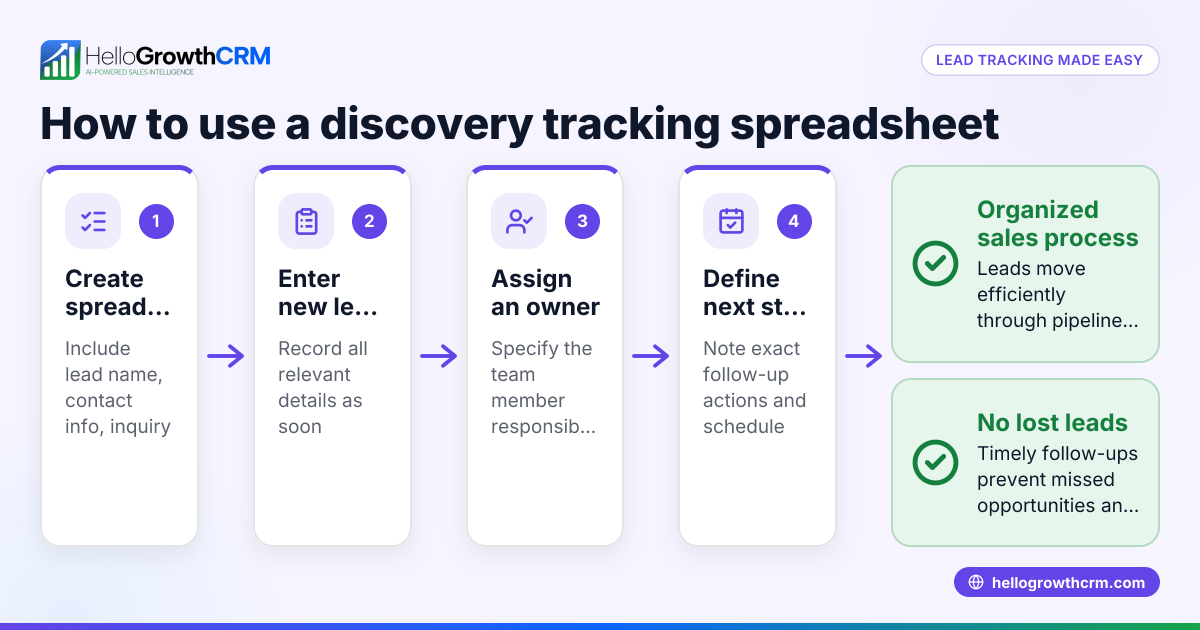
- Not assigning lead ownership: Leads get lost if no one is responsible. Prevent this by clearly assigning owners in your CRM or spreadsheet.
- Failing to review data regularly: Outdated data leads to poor decisions. Prevent this by scheduling regular updates and reviews.
For more on tracking customer engagement, see customer health score.
Doing this in HelloGrowthCRM
This WhatsApp-native AI CRM captures every enquiry from a form, call, or WhatsApp as a lead with an assigned owner and a next step, preventing leads from being lost in notebooks. WhatsApp conversations with leads are logged on the lead record, and follow-ups can be sent directly as WhatsApp or SMS messages. Additionally, AI agents (currently in beta) draft follow-up messages after calls, allowing sales reps to review and send quickly. This setup helps growing UK businesses organise leads and maintain timely communication. Learn more about this solution for the United Kingdom at hellogrowthcrm.com/uk.
Frequently asked questions
Can I start with a spreadsheet and move to a CRM later? Yes. Many small businesses begin with spreadsheets due to their simplicity. However, as leads increase and tracking becomes more complex, moving to a CRM helps automate processes and reduce errors.
Is a CRM expensive compared to spreadsheets? CRMs often have subscription costs, but they save time and reduce lost sales. Some CRMs offer free plans suitable for small teams.
Can a CRM integrate with WhatsApp for customer communication? Yes. Some CRMs are WhatsApp-native, logging conversations and enabling follow-ups via WhatsApp and SMS, improving customer engagement.
How does a CRM help with sales forecasting? CRMs provide built-in reporting tools that analyse lead stages and expected revenue, helping sales leaders forecast more accurately.
Are CRMs difficult to learn for small teams? Modern CRMs are designed for ease of use. Training and support are usually available, and the benefits outweigh the initial learning curve.
For more CRM comparisons, visit compare CRMs.
Key takeaways
- Spreadsheets suit very small or simple customer tracking but lack automation and scalability.
- CRMs automate lead capture, assign owners, and track communications across channels.
- Using a CRM reduces missed leads and improves follow-up speed.
- Logging WhatsApp and SMS communications in a CRM centralises customer data.
- Regularly reviewing and updating customer data prevents lost opportunities.
Start organising your leads better today. Start on the Free Forever plan (200 leads, no credit card).
Ready to put this into practice?
Set up your pipeline, WhatsApp follow-ups, and AI lead scoring in minutes — free, no credit card.
Try HelloGrowthCRM freeGet CRM tips in your inbox
Join thousands of sales professionals who get weekly insights on CRM strategy, AI automation, and pipeline optimization.

The HelloGrowthCRM team publishes guides on CRM strategy, AI sales tools, and revenue operations for small business sales teams.