HelloGrowthCRM software
Built for real small-business sales teams
HelloGrowthCRM helps reps qualify faster, follow up on time, and close more deals—with practical automation in one place.
- AI lead scoring and pipeline visibility
- Built-in dialer, WhatsApp, and email automation
- Sales forecasting and RevOps-ready reporting
In the UAE, the best payment reminder message is short, specific and tied to the way your customer actually pays: usually WhatsApp for the nudge, with the invoice number, amount in AED, and a clear way to confirm transfer, card payment or cheque status.
That sounds simple until local realities get involved. A facilities-management contractor in Al Quoz may be waiting on a bank transfer after a site manager approved the work. A dental clinic in Jumeirah may collect a deposit before treatment and the tax point may already matter. A corporate services firm in DIFC may have clients who want every reminder copied to finance, not just the person who signed the proposal. A car-service workshop in Sharjah may still accept post-dated cheques. In each case, the message has to do more than say “gentle reminder”. It has to help the customer match your note to their internal process.
This guide gives UAE-specific reminder examples, explains what to include, and shows where local law and business practice change the wording.
Put invoice facts first so the customer can match your message to their accounts
Many payment reminders fail because they make the recipient search. UAE customers often pay from a finance queue, not from memory, especially when the lead came in through WhatsApp, Instagram, Dubizzle, Google Business Profile or a trade show and the billing later moved to email. Your reminder should therefore open with the details their accounts team needs to identify the liability immediately.
Use the customer name as billed, your invoice reference, the amount in AED, what the amount covers, and the payment method available. If the customer paid part already, say what remains rather than repeating the full total. If there is a purchase order or job number, include that too.
Useful UAE-style message: “Hello, this is a reminder that Invoice INV-2841 for AED 4,800 for March AC maintenance at Warehouse 2 remains outstanding. If payment has already been arranged by bank transfer, please reply with the transfer reference so we can match it quickly.”
For consumer services: “Dear patient, your balance of AED 650 for today’s treatment plan remains unpaid. You can settle by card at reception or we can send a payment link. If already paid, please ignore this message and send the receipt reference.”
The phrase “what the amount covers” matters. In the UAE, customers often handle several jobs, visits or branches with the same supplier. “AED 4,800 due” creates avoidable back-and-forth. “AED 4,800 for March AC maintenance at Warehouse 2” gives the recipient enough context to act without digging.
WhatsApp usually gets the reply, but the message must read like service communication
In the UAE, customers commonly reply on WhatsApp even when the invoice was issued by email. That does not mean every reminder should sound casual or promotional. The regulatory framework overseen by the TDRA distinguishes promotional traffic from service messages, and a payment reminder is safer when it is clearly about an existing transaction, not a sales push. Keep the wording operational: invoice, amount, payment method, reference, next action.
Avoid adding offers, upsells or marketing language to the same reminder. “Pay now and book your next service” turns an accounts message into something harder to classify and justify. If you collect or process personal data for reminders, the UAE Personal Data Protection Law also matters. The UAE Data Office oversees the federal framework, while DIFC and ADGM have their own data protection regimes through the DIFC Commissioner of Data Protection and the ADGM Office of Data Protection. The practical point is simple: only use contact details for a clear business purpose connected to the transaction, and keep your records straight.
Good WhatsApp wording: “Good afternoon. A reminder that Invoice INV-2841 for AED 4,800 is still open. Please reply with the bank transfer reference, cheque date or request a card payment link.”
Poor wording: “Hi dear customer, limited-time reminder to clear dues today and enjoy our latest offers.”
If your team sends reminders through WhatsApp and SMS workflows, keep service reminders in their own track and avoid mixing them with campaigns. The aim is not volume; it is getting a usable reply.
Bank transfer, card and cheque each need a different call to action
The UAE does not run on a single payment rail. Some customers pay by bank transfer, some by credit card, some by Apple Pay or Google Pay, some by cash at the counter, and in some sectors post-dated cheques are still part of the commercial routine. Careem Pay may also be relevant in some consumer-facing setups. Your reminder should ask for the proof that matches the rail.
For bank transfers, ask for the transfer reference or remittance advice. For card or wallet payments, offer the payment link or point-of-sale option. For cheques, ask the customer to confirm the cheque number and deposit timing. For cash businesses, say where and when payment can be made, because branch hours and Ramadan timings affect actual collection.
One short checklist helps before you draft the template:
- How does this customer usually pay: bank transfer, card, cheque, cash or wallet?
- What exact reference do you need back to reconcile the payment?
- Is there a partial payment, deposit or retention that changes the balance shown?
- Does the customer route payment through procurement, finance or a site manager?
- Will the customer respond faster in WhatsApp, email, Arabic or English?
A workshop in Sharjah waiting on a post-dated cheque should not send the same reminder as a tutoring centre in Abu Dhabi collecting card payments from parents. One message asks for settlement. The other asks for confirmation of cheque status and deposit date.
Deposits and advance payments can change the VAT position before the service happens
In the UAE, a reminder about a deposit is not just a collection message. It can affect how you document VAT. The Federal Tax Authority publishes the rules on VAT registration, tax invoices and the treatment of advances. The operational issue for businesses is that receipt of payment can trigger the obligation, so a deposit can matter when it arrives rather than when the service is delivered. Free-zone and mainland entities can also face different treatment, which is why copied wording from another country is risky.
If you take advance payment for a fit-out, dental treatment package or annual maintenance contract, your reminder should identify it as a deposit or stage payment, not as the final invoice unless that is truly what it is. That helps your own team issue the right paperwork and helps the customer understand whether they are settling an advance, a milestone or the closing balance.
Deposit reminder: “This is a reminder to pay the advance of AED 7,500 against your approved proposal for office licensing support. Once received, we will issue the related tax documentation and schedule the next step.”
Final balance reminder: “This is a reminder that the remaining balance of AED 3,200 on Invoice INV-916 is outstanding after the advance already received.”
Do not guess the current VAT figures, registration points or filing timings in your templates. Check the current publications of the FTA and, where needed, take advice on the Federal Decree-Law on Value Added Tax and related guidance. The message itself should be accurate about what stage of billing the customer is paying.
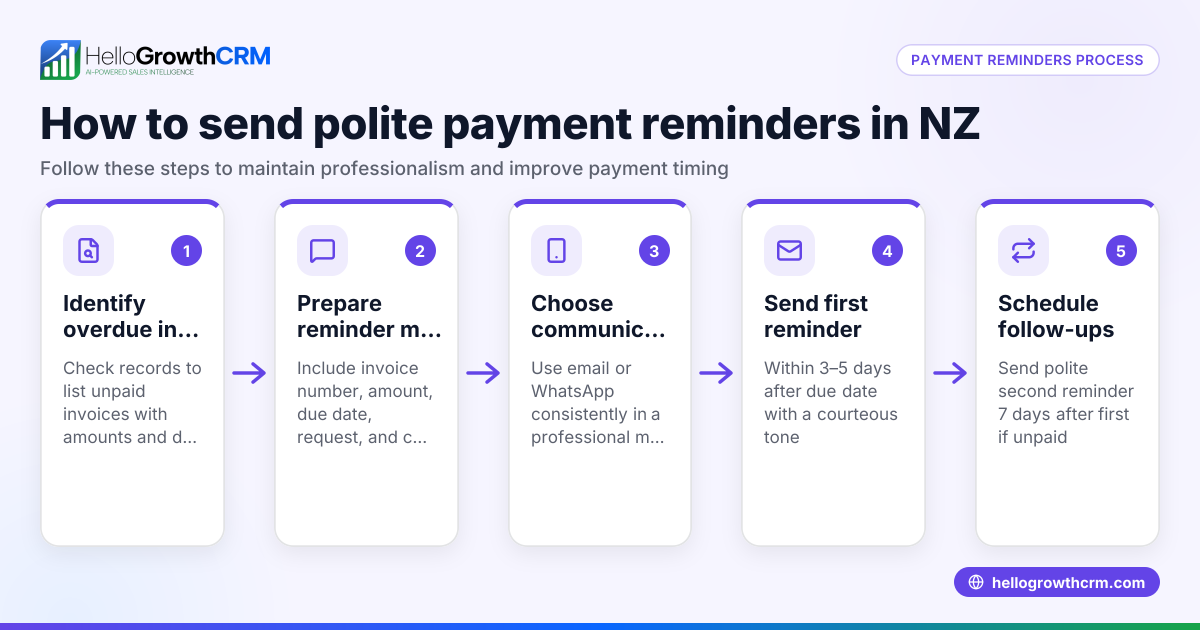
Reminder timing should follow UAE working patterns, not a default automation clock
Timing in the UAE is not just “three days before due, one day after due”. The working week is not uniform across every customer, public-sector and private-sector rhythms are not identical, and Ramadan changes response windows because reduced working hours apply and many customers become more responsive in the evening. Several holidays follow the Hijri calendar, so schedules are announced closer to the time than many foreign teams expect.
That affects both tone and send time. A finance reminder sent at the wrong hour may be seen, but not acted on. If your customer base includes property managers, clinics, workshops or food-service operators, daily rhythms differ sharply. A Talabat merchant is not reviewing accounts like a DIFC professional-services firm. A building supervisor may answer a WhatsApp voice note after a site round; a corporate finance contact may want the PDF and bank details resent by email.
Good practice is to tie reminders to the customer’s operating pattern, not your software default. For Ramadan, shorten the text and make it easy to reply with a single item, such as “send link” or “share bank details”. For clients affected by holidays announced on the Hijri calendar, build a buffer before the expected payment date instead of relying on a rigid final-day chase.
If you automate reminders, use sequences and campaigns carefully so each stage asks for one action only. Automation should reflect the customer’s business rhythm, not flatten it.
Arabic and English are usually enough, but script handling matters more than polished tone
The UAE is multilingual. English works in many business contexts, but Arabic matters for some customers, and Hindi, Urdu, Tagalog or Malayalam may help in operational follow-up. The real issue is not elegant phrasing. It is whether names, amounts and references survive accurately across systems.
If your public page or message flow includes Arabic, it must render right-to-left properly on the customer side, not only inside an admin screen. Arabic-script names should also survive export and re-import if your accounts team moves data between CRM, spreadsheet and invoicing systems. A reminder that corrupts the customer name or flips the text direction looks careless and creates friction at exactly the moment you need trust.
Plain Arabic-style service reminder structure: start with the customer name, state the invoice or balance, show the AED amount, and end with one reply action such as sending the transfer reference.
Also be careful with personal identifiers. Emirates ID is the standard individual identifier in the UAE, but collecting it needs a purpose. A payment reminder should not ask for Emirates ID unless there is a real legal or operational need connected to the service.
One worked UAE example shows why the message should name what the amount covers
The arithmetic below is illustrative; the figures are made up to show the shape of the decision.
A facilities-management contractor in Al Quoz services two units for the same customer in one month. Unit A is billed at AED 3,600. Unit B is billed at AED 2,400. The customer already paid a deposit of AED 2,000 earlier in the month for emergency callouts. The contractor sends a reminder saying only, “AED 4,000 outstanding, please pay today.”
The customer’s finance team replies asking: does the AED 4,000 relate to Unit A, Unit B, or both; has the deposit been allocated; and is this the final balance or another stage bill? Payment stalls while operations and accounts trade screenshots.
A better reminder is: “Reminder that AED 4,000 remains outstanding for March FM services: Unit A AED 3,600 plus Unit B AED 2,400, less deposit received AED 2,000. Please reply with the bank transfer reference once processed.”
That message does three jobs at once. It shows the arithmetic, tells the customer what the amount covers, and prompts the exact proof you need back. What it leaves out is any VAT analysis, contractual retention, or special treatment that might apply to the business structure. Those points depend on the actual contract, invoice and tax position.
Keep the reminder trail attached to the customer record in case payment is disputed
In the UAE, disputes often turn on documentation: which invoice was sent, whether the customer acknowledged it, whether a cheque was promised, which branch or site the work related to, and what was said when payment was chased. That is especially true for businesses operating across emirates, where licensing authorities differ and a single customer relationship may involve several branches or legal entities.
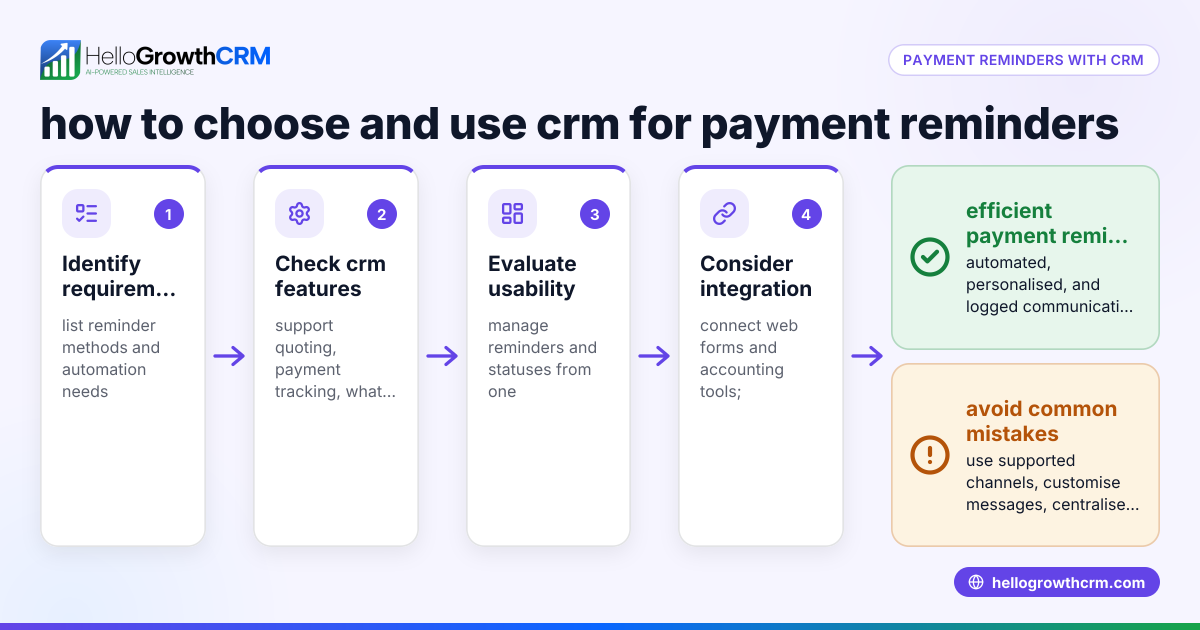
Scattered reminders across personal phones, inboxes and spreadsheets create risk. Keep each reminder tied to the contact, deal and invoice context so anyone on the team can see the sequence. If the business later needs to clarify a balance, resend bank details, or show that a service message was sent to the agreed contact point, the history matters more than a polished template.
HelloGrowthCRM can help here if you use it to keep the interaction history in one place: activities and task boards for notes and follow-up, deals and pipeline records for commercial context, and quotes, invoices and payments received tied back to the deal record. The value is not fancy wording. It is having the reminder, reply and next action visible to the team handling collection.
Short UAE-ready reminder templates you can adapt today
Bank transfer reminder: “Good morning. Invoice INV-2841 for AED 4,800 for March AC maintenance at Warehouse 2 is still outstanding. Please reply with the bank transfer reference once processed, or let us know if you need our bank details resent.”
Deposit reminder: “This is a reminder for the advance payment of AED 7,500 for your office setup file. Once payment is received, we will issue the related paperwork and proceed to the next stage. Please reply if you need the payment link or bank details.”
Partial balance reminder: “A balance of AED 1,350 remains on your treatment invoice after the amount already paid. You can settle at reception by card, Apple Pay or Google Pay, or reply and we will send a payment link.”
Cheque follow-up: “Kind reminder that Invoice INV-916 remains pending against the cheque discussed. Please confirm the cheque number and when it will be ready for deposit so we can update our records.”
Polite escalation: “We have not yet received payment or confirmation for Invoice INV-2841 for AED 4,800. If payment has been arranged, please share the reference today. If there is any issue with the invoice, please reply so we can resolve it promptly.”
The strongest UAE reminder is not the one with the softest tone. It is the one that makes payment easy to match, easy to approve and easy to confirm. If you build your process around the customer’s channel, payment rail and paperwork, your messages will do their job with less chasing. For teams tightening that process, a free CRM setup is a practical place to centralise reminders before they become disputes.
Ready to put this into practice?
Set up your pipeline, WhatsApp follow-ups, and AI lead scoring in minutes — free, no credit card.
Try HelloGrowthCRM freeGet CRM tips in your inbox
Join thousands of sales professionals who get weekly insights on CRM strategy, AI automation, and pipeline optimization.

The HelloGrowthCRM team publishes guides on CRM strategy, AI sales tools, and revenue operations for small business sales teams.