HelloGrowthCRM software
Built for real small-business sales teams
HelloGrowthCRM helps reps qualify faster, follow up on time, and close more deals—with practical automation in one place.
- AI lead scoring and pipeline visibility
- Built-in dialer, WhatsApp, and email automation
- Sales forecasting and RevOps-ready reporting
Customer retention cost is the total expense a business incurs to keep existing customers engaged and purchasing over time. This includes costs for support, loyalty programs, marketing, and service efforts aimed at reducing customer churn. This article covers why measuring retention cost matters, provides a clear step-by-step guide to calculate it, highlights common mistakes to avoid, and explains how HelloGrowthCRM’s customer portal and ticketing features help manage retention efficiently.
Why this comes up / what goes wrong
Small business owners in the US often focus heavily on acquiring new customers, investing in advertising and sales outreach, without fully understanding how much they spend to keep existing customers. This can lead to inefficient spending on support or loyalty programs that don’t actually improve repeat sales. Poor follow-up or slow service response can cause customers to leave, increasing churn rates and forcing more spending on acquisition to replace lost customers. Evaluating customer retention cost helps owners balance acquisition and retention budgets and decide which software or services offer the best return on investment. Without this insight, businesses risk wasting resources or losing customers unnoticed.
Step-by-step
- Define the measurement period: Choose a clear timeframe such as a fiscal year or quarter to collect consistent data.
- Collect direct retention expenses: Gather costs for customer service salaries, loyalty programs, referral incentives, retention marketing campaigns, and any software or tools used specifically for retention.
- Include indirect costs: Add proportional overhead expenses like office space, utilities, and training related to retention activities.
- Count the number of retained customers: Determine how many customers remained active during the period, excluding new acquisitions.
- Calculate total retention cost: Sum all direct and indirect retention expenses.
- Calculate retention cost per customer: Divide total retention expenses by the number of retained customers to find the average cost per customer.
- Compare retention cost to customer lifetime value (CLV): Ensure the retention spending is justified by the revenue each customer generates over time.
- Track customer engagement metrics: Use tools like HelloGrowthCRM’s customer health score to monitor customer satisfaction and retention effectiveness.
- Adjust retention strategies based on data: Optimize loyalty programs, referral incentives, and support response times according to insights.
Example (fictional figures)
A B2B software reseller in Denver, Colorado, calculates customer retention cost for the year ending 12/31/2025.
- Customer service salaries: $120,000
- Loyalty program costs: $30,000
- Retention marketing campaigns: $50,000
- Software tools for retention (annual): $20,000
- Overhead allocated to retention: $15,000
- Total retained customers: 1,500
Calculate total retention expenses: $120,000 + $30,000 + $50,000 + $20,000 + $15,000 = $235,000
Calculate retention cost per customer: $235,000 ÷ 1,500 = $156.67
This means the business spends an average of $156.67 per customer each year to keep them engaged and buying.
Common mistakes
- Ignoring indirect costs: Counting only direct expenses underestimates true retention cost. Always include salaries, overhead, and training.
- Mixing acquisition and retention costs: Keep these separate to measure retention cost accurately and allocate budgets effectively.
- Not updating data regularly: Customer retention cost changes with business growth and customer behavior; track it quarterly or semi-annually.
- Overlooking customer engagement metrics: Without measuring how customers interact with your business, you can’t tell if spending improves retention. Use tools like HelloGrowthCRM’s customer health score to monitor.
- Failing to link retention cost to revenue: Spending on retention must be justified by customer lifetime value to avoid losses.
- Neglecting to track service requests on customer records: Without linking support tickets to customer records, retention cost tracking is incomplete. HelloGrowthCRM keeps service requests on the same customer record as the deal, simplifying this process.
Doing this in HelloGrowthCRM
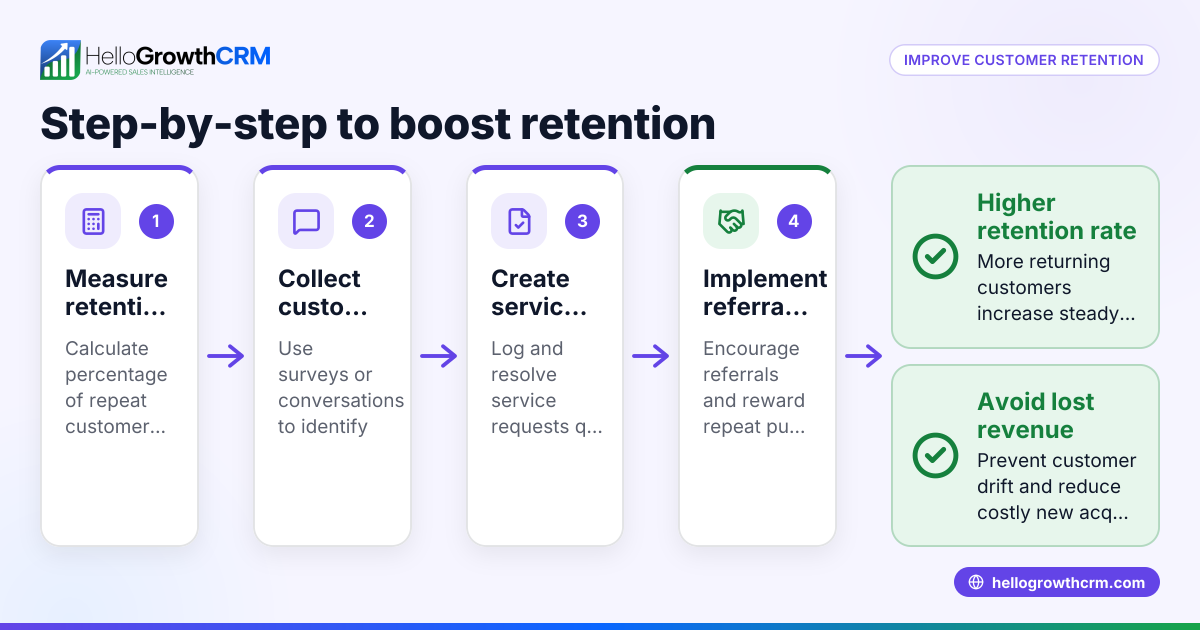
HelloGrowthCRM helps manage customer retention cost through its customer portal, referrals, tickets, and knowledge base features. After the sale, all service requests stay on the same customer record as the deal, making it easier to track support costs alongside sales. Referral program tracking helps monitor incentives, while the knowledge base reduces support load by enabling self-service. These features let your team manage retention activities efficiently in one platform. Learn more about these capabilities here.
Frequently asked questions
What is a good customer retention cost? A good retention cost depends on your industry and customer lifetime value. Ideally, your retention cost per customer should be less than the revenue they generate over time. Calculate your retention cost and compare it to your average customer lifetime value to evaluate efficiency.
How do I reduce customer retention costs? Improving customer service efficiency, automating common support tasks with a knowledge base, and encouraging referrals can lower retention costs. Using a CRM with a customer portal and ticketing system speeds up issue resolution and reduces manual work.
Why track customer retention cost separately from acquisition cost? Retention and acquisition require different strategies and budgets. Tracking them separately helps allocate resources effectively and identify which efforts yield better returns.
How often should I calculate customer retention cost? Calculate retention cost at least quarterly to monitor trends and adjust strategies promptly.
Can software help lower retention costs? Yes, software like HelloGrowthCRM centralizes customer data, automates support tickets, tracks referrals, and provides a customer portal, all of which reduce manual work and improve customer satisfaction, lowering overall retention costs.
How does HelloGrowthCRM support retention tracking? HelloGrowthCRM keeps service requests on the same customer record as the deal, tracks referrals, and offers a knowledge base and ticketing system. This integration simplifies tracking retention costs and managing customer service efficiently.
Key takeaways
- Customer retention cost includes all expenses to keep existing customers engaged and buying.
- Calculate retention cost by dividing total retention expenses by the number of retained customers.
- Include both direct and indirect costs for an accurate figure.
- Track customer health scores and link retention cost to customer lifetime value.
- Avoid mixing acquisition and retention costs.
- Regularly update retention cost data to reflect business changes.
- HelloGrowthCRM’s customer portal, referrals, and ticketing features help manage and reduce retention costs effectively.
To explore pricing options for US businesses, see US pricing.
Ready to put this into practice?
Set up your pipeline, WhatsApp follow-ups, and AI lead scoring in minutes — free, no credit card.
Try HelloGrowthCRM freeGet CRM tips in your inbox
Join thousands of sales professionals who get weekly insights on CRM strategy, AI automation, and pipeline optimization.

The HelloGrowthCRM team publishes guides on CRM strategy, AI sales tools, and revenue operations for small business sales teams.