HelloGrowthCRM software
Built for real small-business sales teams
HelloGrowthCRM helps reps qualify faster, follow up on time, and close more deals—with practical automation in one place.
- AI lead scoring and pipeline visibility
- Built-in dialer, WhatsApp, and email automation
- Sales forecasting and RevOps-ready reporting
Customer service channels are the communication paths customers use to reach your business for support or questions. Common channels include phone calls, email, WhatsApp, SMS, web chat, social media, and self-service portals. Selecting and managing the right channels helps you respond faster, keep customers satisfied, and reduce lost or missed requests. This article covers why customer service channels matter for small businesses, step-by-step how to set them up, a practical example with USD figures, common mistakes to avoid, and how to manage service requests efficiently.
Why this comes up / what goes wrong
Small business owners often find customer inquiries coming from many places like texts, emails, or calls. Without clear channels or a way to track requests, messages can get lost or delayed. This causes unhappy customers, lost sales, and extra work chasing down details. Businesses that run sales and service on spreadsheets or scattered apps struggle to keep up. They need a clear, manageable system for customer service channels that fits their team size and communication style.
Step-by-step
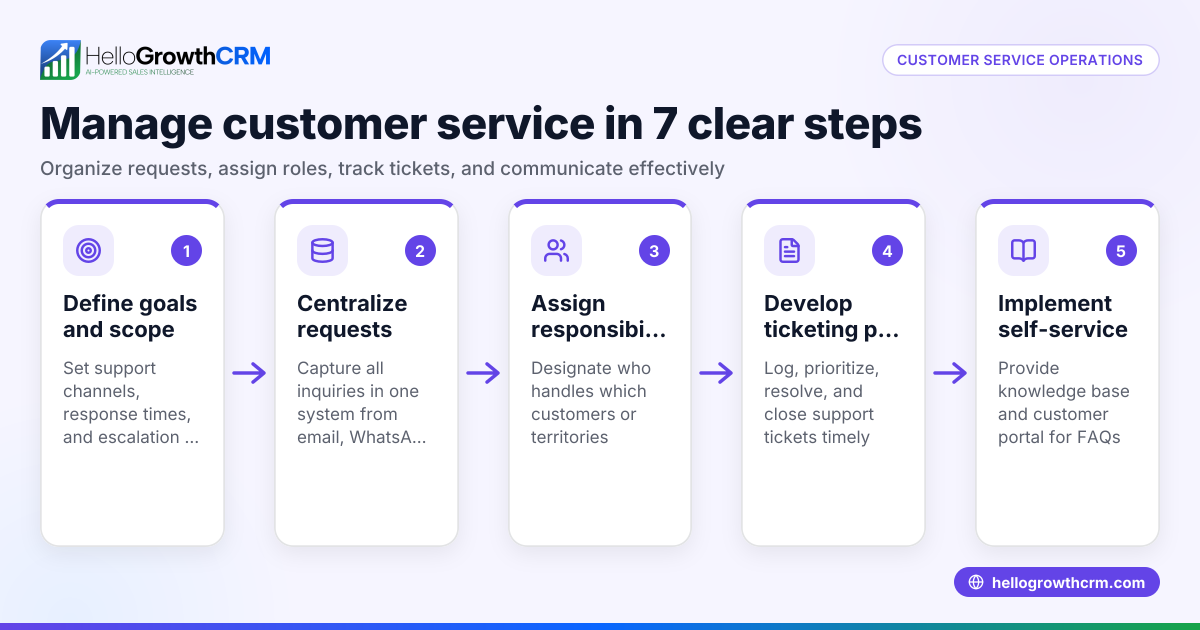
- Identify your customers’ preferred contact methods. Survey your customers or ask your team to find out which channels customers use most, such as WhatsApp, SMS, or email.
- Choose a limited set of channels to manage well. Pick 2-4 channels that cover most customer needs without overwhelming your team.
- Set up clear contact points for each channel. For example, a dedicated support email, a WhatsApp business number, or a web form linked to your CRM.
- Train your team on response expectations. Assign responsibility for monitoring each channel and set response time goals.
- Use a system to track all incoming requests in one place. This prevents lost messages and makes follow-up easier. Check if your CRM supports tickets and integrates multiple channels.
- Create a knowledge base or FAQ for common questions. This reduces repetitive inquiries and helps customers self-serve.
- Monitor channel performance regularly. Track response times, volume, and customer satisfaction to adjust your channels as needed.
- Encourage referrals and feedback through your channels. This strengthens relationships and grows your business.
Example (fictional figures)
A two-location dental practice in Columbus, Ohio, began tracking customer service channels on 01/15/2026. They selected phone, email, and WhatsApp based on patient preferences.
- Monthly incoming requests: Phone 300, Email 150, WhatsApp 100
- Average response time goals: Phone 5 minutes, Email 1 hour, WhatsApp 15 minutes
They used a CRM to combine these channels into tickets linked to patient records.
Calculations:
Total monthly requests = 300 + 150 + 100 = 550
If 270 phone calls meet response goals, then 270 ÷ 300 = 90% on-time phone responses
If 120 emails meet response goals, then 120 ÷ 150 = 80% on-time email responses
If 85 WhatsApp messages meet goals, then 85 ÷ 100 = 85% on-time WhatsApp responses
Total on-time responses = 270 + 120 + 85 = 475
On-time response rate = 475 ÷ 550 = 86.36%
Tracking these metrics helped identify WhatsApp as a strong channel and showed email needed faster replies.
Common mistakes
- Using too many channels at once. Prevent this by focusing on a few channels your customers use most.
- Not centralizing requests. Use a CRM or ticket system to avoid lost messages.
- Ignoring team training or response goals. Set clear roles and monitor performance regularly.
- No self-service options. Create a knowledge base to reduce repetitive questions.
- Not reviewing channel effectiveness. Regularly analyze data and adjust your channels.
- Separating sales and service records. Keep service requests on the same customer record for full context.
Doing this in HelloGrowthCRM
This CRM offers a branded self-service customer portal, referral program tracking, support tickets, and a knowledge base. After the sale, service requests stay on the same customer record as the deal, keeping all communication in one place. This helps your team respond faster and keep customers satisfied. Learn more about managing customer interactions efficiently at HelloGrowthCRM for the United States and see how the customer health score supports service quality. The CRM also integrates WhatsApp and SMS channels to centralize communication WhatsApp and SMS CRM.
Frequently asked questions
What are the most effective customer service channels for small businesses? The best channels depend on your customers’ habits. Common effective channels include phone, email, WhatsApp, SMS, and self-service portals. Focus on the channels your customers prefer and your team can manage well.
How can I track service requests from multiple channels? Use a CRM or ticketing system that integrates your channels into one dashboard. This centralizes requests and prevents lost messages. The CRM can keep service requests linked to customer records for full context.
Why is a knowledge base important for customer service? A knowledge base lets customers find answers quickly without contacting support. This reduces repetitive questions and frees your team to handle complex issues.
How do I measure if my customer service channels are working? Track metrics like response times, resolution rates, and customer satisfaction. Regularly review these to improve or adjust your channels. The customer health score feature can help monitor service quality over time.
Can sales and customer service be managed in the same system? Yes. Managing sales and service in one CRM keeps all customer data together, improving communication and follow-up. Service requests stay on the same record as the deal, making it easier to provide personalized support.
Key takeaways
- Customer service channels are the ways customers reach your business for support.
- Choose a few manageable channels your customers prefer and your team can handle.
- Track all requests in one system to avoid lost messages and delays.
- Use a knowledge base to reduce repetitive questions and speed up service.
- Regularly review channel performance and adjust as needed.
- Keep service requests linked to customer records with tickets and a self-service portal.
Start managing your customer service channels efficiently today. Start on the Free Forever plan (200 leads, no credit card).
Ready to put this into practice?
Set up your pipeline, WhatsApp follow-ups, and AI lead scoring in minutes — free, no credit card.
Try HelloGrowthCRM freeGet CRM tips in your inbox
Join thousands of sales professionals who get weekly insights on CRM strategy, AI automation, and pipeline optimization.

The HelloGrowthCRM team publishes guides on CRM strategy, AI sales tools, and revenue operations for small business sales teams.