HelloGrowthCRM software
Built for real small-business sales teams
HelloGrowthCRM helps reps qualify faster, follow up on time, and close more deals—with practical automation in one place.
- AI lead scoring and pipeline visibility
- Built-in dialer, WhatsApp, and email automation
- Sales forecasting and RevOps-ready reporting
Ecommerce customer service best practices require fast, clear, and consistent support that meets online shoppers’ expectations. Key actions include quick responses to inquiries, centralized communication channels, easy-to-understand return policies, well-trained staff, and using customer feedback to improve service. Tracking customer issues in one place helps resolve problems efficiently and builds trust.
Why this comes up / what goes wrong
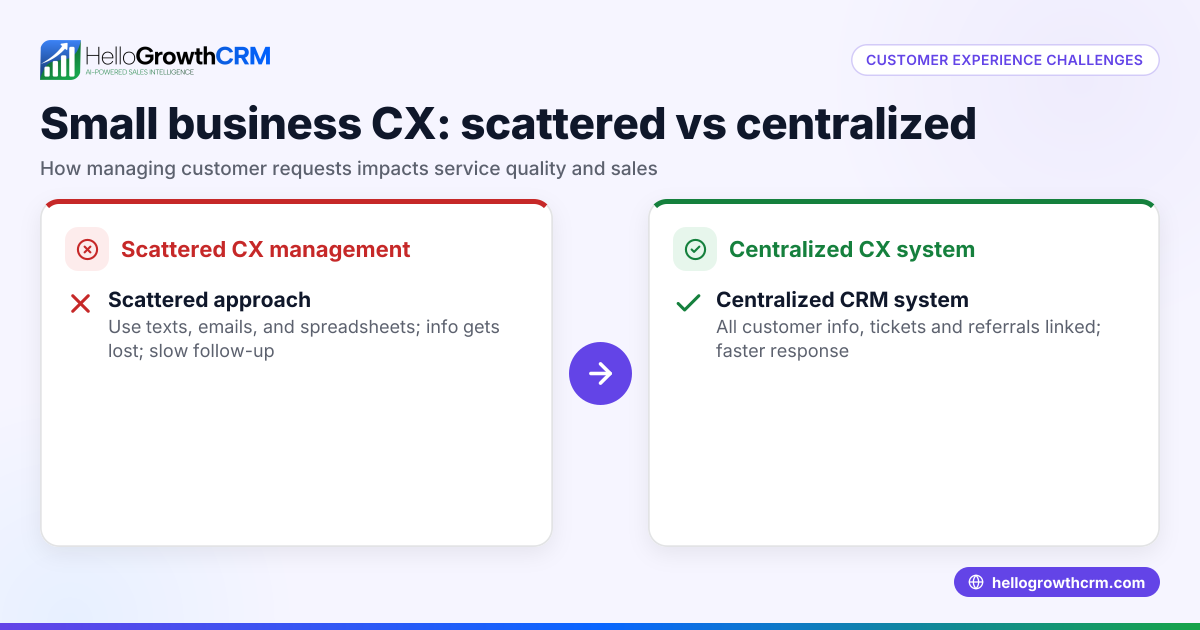
Ecommerce business owners and accountants often face challenges managing customer service because they use multiple tools like email, text messages, and spreadsheets. This fragmentation causes slow or missed responses, frustrating customers who expect immediate help when shopping online. Without a unified system, service requests can get lost, returns become complicated, and customer satisfaction drops. This harms repeat business and damages the brand’s reputation.
Step-by-step
- Set clear response time goals. Define targets such as replying to all customer inquiries within 24 hours or less. Regularly check if your team meets these goals.
- Centralize all customer communication. Use a system that consolidates emails, chats, calls, and social messages so no customer inquiry is missed. Make sure all channels feed into one platform.
- Create a simple, transparent return policy. Publish clear return instructions on your website. Confirm receipt of each return request promptly and update customers through every step. Review your return policy quarterly for improvements.
- Train your team on product knowledge and customer tone. Ensure staff can confidently answer questions and maintain a friendly, helpful attitude.
- Build and maintain a knowledge base and FAQs. Offer self-service resources to reduce repetitive questions. Update content based on common support tickets.
- Track and prioritize support tickets. Assign priority levels to requests and monitor resolution times to avoid backlogs.
- Gather and act on customer feedback. After resolving issues, ask customers for feedback and use it to improve your service.
- Leverage referral programs. Encourage satisfied customers to refer others, which builds trust and lowers acquisition costs.
- Monitor customer health scores. Regularly evaluate customer engagement and satisfaction to spot potential issues early. Learn more about customer health score.
- Integrate customer service with sales data. Keep service requests linked to customer purchase records for context and faster support.
Example (fictional figures)
An ecommerce company in Phoenix, Arizona, selling home fitness equipment handles about 1,200 customer support tickets monthly. Their current average response time is 24 hours, but they want to reduce it to 12 hours.
- Monthly ticket volume: 1,200
- Current average response time: 24 hours
- Target response time: 12 hours
They hire two additional customer service representatives, each able to handle 300 tickets monthly.
Total tickets handled by new staff = 2 × 300 = 600
Remaining tickets handled by original team = 1,200 - 600 = 600
Assuming the original team was the bottleneck, halving the tickets it handles roughly halves its queue: 24 hours ÷ 2 = 12 hours
By doubling their capacity, they meet their response time goal, improving customer satisfaction and reducing complaints.
Common mistakes
- Ignoring multi-channel integration. Prevent this by consolidating all customer communications into one system to avoid missed messages.
- Slow response times. Prevent by setting clear targets and monitoring team performance regularly.
- Complicated return processes. Prevent by simplifying instructions, confirming each return promptly, and communicating clearly.
- Lack of product knowledge among staff. Prevent by providing regular training and updated resources.
- Not using customer feedback. Prevent by routinely collecting feedback and acting on it to improve service.
- Separating sales and service data. Prevent by linking service tickets to customer purchase history for full context. Learn more about managing E-commerce and online sellers.
Doing this in HelloGrowthCRM
HelloGrowthCRM supports ecommerce customer service by keeping service requests on the same customer record as the deal, ensuring full context is always available. Its branded self-service customer portal allows customers to find answers and submit support tickets easily. The system tracks referrals and maintains a knowledge base, helping teams respond faster and keep customers satisfied. Explore HelloGrowthCRM features tailored for the United States.
Frequently asked questions
What is the best way to handle returns in ecommerce? Make the return process clear and easy to follow, with step-by-step instructions on your website. Confirm receipt of return requests quickly and provide timely updates until the refund or exchange is complete.
How can I reduce customer service response times? Centralize all communication channels into one platform and set measurable response time goals. Use ticket prioritization and ensure your team is adequately staffed and trained.
Should ecommerce businesses offer self-service support? Yes, a knowledge base and customer portal reduce repetitive questions and empower customers to solve simple issues independently, improving overall efficiency.
How do referral programs improve customer service? Referral programs reward satisfied customers for recommending your business, increasing trust and reducing the cost of acquiring new customers, which complements good service.
Why link service requests to sales records? Linking service requests to purchase history gives your team full context, enabling faster and more personalized support, which improves customer satisfaction.
Key takeaways
- Respond quickly and clearly to all customer inquiries.
- Centralize communication channels and track all support requests.
- Simplify and clearly communicate your return policy.
- Train your team and maintain a knowledge base.
- Use customer feedback to improve service continuously.
- Link service requests to sales data for better support.
- Use referral programs and monitor customer health scores.
Start improving your ecommerce customer service today. Start on the Free Forever plan (200 leads, no credit card).
Ready to put this into practice?
Set up your pipeline, WhatsApp follow-ups, and AI lead scoring in minutes — free, no credit card.
Try HelloGrowthCRM freeGet CRM tips in your inbox
Join thousands of sales professionals who get weekly insights on CRM strategy, AI automation, and pipeline optimization.

The HelloGrowthCRM team publishes guides on CRM strategy, AI sales tools, and revenue operations for small business sales teams.