HelloGrowthCRM software
Built for real small-business sales teams
HelloGrowthCRM helps reps qualify faster, follow up on time, and close more deals—with practical automation in one place.
- AI lead scoring and pipeline visibility
- Built-in dialer, WhatsApp, and email automation
- Sales forecasting and RevOps-ready reporting
Empathy in customer experience means truly understanding your customers' feelings and perspectives to respond with care and relevance. It involves actively listening, validating emotions, and providing thoughtful solutions that make customers feel valued and respected. This article covers why empathy matters for small businesses, clear steps to practice it, common mistakes to avoid, and how HelloGrowthCRM can help you maintain empathetic customer interactions.
Why this comes up / what goes wrong
Small-business owners often wear many hats at once—handling sales, marketing, customer support, and operations. This juggling act can stretch attention and resources thin. When customer-facing teams lack empathy, customers may feel ignored, misunderstood, or treated like just another transaction. Common issues include slow follow-up, generic responses, or failure to fully understand customer problems. These gaps can lead to lost sales, negative reviews, and damaged reputation, which are especially harmful for small and mid-sized businesses that rely heavily on repeat customers and referrals.
Step-by-step
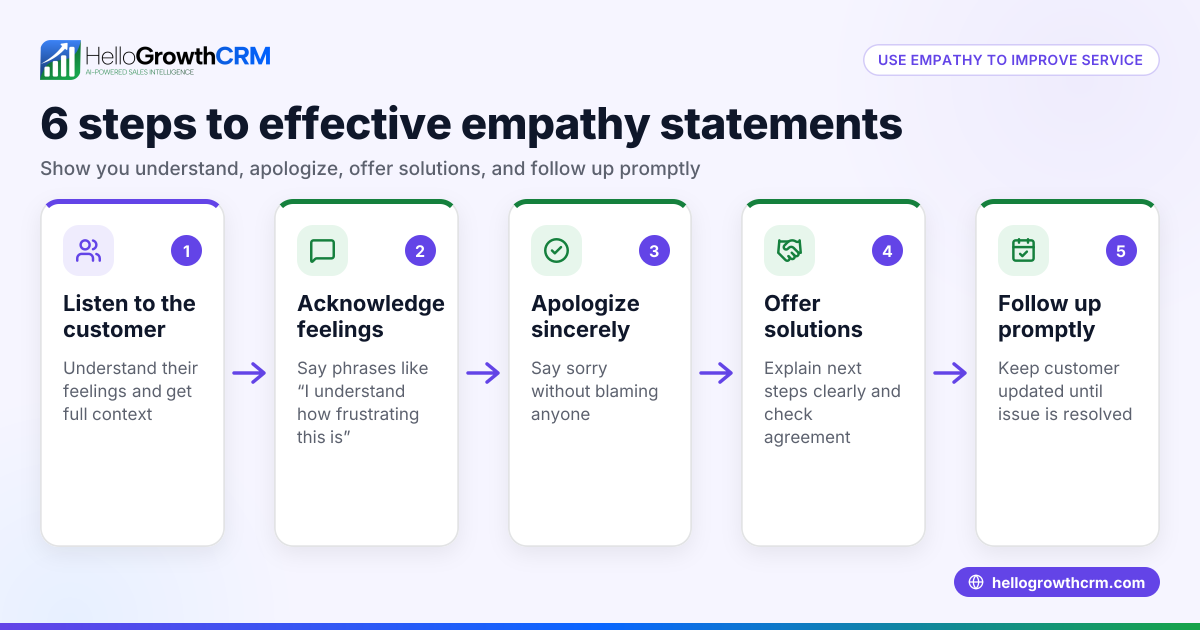
- Listen actively to customers: Give your full attention when customers speak or write. Notice not only their words but also the emotions behind them. Acknowledge their feelings with phrases like "I understand how that could be frustrating."
- Respond promptly and personally: Use the customer's name and address their specific concerns. Avoid canned replies. Quick responses show you value their time.
- Validate customer feelings: Let customers know their emotions are reasonable and important. For example, say "I see why this situation upset you."
- Offer clear, realistic solutions: Explain exactly what steps you will take to help and set honest expectations about timelines and outcomes.
- Follow up consistently: After resolving an issue, reach out to confirm the customer is satisfied and see if further help is needed.
- Train your team on empathy: Include empathy skills in your sales and support training. Use role-playing and real examples to build these habits.
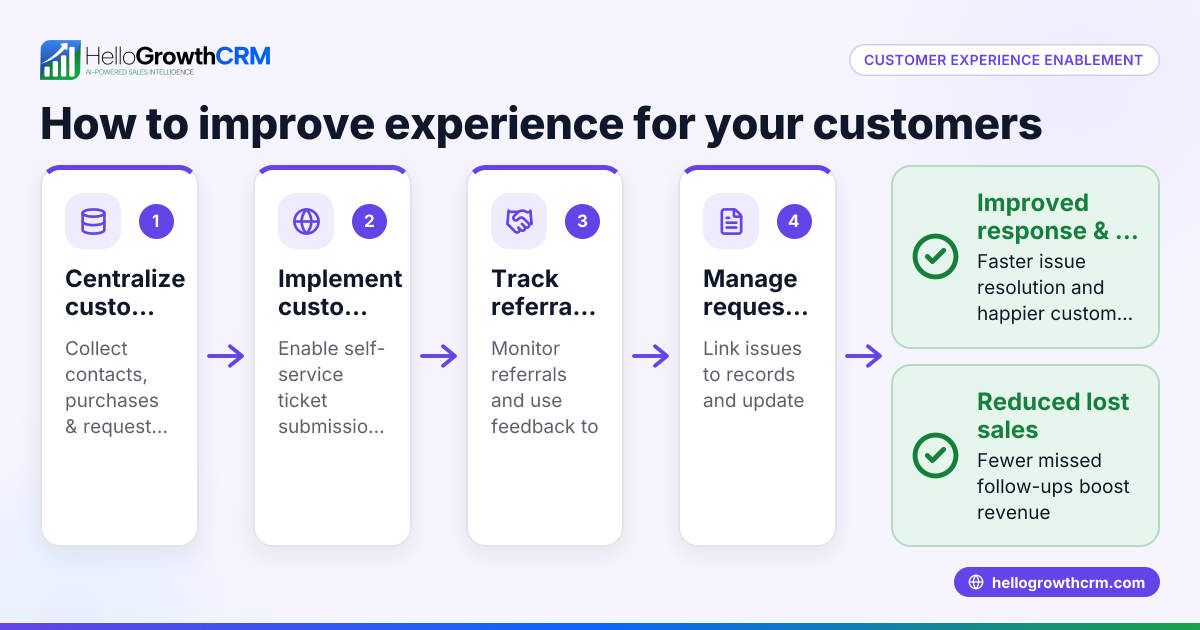
- Use tools to track all communications and service requests: Keep every interaction linked to the customer’s record to maintain context and continuity.
- Monitor customer sentiment and health: Use feedback and tools like a customer health score to identify unhappy customers early and act accordingly (customer health score).
Example (fictional figures)
A B2B software reseller in Denver, Colorado, began improving empathy in their customer experience on 01/15/2026.
- They trained 5 sales reps on empathetic communication, costing $2,000.
- They set a policy to call customers within 24 hours of receiving support tickets.
- Average revenue per customer was $4,000.
- Before the change, 80 customers did not return.
- After 3 months, 120 customers returned.
Calculations:
Lost revenue before = 80 customers × $4,000 = $320,000
Gained revenue after = 120 customers × $4,000 = $480,000
Revenue increase = $480,000 - $320,000 = $160,000
Training cost = $2,000
Net gain = $160,000 - $2,000 = $158,000
This example shows how investing in empathy can lead to significant revenue gains by improving customer retention.
Common mistakes
- Ignoring customer emotions: Staff may focus only on facts and miss feelings. Prevent this by training your team to recognize and respond to emotions.
- Using scripted, robotic replies: Customers can tell when responses are generic. Encourage personalized, sincere communication.
- Delaying follow-up: Slow responses make customers feel unimportant. Use tools like HelloGrowthCRM’s built-in dialer to call customers directly and log outcomes promptly (WhatsApp and SMS CRM, HelloGrowthCRM for the United States).
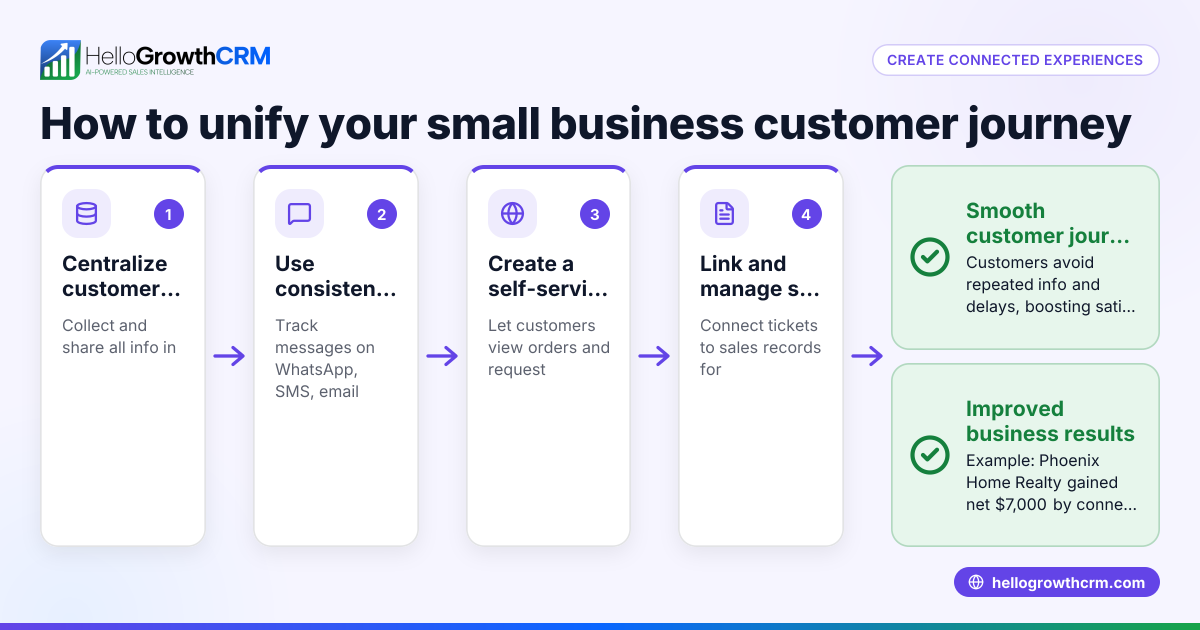
- Separating sales and service data: When sales and support records are siloed, teams lack full context. Keep service requests and sales on the same customer record.
- Failing to check if solutions worked: Don’t assume a problem is solved without confirmation. Follow up to ensure customer satisfaction.
- Neglecting empathy training: Without ongoing coaching, empathy can fade. Make it part of your company culture.
Doing this in HelloGrowthCRM
HelloGrowthCRM supports empathy by providing a built-in dialer that lets your team call customers directly from the CRM and log each call’s outcome on the lead record. This feature helps ensure timely, personal follow-up. After the sale, service requests, tickets, and referrals stay linked to the same customer record as the deal, giving your team full context to respond thoughtfully and consistently. Learn more about these features at WhatsApp and SMS CRM.
Frequently asked questions
What is empathy in customer experience? Empathy means understanding and sharing your customer's feelings to respond with care. It goes beyond fixing problems to making customers feel heard, respected, and valued.
Why is empathy important for small businesses? Small businesses rely on loyal customers and positive word-of-mouth. Empathy builds trust and connection, which increases repeat sales and improves your reputation.
How can I train my team to be more empathetic? Use role-playing exercises, provide examples of empathetic communication, and emphasize active listening. Give ongoing feedback to reinforce these skills.
Can technology help improve empathy in customer service? Yes. Tools like HelloGrowthCRM organize customer data, track conversations, and enable quick, personalized responses so customers don’t feel overlooked or forgotten.
How do I measure if my empathy efforts are working? Track customer feedback, repeat purchase rates, and use a customer health score (customer health score) to monitor improvements in satisfaction.
What are common barriers to practicing empathy in customer experience? Time pressure, lack of training, and poor communication tools can hinder empathy. Address these by investing in training and using CRM tools to streamline workflows.
Key takeaways
- Empathy means understanding and sharing customer feelings to improve their experience.
- Active listening and personalized responses are essential steps.
- Following up and validating feelings prevent customers from feeling ignored.
- Avoid scripted replies and slow responses by using CRM tools like HelloGrowthCRM.
- Keep sales and service data unified to maintain full context.
- Train your team regularly to embed empathy in your company culture.
Start improving your customer experience by applying empathy today. To help manage your customer interactions efficiently, Start on the Free Forever plan (200 leads, no credit card).
Ready to put this into practice?
Set up your pipeline, WhatsApp follow-ups, and AI lead scoring in minutes — free, no credit card.
Try HelloGrowthCRM freeGet CRM tips in your inbox
Join thousands of sales professionals who get weekly insights on CRM strategy, AI automation, and pipeline optimization.

The HelloGrowthCRM team publishes guides on CRM strategy, AI sales tools, and revenue operations for small business sales teams.