HelloGrowthCRM software
Built for real small-business sales teams
HelloGrowthCRM helps reps qualify faster, follow up on time, and close more deals—with practical automation in one place.
- AI lead scoring and pipeline visibility
- Built-in dialer, WhatsApp, and email automation
- Sales forecasting and RevOps-ready reporting
AI CRM is revolutionizing B2B sales teams in the United States by combining intelligent automation with sales process management. It improves lead capture, prioritization, communication, and forecasting while freeing sales reps from manual data tasks. This AI-powered approach drives better revenue operations and team performance.
Key takeaways
- AI CRM uses AI-powered lead scoring and automation to increase sales efficiency and accuracy.
- Automated pipeline management with AI enables sales teams to focus more on closing deals.
- AI-enhanced email, calling, and messaging integrate multiple channels while ensuring compliance with US regulations.
- AI-driven sales forecasting delivers data-backed insights for better revenue planning.
- Managed RevOps combined with AI CRM supports scalable growth for small and mid-sized B2B businesses.
- AI CRM helps overcome typical CRM adoption challenges by automating core workflows and user tasks.
What is AI CRM, and why is it essential for B2B sales teams in the United States?
AI CRM stands for artificial intelligence-powered customer relationship management. Unlike traditional CRMs, AI CRM leverages machine learning, natural language processing, and automation to transform how sales teams manage leads, communications, pipeline, and forecasts. It automates repetitive data entry, analyzes sales behaviors, and provides actionable insights.
For B2B sales teams in the US especially, AI CRM is critical because sales cycles can be lengthy, complex, and involve multiple stakeholders. Consider a manufacturing supplier in Detroit working with OEMs or a tech startup in Houston pitching SaaS solutions to enterprise clients. Here, AI CRM speeds up lead qualification and prioritization while helping sales reps personalize their outreach.
Moreover, US businesses must comply with laws like TCPA (Telephone Consumer Protection Act) and CAN-SPAM when contacting prospects by phone or email. AI CRM can embed these compliance rules, preventing legal risks while maintaining outreach effectiveness.
How does AI-powered lead scoring improve sales outcomes?
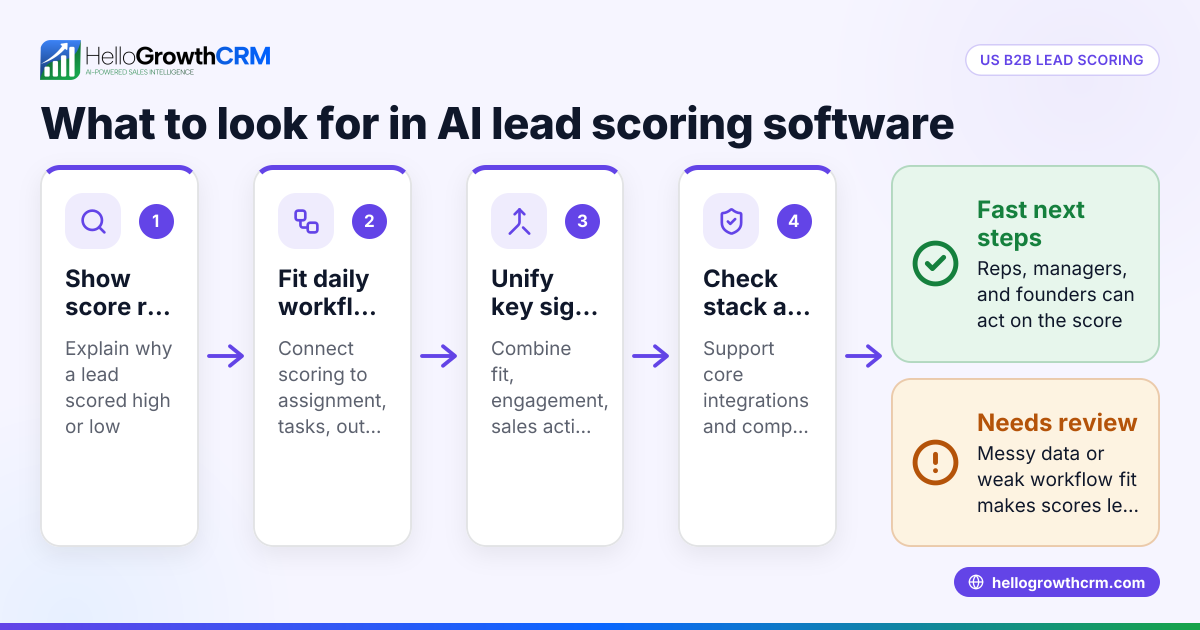
AI lead scoring revolutionizes how teams prioritize leads. Traditional scoring often uses manual rules or simple point systems that fail to adapt or consider nuanced buyer signals. AI lead scoring analyzes a wide range of data points automatically:
- Behavioral data: email opens, clicks, website visits.
- Firmographic data: company size, industry, revenue.
- Engagement history: call duration, meeting attendance.
- External data: news, market trends.
Example: Prioritizing Leads in Chicago Manufacturing
Imagine a Chicago-based industrial supply firm using AI lead scoring. Instead of chasing every inquiry, the AI model identifies leads showing strong buying intent, such as repeated visits to product pages or specific request forms filled. Sales reps get notified about these "hot leads," enabling quicker outreach.
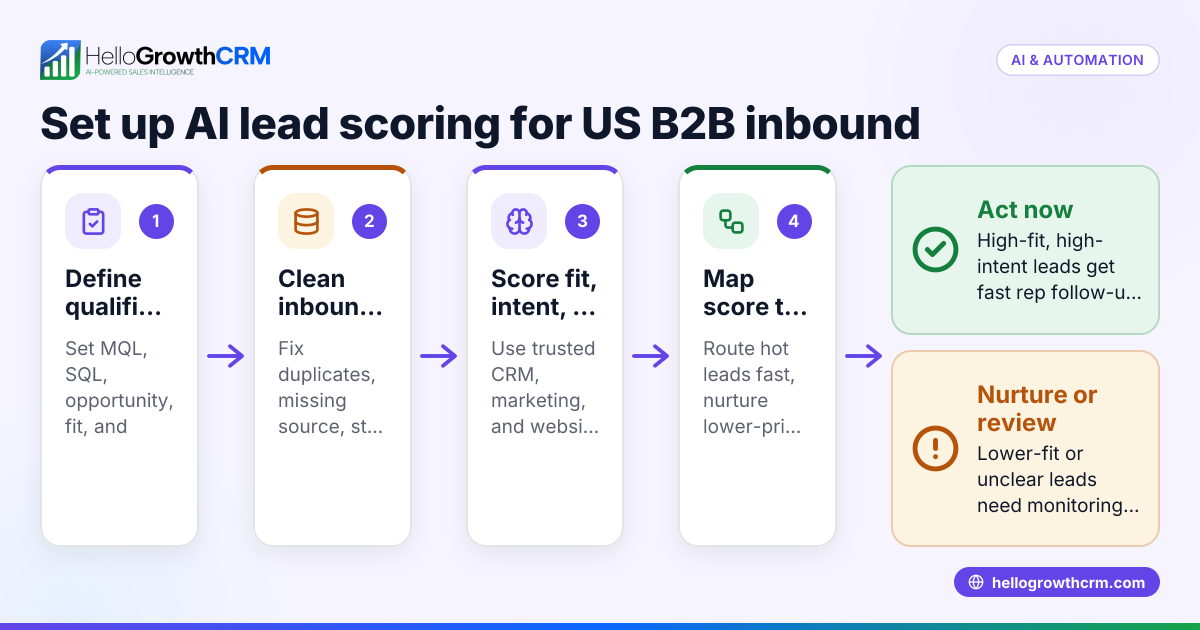
Steps to implement AI lead scoring effectively:
- Gather quality data: Ensure inputs from marketing automation, website tracking, and CRM activities are accurate.
- Define key conversion actions: Such as scheduling a demo or requesting a quote.
- Train AI models with existing sales data to recognize high-value lead patterns.
- Review and adjust scoring criteria regularly to maintain relevance.
Pitfalls to avoid:
- Ignoring data cleanliness: Garbage in, garbage out.
- Blaming AI if rep adoption is low—training and clear benefits help.
- Relying solely on scoring without human validation.
By focusing efforts on prioritized leads, teams increase win rates, shorten sales cycles, and improve overall conversion.
How is pipeline management automated with AI in CRM systems?
Automated with AI pipeline management tracks deals from qualification to close, updating statuses and suggesting next steps without manual effort. This hands-off approach keeps the sales process flowing smoothly while sales reps focus on selling.
AI-powered pipeline management features include automatic deal stage changes triggered by communication activity, stall detection, and AI-driven recommendations to move opportunities forward. Visual dashboards also provide clear pipeline health overviews.
Example: SaaS Provider in Houston
A Houston SaaS startup uses AI CRM to track dozens of leads in various negotiation stages. The AI flags a large deal stuck in contract review for over 30 days. The sales manager receives an alert to coordinate internally or escalate, avoiding delays and last-minute surprises at quarter-end.
Steps to automate pipeline management:
- Map out your sales stages clearly within the CRM.
- Define triggers for moving deals, e.g. contract sent or demo completed.
- Integrate communication channels so AI can detect engagement signals.
- Set alerts for inactivity or regressions.
- Train your team to interpret AI suggestions and act accordingly.
Common pitfalls:
- Overcomplicating sales stages; keep it simple and aligned with actual team behavior.
- Not syncing sales activities across email, calls, and meetings.
- Ignoring AI notifications due to lack of trust or unclear workflows.
Automated pipeline management ensures no opportunity is overlooked and enables accurate forecasting.
How does AI automation enhance email, calling, and messaging campaigns?
AI automation optimizes multi-channel outreach across email, phone calls, and messaging apps like WhatsApp by personalizing messages, scheduling contacts optimally, and ensuring compliance with US laws. This reduces manual follow-up and improves response rates.
AI software can dynamically tailor email templates based on client behavior and segment data. It schedules calls and messages at ideal times, handles automated follow-ups, and filters contacts to comply with regulations like CAN-SPAM and TCPA.
Example: Chicago Consulting Firm Compliance and Automation
A consulting firm based in Chicago must comply with CAN-SPAM for marketing emails. They use AI CRM to automatically add unsubscribe links and record opt-outs. For calling, AI schedules calls only during permissible hours and logs consent to prevent TCPA violations.
Steps to optimize outreach with AI automation:
- Segment your contact lists based on industry, role, or past engagement.
- Create dynamic templates that AI can personalize with client names, companies, or pain points.
- Set follow-up sequences to handle non-responders automatically.
- Enable compliance features in the CRM and train your team on legal aspects.
- Monitor campaign analytics to iteratively improve message effectiveness.
Potential pitfalls:
- Over-automation creating robotic messaging — keep content human and relevant.
- Neglecting compliance rules risking fines and reputation.
- Underestimating training needs for sales reps to trust AI-generated schedules.
By combining AI automation with multi-channel integration, sales teams improve response rates and maintain regulatory compliance.
Can AI CRM help with sales forecasting and reporting accuracy?
AI-powered forecasting improves revenue predictions by analyzing pipeline and historical sales data with advanced algorithms. It detects patterns human analysis often misses and provides reliable, data-backed forecasts swiftly.
This approach enhances planning, resource allocation, and goal setting by delivering actionable insights rather than guesses.
How to implement AI forecasting in your sales process
Start with clean, consistent sales and finance data—ideally synced with systems like QuickBooks. Then, train forecasting AI on several past quarters of data to recognize trends. Combine AI insights with sales team input and use visual dashboards for clear sharing. Regularly review forecast accuracy to refine models.
Pitfalls include
- Overreliance on AI without human context.
- Poor data integration causing skewed results.
- Ignoring outside factors like economic shifts or compliance changes.
With solid data and active team collaboration, AI CRM enables accurate and timely sales forecasting.
What implementation challenges should US B2B sales teams expect with AI CRM?
Implementing AI CRM involves these hurdles:
- Data hygiene and privacy: Clean, accurate data is critical. Respect TCPA and CAN-SPAM rules during outreach.
- User adoption and training: Sales reps may resist automation. Emphasize AI as a tool supporting—not replacing—them.
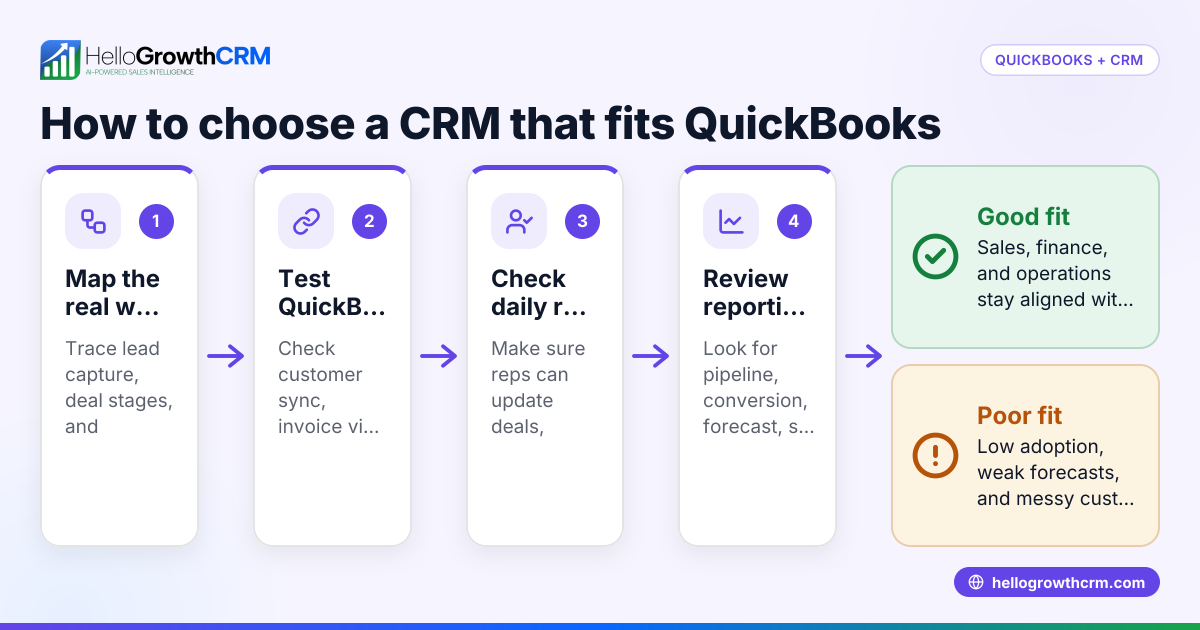
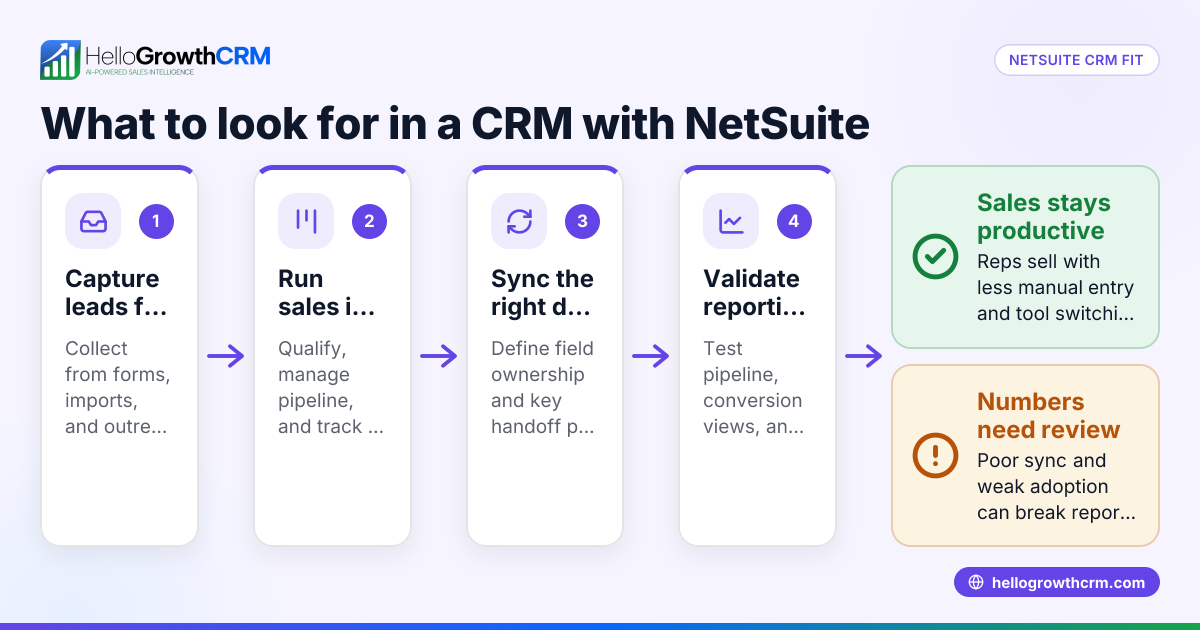
- Integration complexity: Connect AI CRM smoothly with finance (QuickBooks), payments (Stripe), or ERP systems.
- Change management: Align teams across sales, marketing, and operations on AI workflows, monitoring adoption and adjusting as needed.
Leveraging managed RevOps can ease onboarding and ongoing optimization.
How do AI CRM integrations support existing business software ecosystems?
Integrations connect AI CRM with tools US businesses rely on, enabling seamless data flow and synchronizing workflows.
Commonly connected systems include:
- QuickBooks for invoices, payments, and customer financial status.
- Stripe for payment processing insights tied to sales activity.
- ERP systems in manufacturing for inventory and order syncing.
- Email platforms like Outlook or Gmail for streamlined communication.
Example
A Houston manufacturer integrates their ERP with AI CRM. When inventory dips below thresholds linked to customer orders, AI CRM alerts sales reps to expedite or propose alternatives.
Integrated AI CRM creates a unified revenue operations system, improving efficiency and accuracy.
What are the compliance considerations for AI-powered outreach in the US?
AI-powered outreach must comply with these laws:
- CAN-SPAM Act: Mandates email identification, opt-out options, and honest subject lines.
- TCPA: Restricts calling times, call frequency, requires prior consent, and recordkeeping.
AI automation can enforce these rules by managing opt-out lists, scheduling compliant call windows, logging consents, and training reps on legal requirements.
Non-compliance risks heavy fines and reputation damage. Embedding compliance into AI CRM workflows protects your business and builds trust.
How does HelloGrowthCRM utilize AI to support growing B2B sales teams?
HelloGrowthCRM combines powerful AI features into one platform to accelerate your sales growth:
- Intelligent lead capture and AI lead scoring pinpoint high-potential prospects.
- Smart pipeline management updates deal statuses and flags stalled opportunities.
- Integrated email automation, calling, and WhatsApp messaging increase outreach efficiency while ensuring TCPA and CAN-SPAM compliance.
- Advanced sales forecasting provides reliable revenue projections.
- Optional managed RevOps services help onboard your team smoothly and optimize ongoing performance.
- Seamless integrations with QuickBooks, Stripe, and ERP systems maintain consistent business data.
HelloGrowthCRM empowers US founders, sales leaders, and RevOps managers in small to mid-sized companies to overcome CRM adoption barriers and increase sales productivity. The AI-driven platform enables your team to focus on what matters most: closing deals and scaling revenue.
Ready to experience AI CRM for your sales team? Start a free trial or book a demo today and see how HelloGrowthCRM can transform your B2B sales.
Frequently asked questions
What makes AI CRM different from traditional CRM software?
AI CRM includes intelligent automation and predictive analytics that reduce manual updates and sales guesswork. Traditional CRMs rely heavily on users to input and interpret data. AI CRM actively assists with lead prioritization, communication timing, and forecasting, boosting efficiency and adoption.
How can AI lead scoring increase sales productivity?
AI lead scoring ranks prospects by their likelihood to convert, focusing reps’ time on high-value opportunities. This targeted approach minimizes chasing unqualified leads and speeds deals through the pipeline — essential in competitive US B2B markets.
Is AI CRM suitable for small and mid-sized businesses?
Yes. Platforms like HelloGrowthCRM are designed to scale with growing B2B sales teams. They provide enterprise-level intelligence and automation at a price and complexity level suited for small and mid-sized US companies.
How do AI tools handle multi-channel sales communication?
AI tools consolidate email, phone, and messaging channels, automating personalized content and scheduling. They also embed compliance safeguards for TCPA and CAN-SPAM rules, ensuring effective yet legal outreach.
What compliance features should I look for in an AI CRM?
Look for features automating opt-out list management, message logging, call scheduling restrictions, and consent tracking that comply with CAN-SPAM and TCPA requirements. These safeguards protect your business from legal penalties and build customer trust.
Can AI CRM improve sales forecasting accuracy?
Absolutely. AI forecasting learns from past and current pipeline data to generate precise revenue predictions, helping teams plan resources and set achievable targets with confidence.
Harnessing AI-powered CRM technology is no longer optional for B2B sales teams in the US—it’s essential for competing and growing efficiently. By automating lead prioritization, pipeline updates, multi-channel outreach, and forecasting, AI CRM tools like HelloGrowthCRM empower sales teams to close more deals while ensuring compliance and operational alignment. Start today with a free trial or book a demo and see your sales transform.
Read next
This article covers one part of a bigger topic. For the complete picture, read our guide to ai crm.
Frequently Asked Questions
Ready to put this into practice?
Set up your pipeline, WhatsApp follow-ups, and AI lead scoring in minutes — free, no credit card.
Try HelloGrowthCRM freeGet CRM tips in your inbox
Join thousands of sales professionals who get weekly insights on CRM strategy, AI automation, and pipeline optimization.

The HelloGrowthCRM team publishes guides on CRM strategy, AI sales tools, and revenue operations for small business sales teams.