HelloGrowthCRM software
Built for real small-business sales teams
HelloGrowthCRM helps reps qualify faster, follow up on time, and close more deals—with practical automation in one place.
- AI lead scoring and pipeline visibility
- Built-in dialer, WhatsApp, and email automation
- Sales forecasting and RevOps-ready reporting
To automate customer email campaigns in India, start by creating a clear plan for your campaign goals and target audience. Use an email automation tool that supports sequences—timed, multi-step messages that send automatically until the prospect replies. This article explains why Indian small businesses seek automation, provides detailed steps to set up campaigns, shows a worked example with realistic INR figures, highlights common mistakes to avoid, and describes how HelloGrowthCRM supports this process.
Why this comes up / what goes wrong
Indian small and mid-sized business owners often rely on manual email follow-ups or WhatsApp messages to engage customers. This leads to slow responses, missed leads, and inconsistent messaging. Without automation, sales teams spend hours sending individual emails and lose track of replies. They also struggle to maintain timely follow-ups, which reduces conversion rates. Automating email campaigns helps by sending scheduled messages automatically, freeing up time and ensuring no lead is forgotten.
Step-by-step
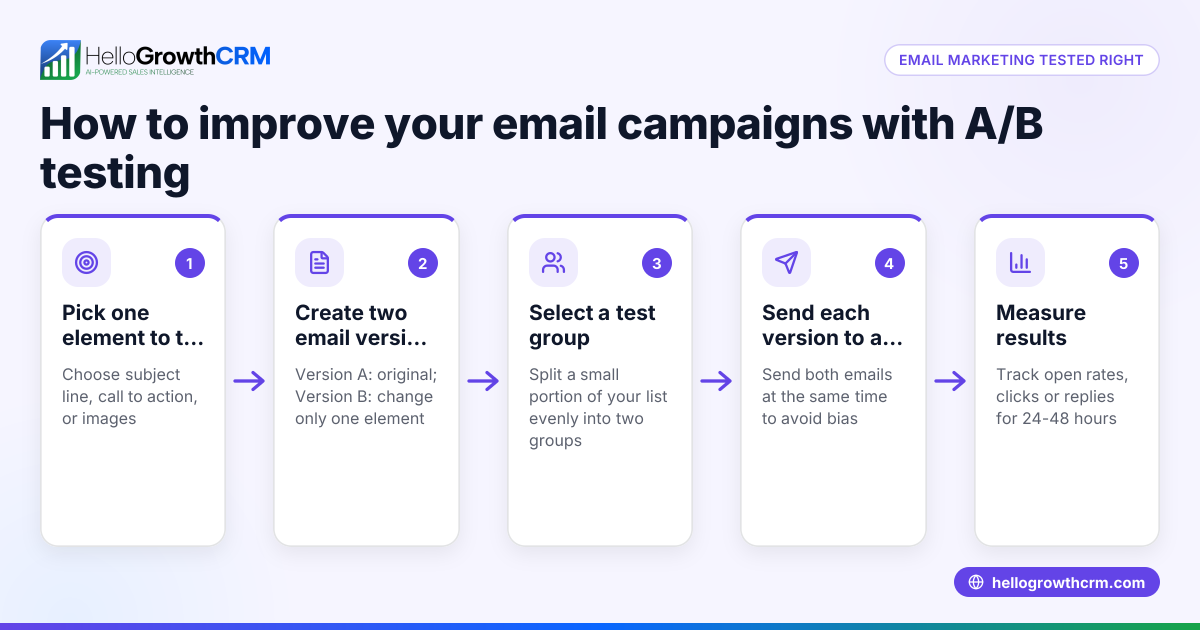
- Define your campaign goal and audience: Decide the purpose (e.g., product launch, follow-up, re-engagement) and segment your customer list accordingly. Check your email list for valid addresses.
- Choose an email automation tool: Select software that supports multi-step sequences and stops on reply. Confirm it allows scheduling messages over days or weeks.
- Create your email sequence: Write a series of 3-5 emails spaced over 1-2 weeks. Each email should have a clear call to action. Check for correct spelling, links, and personalization tokens.
- Set timing and triggers: Schedule emails to send automatically every few days. Ensure the sequence stops immediately when a customer replies to avoid spamming.
- Upload or sync your contacts: Import your customer list into the tool. Verify that contact details are accurate and segmented as planned.
- Test the sequence: Send test emails to yourself or a colleague. Confirm the timing, formatting, and reply detection work correctly.
- Launch the campaign: Start the sequence and monitor progress. Check open rates, replies, and unsubscribes.
- Follow up on replies: When a customer responds, assign the lead to a salesperson or update the CRM record.
- Analyze results and optimize: Review campaign reports to identify what worked and what didn’t. Adjust email content or timing accordingly.
For more on managing email outreach, see email automation and sequences.
Example (fictional figures)
Imagine a Delhi-based small business selling handcrafted bags wants to automate a re-engagement email campaign for 500 past customers.
- They create a 5-step email sequence over 14 days.
- Each email costs roughly ₹0.50 per email sent through their provider.
Calculation:
Total emails = 500 contacts × 5 emails = 2,500 emails
Cost = 2,500 emails × ₹0.50 = ₹1,250
The business expects a 10% reply rate:
Replies = 500 × 10% = 50 replies
Since the sequence stops on reply, fewer emails are sent to these 50 contacts after their reply, saving costs and avoiding over-emailing.
Campaign timeline:
Day 1: Email 1 sent to all 500 Day 4: Email 2 sent to 450 (500 - 50 replied) Day 7: Email 3 sent to 405 (450 - 45 replied) Day 10: Email 4 sent to 364 (405 - 41 replied) Day 14: Email 5 sent to 328 (364 - 36 replied)
This staged sending ensures efficient use of resources and timely follow-up.
Common mistakes
- Not segmenting the email list: Sending the same message to all contacts lowers engagement. Prevent by grouping customers by interest or purchase history.
- Ignoring reply detection: Continuing to email customers who replied annoys them and wastes resources. Use automation that stops sequences on reply.
- Overloading with messages: Sending too many emails too frequently causes unsubscribes. Space emails 2-4 days apart.
- Skipping testing: Launching without test emails leads to errors and broken links. Always test before going live.
- Not tracking results: Without monitoring open and reply rates, you can’t improve. Use tools with reporting features.
- Using manual follow-ups: Manual emails cause delays and missed leads. Automate initial outreach and assign replies promptly.
See more on avoiding these in customer health score.
Doing this in HelloGrowthCRM
HelloGrowthCRM offers sequences and campaigns that automate multi-step outreach workflows sending timed messages across email, SMS, and other channels until a prospect replies. A five-step follow-up over two weeks runs on its own and stops the moment the prospect replies. The HelloMail shared inbox lets your team manage replies to quotation emails on the same deal record without switching apps. After the sale, service requests stay on the same customer record with the customer portal, referrals, tickets, and knowledge base features. Learn more at HelloGrowthCRM for India.
Frequently asked questions
Can I automate email campaigns without technical skills? Yes, many tools, including HelloGrowthCRM, provide user-friendly interfaces with templates and drag-and-drop builders. Follow step-by-step guides and test your campaigns before launch.
How often should I send automated emails in a campaign? A common practice is to space emails 2-4 days apart to avoid overwhelming recipients while keeping your brand top of mind.
Can I combine email with WhatsApp or SMS in campaigns? Yes, multi-channel campaigns that include email, SMS, and WhatsApp improve reach and engagement. HelloGrowthCRM sequences support these channels.
What happens if a customer replies during an automated campaign? The automation stops sending further messages to that customer to avoid spamming. The team can then follow up personally.
How do I measure the success of my email campaigns? Track metrics like open rates, click-through rates, reply rates, and conversions. Adjust your campaign based on these insights.
Key takeaways
- Automate customer email campaigns using multi-step sequences that stop on reply.
- Segment your contact list for targeted messaging.
- Space emails 2-4 days apart and test before launching.
- Monitor campaign metrics and optimize content and timing.
- Use tools like HelloGrowthCRM to manage sequences, shared inbox, and post-sale service.
Automating your customer email campaigns can save time, improve lead follow-up, and increase sales. To start automating today, explore HelloGrowthCRM’s email automation features and Start on the Free Forever plan (200 leads, no credit card).
Ready to put this into practice?
Set up your pipeline, WhatsApp follow-ups, and AI lead scoring in minutes — free, no credit card.
Try HelloGrowthCRM freeGet CRM tips in your inbox
Join thousands of sales professionals who get weekly insights on CRM strategy, AI automation, and pipeline optimization.

The HelloGrowthCRM team publishes guides on CRM strategy, AI sales tools, and revenue operations for small business sales teams.