HelloGrowthCRM software
Built for real small-business sales teams
HelloGrowthCRM helps reps qualify faster, follow up on time, and close more deals—with practical automation in one place.
- AI lead scoring and pipeline visibility
- Built-in dialer, WhatsApp, and email automation
- Sales forecasting and RevOps-ready reporting
To build a marketing campaign calendar in Singapore, start by listing your main campaigns and important dates, set clear goals and budgets, plan the marketing channels and content timing, then monitor progress and adjust as needed. This article explains why a calendar is critical for small businesses, walks through the steps to create one, provides a worked example for an F&B supplier in Woodlands, highlights common mistakes, and shows how HelloGrowthCRM sequences can automate follow-ups.
Why this comes up / what goes wrong
Small business owners in Singapore often struggle with managing multiple marketing efforts spread across WhatsApp, email, and other channels without a clear schedule. This leads to missed opportunities, inconsistent messaging, and poor lead follow-up. Without a marketing campaign calendar, teams can lose track of deadlines, overlap campaigns, or waste budget on uncoordinated activities. A calendar helps organise campaigns by date, channel and objective to ensure timely, focused marketing that drives sales.
Step-by-step
- List key campaigns and events: Write down all planned marketing campaigns, product launches, promotions, and public holidays relevant to your business. Check for Singapore-specific dates like National Day or festive seasons.
- Set goals for each campaign: Define what you want to achieve — for example, increase sales by 10%, grow email subscribers by 500, or boost WhatsApp inquiries by 20%. Goals should be specific and measurable.
- Assign budgets: Allocate a budget for each campaign considering advertising, content creation, and any discounts or giveaways.
- Choose marketing channels: Decide which channels to use for each campaign — WhatsApp, SMS, email, social media, or physical events. Note that many Singapore small businesses rely heavily on WhatsApp and email.
- Schedule content and activities: Plan the dates for each message, post, or event within the campaign period. Space out communications to avoid overwhelming customers.
- Assign responsibilities: Specify who in your team handles each task, such as content writing, design, or sending messages.
- Track progress and results: Use a simple spreadsheet or calendar tool to update campaign status regularly. Measure results against goals and adjust future plans accordingly.
- Review and refine: After each campaign, hold a review to identify what worked and what didn’t to improve your calendar for next time.
Check that your calendar covers all months ahead, aligns with your sales targets, and avoids overlapping campaigns that might confuse customers or waste resources.
Example (fictional figures)
An F&B supplier in Woodlands plans a "Mid-Year Promotion" campaign from 01/06/2024 to 15/06/2024.
- Campaign goal: Increase sales by 15% during the period.
- Usual monthly sales: S$80,000.
- Target sales increase: S$80,000 × 15% = S$12,000.
- Campaign budget: S$3,000 for WhatsApp and email promotions.
- Channels: WhatsApp sequences and email newsletters.
- Schedule:
- 01/06/2024: Launch message on WhatsApp and email.
- 05/06/2024: Reminder message.
- 10/06/2024: Last chance message.
- Responsibility: Sales lead manages WhatsApp sequences; marketing assistant sends emails.
Tracking:
- Sales reported on 15/06/2024: S$95,000.
- Sales increase: S$95,000 − S$80,000 = S$15,000 (exceeds target).
This straightforward calendar helps the team coordinate and measure their campaign effectively.
Common mistakes
- Not aligning campaigns with business goals: Prevent by setting clear, measurable goals for each campaign.
- Ignoring Singapore-specific dates: Prevent by including national holidays and local events in your calendar.
- Overlapping campaigns causing customer fatigue: Prevent by spacing campaigns and coordinating channels.
- Failing to assign responsibilities: Prevent by clearly defining who does what in the calendar.
- Not tracking results: Prevent by regularly updating your calendar with outcomes and learnings.
- Relying on manual follow-up: Prevent by using automated tools like HelloGrowthCRM sequences to manage outreach.
Doing this in HelloGrowthCRM
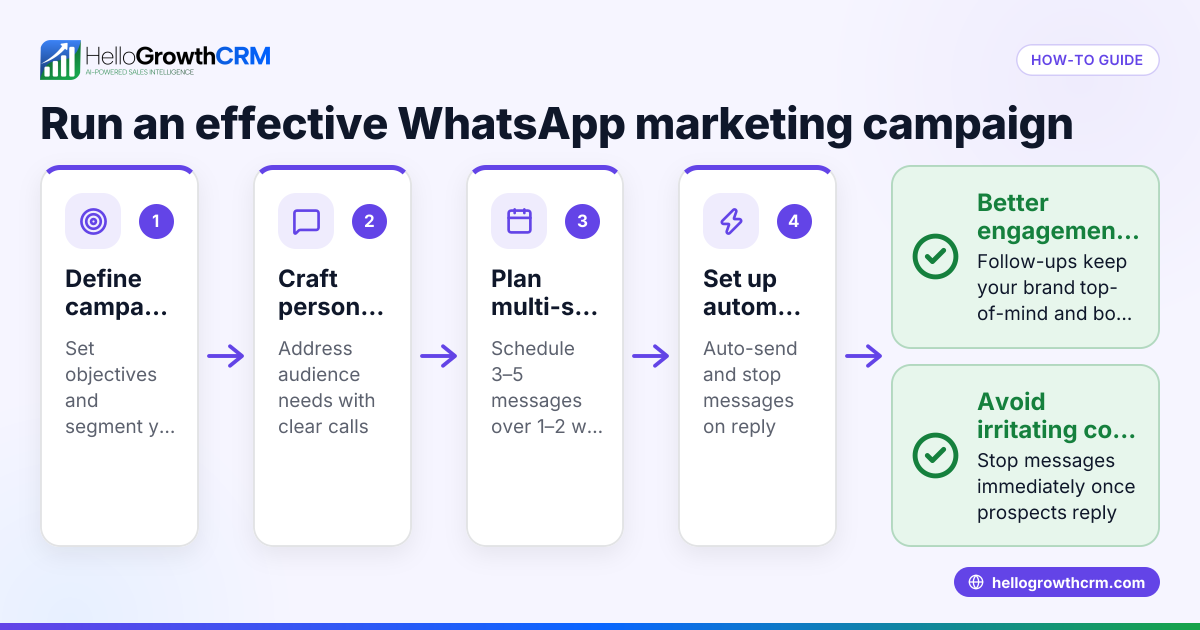
HelloGrowthCRM offers Sequences and campaigns to automate your marketing follow-ups. You can set up a five-step follow-up over two weeks that runs automatically across email, SMS, and WhatsApp, stopping the moment a prospect replies. This helps maintain timely contact without manual effort, ensuring no lead is lost due to slow follow-up. Learn more about WhatsApp and SMS CRM and how the built-in CRM dialer supports your sales team.
Frequently asked questions
How often should I update my marketing campaign calendar? Update your calendar at least monthly or whenever new campaigns arise. Regular updates ensure your team stays aligned and can adjust plans based on results.
What marketing channels work best for Singapore small businesses? WhatsApp, email, and SMS are popular and effective channels for Singapore small businesses due to their wide usage and direct reach.
Can I use HelloGrowthCRM to schedule all my campaign messages? Yes, HelloGrowthCRM’s Sequences allow you to automate multi-step outreach workflows on WhatsApp, email, and SMS, saving time and improving follow-up.
Should I include public holidays in my campaign calendar? Yes, including Singapore public holidays and festivals helps you plan campaigns around times when customers are more receptive or unavailable.
How do I measure if a campaign is successful? Compare your actual sales or leads generated against the goals set in your calendar. Tracking tools and reports help you evaluate performance.
Key takeaways
- List all campaigns and important dates relevant to your Singapore business.
- Set clear, measurable goals and budgets for each campaign.
- Plan channels like WhatsApp, email, and SMS suited to your audience.
- Schedule content timing and assign team responsibilities.
- Track campaign progress and results to improve future planning.
- Use HelloGrowthCRM sequences to automate follow-up and save time.
Start organising your marketing efforts today with a clear campaign calendar. For easy automation, try HelloGrowthCRM’s free plan with 200 leads and no credit card at Start on the Free Forever plan (200 leads, no credit card).
Ready to put this into practice?
Set up your pipeline, WhatsApp follow-ups, and AI lead scoring in minutes — free, no credit card.
Try HelloGrowthCRM freeGet CRM tips in your inbox
Join thousands of sales professionals who get weekly insights on CRM strategy, AI automation, and pipeline optimization.

The HelloGrowthCRM team publishes guides on CRM strategy, AI sales tools, and revenue operations for small business sales teams.