HelloGrowthCRM software
Built for real small-business sales teams
HelloGrowthCRM helps reps qualify faster, follow up on time, and close more deals—with practical automation in one place.
- AI lead scoring and pipeline visibility
- Built-in dialer, WhatsApp, and email automation
- Sales forecasting and RevOps-ready reporting
To create customer reactivation campaigns in the UK, start by identifying inactive customers, segmenting them based on inactivity length or purchase history, and crafting personalised multi-step messages to re-engage them. Schedule these messages over a set period, track responses, and adjust accordingly. This article covers why reactivation matters, detailed steps, a worked example, common mistakes, and how HelloGrowthCRM can help.
Why this comes up / what goes wrong
Small and mid-sized UK businesses often struggle to keep customers engaged after initial sales or periods of activity. Customers may stop buying or interacting for various reasons: forgetfulness, switching to competitors, or lack of follow-up. Without a clear process to reactivate these customers, businesses lose valuable revenue and waste marketing resources on acquiring new leads instead. Many owners run sales through WhatsApp, email and spreadsheets, which makes tracking inactive customers and sending timely messages difficult. This leads to slow or inconsistent follow-up and missed chances to revive customer interest.
Step-by-step
- Identify inactive customers
- Use your sales records or CRM to find customers who haven’t purchased or engaged in a set period (e.g., 3 to 6 months).
- Check for completeness of contact details like email and WhatsApp numbers.
- Segment your inactive customers
- Group customers by inactivity duration (e.g., 3 months, 6 months, 12 months).
- Further segment by purchase history or customer value to tailor messages.
- Define your campaign goal
- Decide whether you want to encourage repeat purchases, update customers on new products, or offer special discounts.
- Craft personalised messages
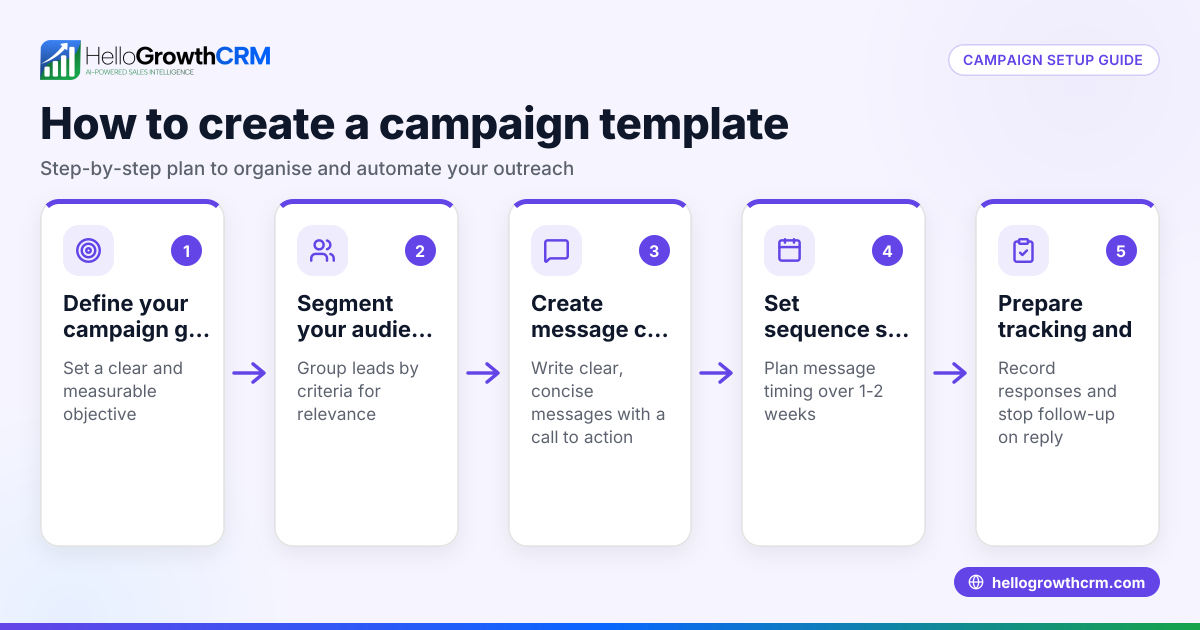
- Write a series of 3 to 5 messages spaced over 1 to 2 weeks.
- Include a clear call to action (e.g., "Check out our new range", "Exclusive 10% discount for returning customers").
- Personalise messages with customer names and references to past purchases if possible.
- Choose communication channels
- Use email, WhatsApp, SMS, or a mix depending on customer preferences.
- Ensure messages comply with UK marketing and data protection laws (NEEDS EXPERT REVIEW).
- Schedule and automate the campaign
- Set up your messages to send automatically over the chosen timeframe.
- Use a tool that stops sending once a customer responds to avoid over-messaging.
- Track responses and engagement
- Monitor who opens, clicks, or replies.
- Update customer status accordingly in your CRM or system.
- Follow up personally where needed
- For high-value or unresponsive customers, consider a direct call or personal message.
- Analyse results and refine
- Review campaign metrics to see what worked.
- Adjust message content, timing or segmentation for future campaigns.
- Maintain a customer health score
- Track ongoing engagement to catch early signs of inactivity. See customer health score for more.
Example (fictional figures)
A recruitment consultancy in Bristol wants to reactivate clients who haven’t used their services for 6 months. They identify 150 inactive clients and segment them into two groups: 100 clients inactive for 6-9 months, and 50 inactive for 9-12 months.
They decide on a five-step WhatsApp and email sequence over two weeks offering a 15% discount on their next recruitment fee.
- Campaign cost estimate: £50 for messaging platform fees.
- Expected reactivation rate: 10% (15 clients).
Revenue from reactivated clients:
Average recruitment fee per client = £3,000
Total expected revenue = 15 × £3,000 = £45,000
Campaign ROI:
Revenue - Cost = £45,000 - £50 = £44,950
ROI percentage = (£44,950 ÷ £50) × 100 = 89,900%
This high ROI shows the value of reactivation campaigns when done efficiently.
Common mistakes
- Not segmenting customers: Sending the same message to all inactive customers wastes relevance. Prevent by grouping customers based on inactivity and value.
- Over-messaging: Bombarding customers with too many messages causes annoyance. Prevent by limiting sequence steps and stopping when a reply is received.
- Ignoring channel preferences: Using only email when customers prefer WhatsApp reduces engagement. Prevent by collecting channel preferences and using multi-channel campaigns like WhatsApp and SMS CRM.
- Lack of personalisation: Generic messages feel spammy. Prevent by including customer names and references to past interactions.
- No tracking or follow-up: Not monitoring campaign results wastes effort. Prevent by tracking responses and updating customer records.
- Failing to comply with marketing laws: Sending unsolicited messages can cause penalties. Prevent by ensuring compliance with UK marketing and data protection requirements (NEEDS EXPERT REVIEW).
Doing this in HelloGrowthCRM
HelloGrowthCRM offers automated sequences and campaigns that let you set up a five-step follow-up over two weeks. The system sends messages across email, SMS and WhatsApp and stops as soon as the customer replies, preventing over-messaging. After a sale, service requests and tickets stay on the same customer record as the deal, keeping your customer data organised. Learn more about these features at HelloGrowthCRM for the United Kingdom.
Frequently asked questions
How often should I send messages in a reactivation campaign? A common approach is to send 3 to 5 messages spaced over 1 to 2 weeks. This keeps your brand in mind without overwhelming customers. Adjust timing based on customer responses.
What if customers don’t respond to the campaign? If there is no response after the sequence, consider a personal follow-up call or email for high-value customers. You can also review the message content and timing for future campaigns.
Can I use WhatsApp for reactivation campaigns? Yes, WhatsApp is effective for personal and direct communication. Using a CRM with WhatsApp integration helps automate and track these messages, as described in WhatsApp and SMS CRM.
How do I measure if a reactivation campaign worked? Measure success by tracking responses, repeat purchases, and revenue generated from the campaign. Update your CRM to reflect reactivated customers and compare sales before and after the campaign.
Is it legal to send marketing messages to inactive customers? You must comply with UK marketing and data protection laws, including obtaining consent and providing opt-out options. Consult a legal expert to ensure compliance (NEEDS EXPERT REVIEW).
Key takeaways
- Identify and segment inactive customers by time and value.
- Use personalised, multi-step messages spaced over 1-2 weeks.
- Choose preferred communication channels like WhatsApp, SMS, and email.
- Automate sequences that stop once the customer replies.
- Track engagement and follow up personally if needed.
- Avoid common mistakes like over-messaging and ignoring preferences.
Creating effective customer reactivation campaigns helps UK businesses recover lost revenue and improve customer relationships. To start building automated sequences that run on their own and stop when a customer replies, try HelloGrowthCRM.
Start on the Free Forever plan (200 leads, no credit card) at HelloGrowthCRM.
Ready to put this into practice?
Set up your pipeline, WhatsApp follow-ups, and AI lead scoring in minutes — free, no credit card.
Try HelloGrowthCRM freeGet CRM tips in your inbox
Join thousands of sales professionals who get weekly insights on CRM strategy, AI automation, and pipeline optimization.

The HelloGrowthCRM team publishes guides on CRM strategy, AI sales tools, and revenue operations for small business sales teams.