HelloGrowthCRM software
Built for real small-business sales teams
HelloGrowthCRM helps reps qualify faster, follow up on time, and close more deals—with practical automation in one place.
- AI lead scoring and pipeline visibility
- Built-in dialer, WhatsApp, and email automation
- Sales forecasting and RevOps-ready reporting
Forecasting monthly sales revenue helps Canadian small business owners predict income and manage cash flow. By estimating expected revenue from your sales pipeline and adjusting for trends, you can create a reliable monthly forecast.
Why this comes up / what goes wrong
Small business owners in Canada often struggle with sales revenue forecasting because they lack a clear process or rely on guesswork. This leads to inaccurate forecasts that can cause cash flow problems or missed growth opportunities. Common issues include not assigning probabilities to sales stages, mixing closed deals with open opportunities, ignoring seasonal trends, and failing to update forecasts regularly. These problems reduce forecast reliability and hurt business planning.
Step-by-step
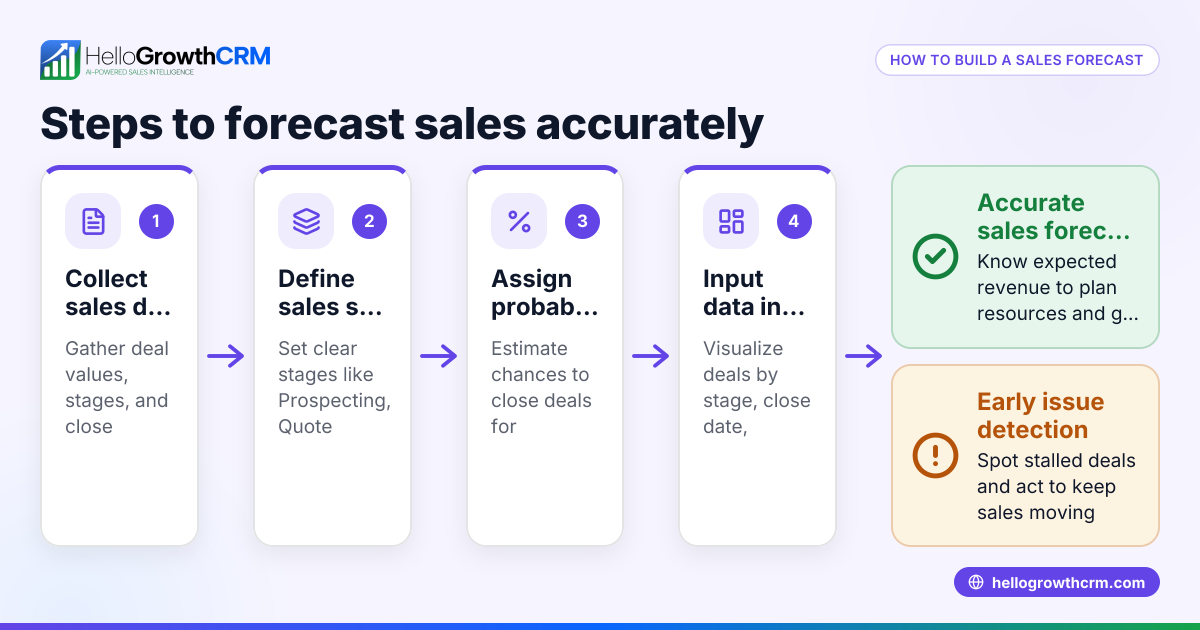
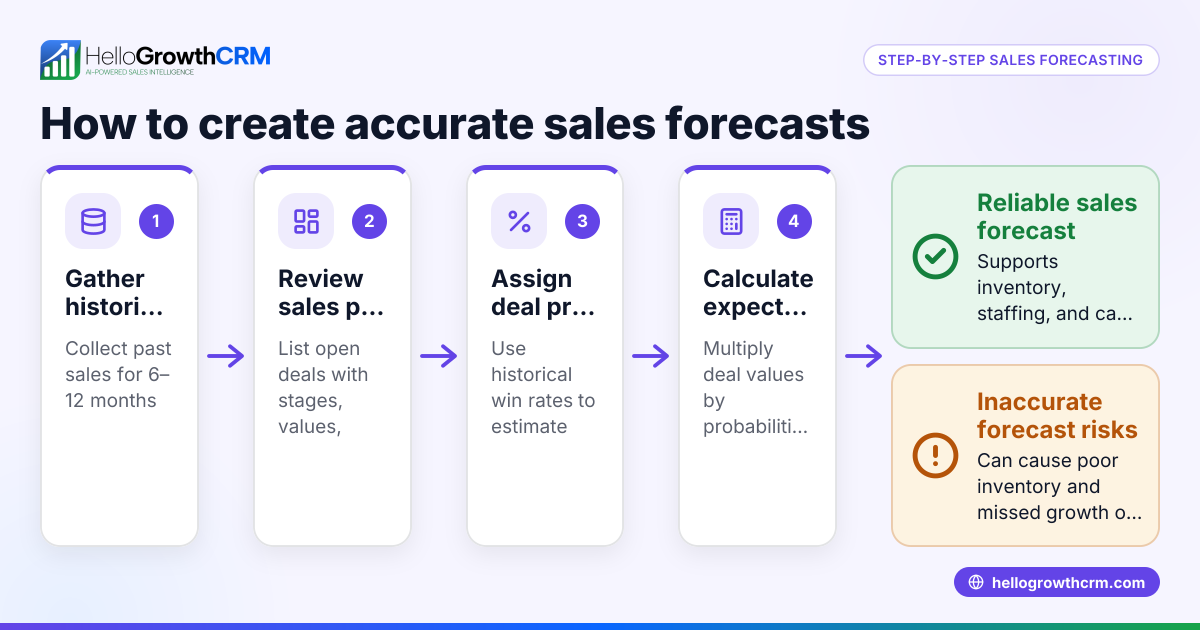
- Collect historical sales data: Gather monthly sales revenue figures from the past 6 to 12 months. Look for patterns, growth, and seasonal changes.
- List current open deals: Identify all active sales opportunities expected to close in the forecast month.
- Assign sales stages and probabilities: Categorize each deal by stage (e.g., prospecting, quote sent, negotiation, closing). Assign each stage a probability of closing based on past experience.
- Calculate expected revenue per deal: Multiply each deal’s value by its stage probability.
- Sum expected revenues: Add expected revenues of all open deals to get the pipeline forecast.
- Adjust for seasonality and market factors: Use historical data to increase or decrease the forecast based on expected seasonal trends or market changes.
- Review forecast accuracy: Compare past forecasts to actual sales and adjust probabilities or assumptions accordingly.
- Document and update monthly: Keep notes on assumptions and revise the forecast regularly as new deals or data appear.
Check that sales data is current and probabilities reflect realistic win rates. Exclude closed deals from the pipeline forecast to avoid double counting. For tools that help automate this, see sales forecasting.
Example (fictional figures)
An HVAC company in Surrey, British Columbia, wants to forecast sales revenue for 2024-07.
- Past average monthly sales: C$120,000
- Open deals:
- Deal A: C$50,000 at 'quote sent' stage, 40% probability
- Deal B: C$30,000 at 'negotiation' stage, 60% probability
- Deal C: C$20,000 at 'prospecting' stage, 20% probability
Calculate expected revenue:
C$50,000 × 40% = C$20,000 C$30,000 × 60% = C$18,000 C$20,000 × 20% = C$4,000
Total expected revenue from pipeline = C$20,000 + C$18,000 + C$4,000 = C$42,000
Adjust for seasonality (assume July is 10% above average):
C$42,000 × 110% = C$46,200
Forecasted monthly sales revenue for 2024-07 = Past average sales + Adjusted pipeline forecast = C$120,000 + C$46,200 = C$166,200
This forecast helps the owner plan inventory, staffing, and cash flow confidently.
Common mistakes
- Ignoring sales stage probabilities: Assign realistic probabilities based on historical conversion rates to avoid overestimating revenue.
- Mixing closed deals with pipeline deals: Include only open deals in your forecast to prevent double counting.
- Not adjusting for seasonality: Use past sales data to identify seasonal patterns and adjust forecasts accordingly.
- Failing to update forecasts regularly: Review forecasts monthly or when pipeline changes significantly to keep projections accurate.
- Overlooking pipeline health signals: Monitor where deals stall in the pipeline to improve sales processes and forecast reliability. HelloGrowthCRM’s sales forecasting tools provide AI insights to highlight these issues.
- Relying solely on spreadsheets: Manual tracking can lead to errors and missed opportunities; consider CRM tools for automation.
Doing this in HelloGrowthCRM
HelloGrowthCRM offers pipeline forecast and AI insights that automatically project expected close amounts based on deal stages, velocity, and historical patterns. This helps owners see which stages deals stall in without building spreadsheets. The Deals (pipeline) feature tracks opportunities from first contact through closing, with stage movement and follow-up dates, so no quotation or lead is forgotten. For businesses with field sales, territories and field operations tools allow reps to log visits from their phones and managers to view daily activities. Learn more about HelloGrowthCRM for Canada here.
Frequently asked questions
How often should I update my sales revenue forecast? Update your forecast monthly or whenever significant changes occur in your pipeline or market conditions. Regular updates keep your projections accurate and actionable.
What sales stages should I use for forecasting? Common stages include prospecting, qualified lead, quote sent, negotiation, and closing. Assign each stage a probability based on your historical win rates to calculate expected revenue.
Can I forecast sales revenue without historical data? While possible, forecasts without historical sales data are less reliable. Use industry benchmarks or start tracking sales data immediately to improve future forecasts.
How does seasonality affect sales forecasting? Seasonality causes predictable fluctuations in sales volume. Adjust your forecast by analysing past sales patterns during similar months to account for these changes.
What tools can help with sales forecasting? CRMs like HelloGrowthCRM provide pipeline forecast and AI insights that simplify forecasting by analysing your deals and sales stages automatically. See AI CRM for details.
Key takeaways
- Gather and analyse historical sales data and current open deals.
- Assign probabilities to sales stages and calculate expected revenue per deal.
- Adjust forecasts for seasonality and market changes.
- Update and review forecasts regularly to improve accuracy.
- Use CRM tools like HelloGrowthCRM to automate pipeline tracking and forecasting.
Start forecasting your monthly sales revenue today with clear steps and practical checks. To streamline this process, consider using HelloGrowthCRM’s free tools. You can start on the Free Forever plan (200 leads, no credit card) now.
Ready to put this into practice?
Set up your pipeline, WhatsApp follow-ups, and AI lead scoring in minutes — free, no credit card.
Try HelloGrowthCRM freeGet CRM tips in your inbox
Join thousands of sales professionals who get weekly insights on CRM strategy, AI automation, and pipeline optimization.

The HelloGrowthCRM team publishes guides on CRM strategy, AI sales tools, and revenue operations for small business sales teams.