HelloGrowthCRM software
Built for real small-business sales teams
HelloGrowthCRM helps reps qualify faster, follow up on time, and close more deals—with practical automation in one place.
- AI lead scoring and pipeline visibility
- Built-in dialer, WhatsApp, and email automation
- Sales forecasting and RevOps-ready reporting
To improve B2B sales pipeline efficiency with software tools, systematically track leads, automate follow-ups, and analyze pipeline stages to identify bottlenecks. This article covers why inefficiencies occur, step-by-step actions to optimize your pipeline, a worked example with realistic figures, common mistakes to avoid, and how HelloGrowthCRM’s features can help streamline your process.
Why this comes up / what goes wrong
Small and mid-sized businesses often lose leads or delay closing deals because their sales pipeline is managed manually or across disconnected tools like text messages, email, and spreadsheets. Without a centralized system, leads get forgotten, follow-ups are inconsistent, and it becomes hard to see which deals are stalling or which sales reps need support. This slows down sales velocity and reduces revenue predictability.
Step-by-step
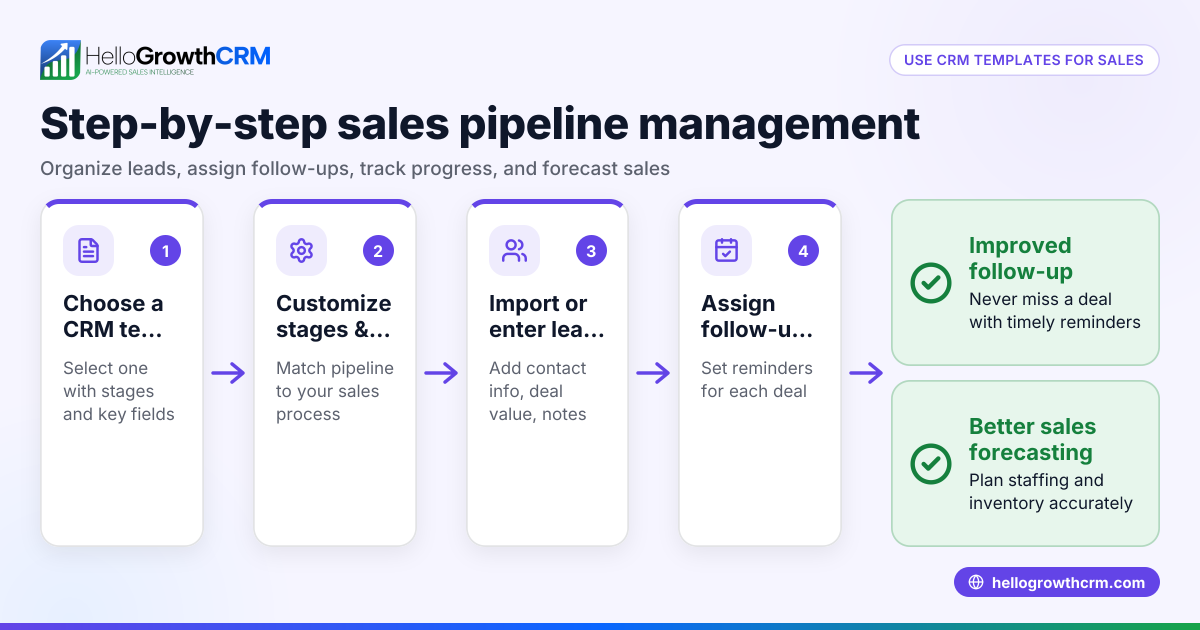
- Centralize your leads and deals in one pipeline tool. Import all current leads and open deals into a single software platform. Check that each lead is assigned to a sales stage reflecting its current status.
- Define clear sales stages and criteria. For example: New Lead, Contacted, Demo Scheduled, Quote Sent, Negotiation, Closed Won/Lost. Check that all deals are categorized correctly.
- Set follow-up tasks and reminders. For each deal, schedule follow-up dates to prevent leads from slipping through. Verify that no deal is without a next action.
- Automate follow-up communications. Use email, SMS, or WhatsApp sequences to nurture leads automatically. Check that sequences are personalized and timed appropriately.
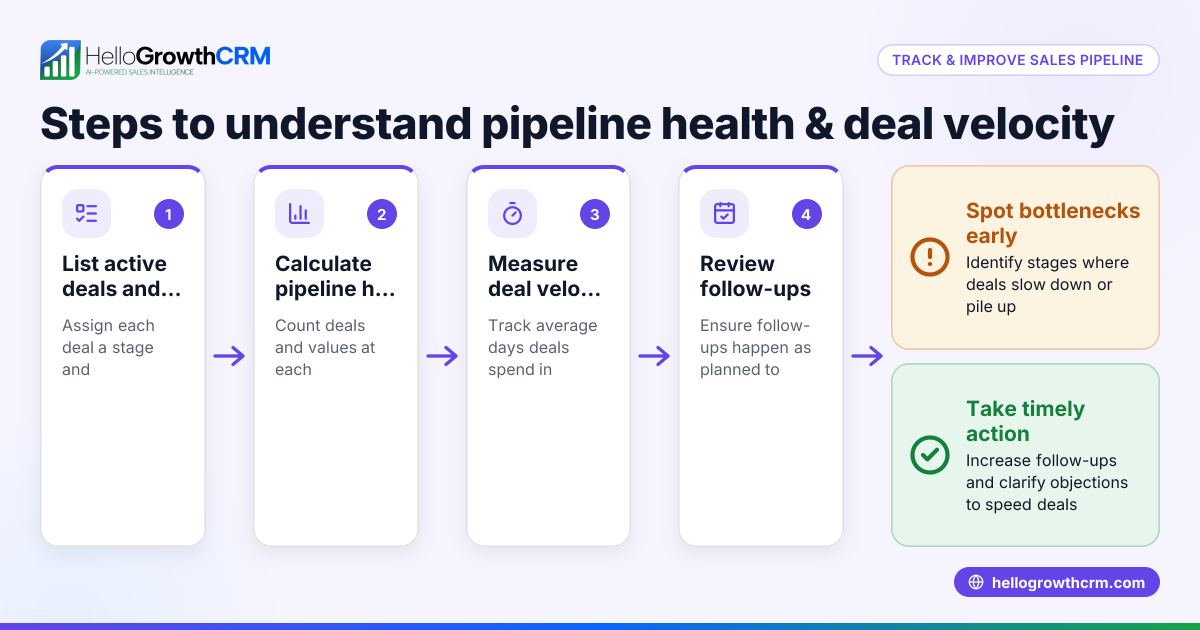
- Track deal movement and velocity. Monitor how long deals stay in each stage and identify bottlenecks. Check pipeline reports weekly for stalled deals.
- Use AI or analytics tools to forecast sales. Analyze your pipeline data to predict revenue and prioritize high-probability deals. Check forecast accuracy regularly and adjust your sales focus accordingly.
- Train your sales team on using the software daily. Ensure everyone updates deal stages and notes consistently. Check usage reports to confirm adoption.
- Download and use free sales tools and templates. Use pipeline templates and follow-up cadences to standardize processes. Check that your pipeline template fits your sales cycle.
Example (fictional figures)
A plumbing company in Austin, Texas, wants to improve its B2B sales pipeline efficiency. They have 50 open deals totaling $500,000 in potential revenue.
- They import all leads into a pipeline software and assign stages.
- They set follow-up reminders for deals at the "Quote Sent" stage totaling $120,000.
- They notice deals stay an average of 15 days at "Quote Sent" before moving.
- They automate email follow-ups to remind prospects.
- After 30 days, 10 deals worth $50,000 close, 5 deals worth $20,000 are lost, and 35 deals remain.
Calculations:
$500,000 total pipeline = sum of all deal values
Deals at "Quote Sent" stage = $120,000
Deals closed = $50,000
Deals lost = $20,000
Remaining pipeline = $500,000 - $50,000 - $20,000 = $430,000
By tracking deal stages and automating follow-ups, the company reduces deal stagnation and improves cash flow.
Common mistakes
- Failing to update deal stages regularly: Leads to inaccurate pipeline views. Prevent by setting daily update reminders.
- No scheduled follow-ups: Causes lost leads. Prevent by automating follow-up tasks and using reminder notifications.
- Using multiple disconnected tools: Results in data fragmentation. Prevent by centralizing sales data in one platform.
- Ignoring pipeline analytics: Misses bottlenecks and forecasting errors. Prevent by reviewing pipeline reports weekly.
- Poor team adoption: Leads to incomplete data. Prevent by training and monitoring software usage.
- Not using templates or sales tools: Causes inconsistent processes. Prevent by downloading free sales tools and templates to standardize.
Doing this in HelloGrowthCRM
HelloGrowthCRM offers a Deals (pipeline) feature that tracks open opportunities from first contact through close. For example, a quotation sent last week appears as a deal at the "quote sent" stage with a follow-up date, so it is not forgotten. You can also download free sales tools, templates, and calculators without an account, including follow-up cadence and pipeline templates to structure your sales process. Additionally, pipeline forecast and AI insights help you see which stages deals are stalling in without building spreadsheets, enabling better prioritization and forecasting. Learn more about HelloGrowthCRM’s AI CRM, sales forecasting, and explore free sales tools and calculators.
Frequently asked questions
How can software tools speed up my B2B sales pipeline? Software centralizes lead data, automates follow-ups, and tracks deal progress in real time. This reduces manual errors and delays, allowing your team to focus on closing deals faster.
What sales stages should I use in my pipeline? Common stages include New Lead, Contacted, Demo Scheduled, Quote Sent, Negotiation, and Closed Won/Lost. Define stages that reflect your sales process clearly and ensure every deal fits one stage.
How do I ensure my sales team uses the CRM consistently? Provide training, set usage expectations, and monitor activity reports. Choose a user-friendly CRM that integrates with tools your team already uses, like WhatsApp or email.
Can I use free tools to improve pipeline efficiency? Yes, many CRMs offer free templates and calculators to help standardize follow-ups and pipeline management. Using these tools reduces setup time and improves consistency.
What is pipeline forecasting and why is it important? Pipeline forecasting uses current deal data and historical trends to predict future sales revenue. It helps prioritize deals and make informed business decisions.
Key takeaways
- Centralize all leads and deals in one pipeline management tool.
- Define clear sales stages and schedule follow-up tasks for every deal.
- Automate follow-ups using email, SMS, or WhatsApp sequences.
- Regularly analyze pipeline data to identify bottlenecks and forecast revenue.
- Train your sales team for consistent CRM usage.
- Use free sales tools and templates to standardize your sales process.
Start improving your B2B sales pipeline efficiency today. Start on the Free Forever plan (200 leads, no credit card) with HelloGrowthCRM to organize your leads, automate follow-ups, and forecast sales more accurately.
Ready to put this into practice?
Set up your pipeline, WhatsApp follow-ups, and AI lead scoring in minutes — free, no credit card.
Try HelloGrowthCRM freeGet CRM tips in your inbox
Join thousands of sales professionals who get weekly insights on CRM strategy, AI automation, and pipeline optimization.

The HelloGrowthCRM team publishes guides on CRM strategy, AI sales tools, and revenue operations for small business sales teams.