HelloGrowthCRM software
Built for real small-business sales teams
HelloGrowthCRM helps reps qualify faster, follow up on time, and close more deals—with practical automation in one place.
- AI lead scoring and pipeline visibility
- Built-in dialer, WhatsApp, and email automation
- Sales forecasting and RevOps-ready reporting
To issue a credit note in Singapore, you must create a formal document that adjusts or cancels a previously issued invoice. The credit note should clearly reference the original invoice and state the reason for the credit, such as returned goods, overbilling, or discounts. It must include a unique credit note number, the date, customer details, and the amount credited. This process ensures your accounting and GST records remain accurate.
Why this comes up / what goes wrong
Small business owners in Singapore often need to issue credit notes when customers return goods, services are partially cancelled, or billing errors occur. For example, an F&B supplier might deliver damaged items, or a service provider might overcharge. Without a proper credit note, the customer may not get a refund or adjustment, and your GST reporting could be incorrect. Some businesses struggle because they do not know how to format a credit note or when to issue one, leading to delayed payments or compliance issues.
Step-by-step
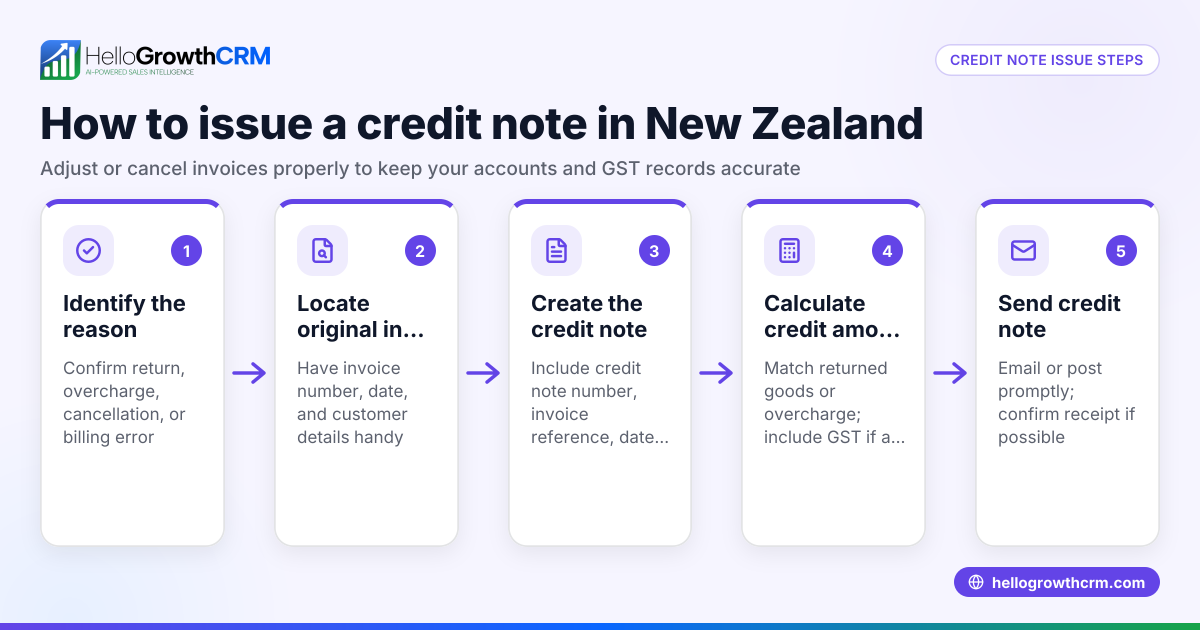
- Identify the reason for the credit note: Determine why you need to issue a credit note, such as returned goods, pricing errors, or service cancellations. Check your original invoice for details.
- Prepare the credit note document: Create a document titled "Credit Note" that includes:
- A unique credit note number for tracking
- Date of issue
- Customer’s name and contact details
- Reference to the original invoice number and date
- Description of the goods or services being credited
- Quantity and price adjustments
- Total credit amount
- State the reason clearly: Include a brief explanation for the credit note, e.g., "Return of damaged goods" or "Price adjustment due to overbilling".
- Calculate the credit amount: Confirm the amount to be credited, including GST if applicable. Ensure calculations are accurate.
- Send the credit note to the customer: Deliver the credit note promptly via email or physical copy, depending on your usual communication.
- Record the credit note in your accounts: Adjust your accounting records to reflect the credit note. This affects your sales ledger and GST returns.
- Keep a copy for your records: Maintain a copy of the credit note for audit and GST filing purposes.
- Check GST implications: If GST was charged on the original invoice, adjust your GST reporting accordingly. NEEDS EXPERT REVIEW
For efficient follow-up on credit notes and customer queries, consider using tools like the built-in CRM dialer and WhatsApp and SMS CRM to keep your sales and support teams coordinated.
Example (fictional figures)
A Woodlands-based F&B supplier issued Invoice #INV2023-1001 to a restaurant for 100 crates of fruit at S$50 each, dated 10/05/2023. The restaurant returned 10 crates due to spoilage.
- Original invoice amount: 100 × S$50 = S$5,000
- Returned goods credit: 10 × S$50 = S$500
- GST assumed at illustrative 8% on credit amount: S$500 × 8% = S$40
- Total credit note amount: S$500 + S$40 = S$540
The credit note would reference Invoice #INV2023-1001, state the return of 10 crates, and show a credit of S$540 dated 15/05/2023.
Common mistakes
- Not referencing the original invoice: Always include the original invoice number to avoid confusion. Prevent by double-checking before sending.
- Incorrect credit amount or GST calculation: Verify amounts carefully and consult GST rules. Use a calculator or accounting software.
- Delaying issuance: Issue credit notes promptly to maintain customer trust and accurate records.
- Failing to keep records: Keep copies for audit and GST filing to avoid compliance issues.
- Not informing the customer properly: Always send the credit note clearly and confirm receipt.
Using a built-in CRM dialer can help your sales team follow up on credit notes and customer queries efficiently.
Frequently asked questions
What is the difference between a credit note and a debit note? A credit note reduces the amount a customer owes, usually due to returns or errors. A debit note is issued by the buyer to request a credit note or to indicate an increase in amount payable. Both should reference original invoices.
Do I need to issue a credit note for GST purposes? Yes, if GST was charged on the original invoice, a credit note is necessary to adjust the GST amount reported. This ensures your GST returns are accurate. NEEDS EXPERT REVIEW
Can I issue a credit note for part of an invoice? Yes, credit notes can cover partial returns or adjustments. Clearly state the quantity and value being credited.
Is there a time limit to issue a credit note? There is no fixed statutory deadline, but it should be issued as soon as the need arises to keep accounting and GST records correct. Check your business policies.
How do I record a credit note in my accounting system? Record the credit note as a negative invoice or adjustment to sales. Ensure the GST is adjusted accordingly. Consult your accountant or accounting software help.
Key takeaways
- Always issue a credit note referencing the original invoice with a unique number and date.
- Clearly state the reason for the credit and calculate amounts including GST if applicable.
- Send the credit note promptly and keep copies for your records.
- Avoid common mistakes like incorrect amounts, delayed issuance, or poor record-keeping.
- Adjust your accounting and GST reporting to reflect the credit note.
Start managing your sales and customer communications better with HelloGrowthCRM for Singapore. For efficient follow-up on credit notes and customer queries, use the built-in CRM dialer and WhatsApp and SMS CRM.
Start on the Free Forever plan (200 leads, no credit card) at HelloGrowthCRM.
Ready to put this into practice?
Set up your pipeline, WhatsApp follow-ups, and AI lead scoring in minutes — free, no credit card.
Try HelloGrowthCRM freeGet CRM tips in your inbox
Join thousands of sales professionals who get weekly insights on CRM strategy, AI automation, and pipeline optimization.

The HelloGrowthCRM team publishes guides on CRM strategy, AI sales tools, and revenue operations for small business sales teams.