HelloGrowthCRM software
Built for real small-business sales teams
HelloGrowthCRM helps reps qualify faster, follow up on time, and close more deals—with practical automation in one place.
- AI lead scoring and pipeline visibility
- Built-in dialer, WhatsApp, and email automation
- Sales forecasting and RevOps-ready reporting
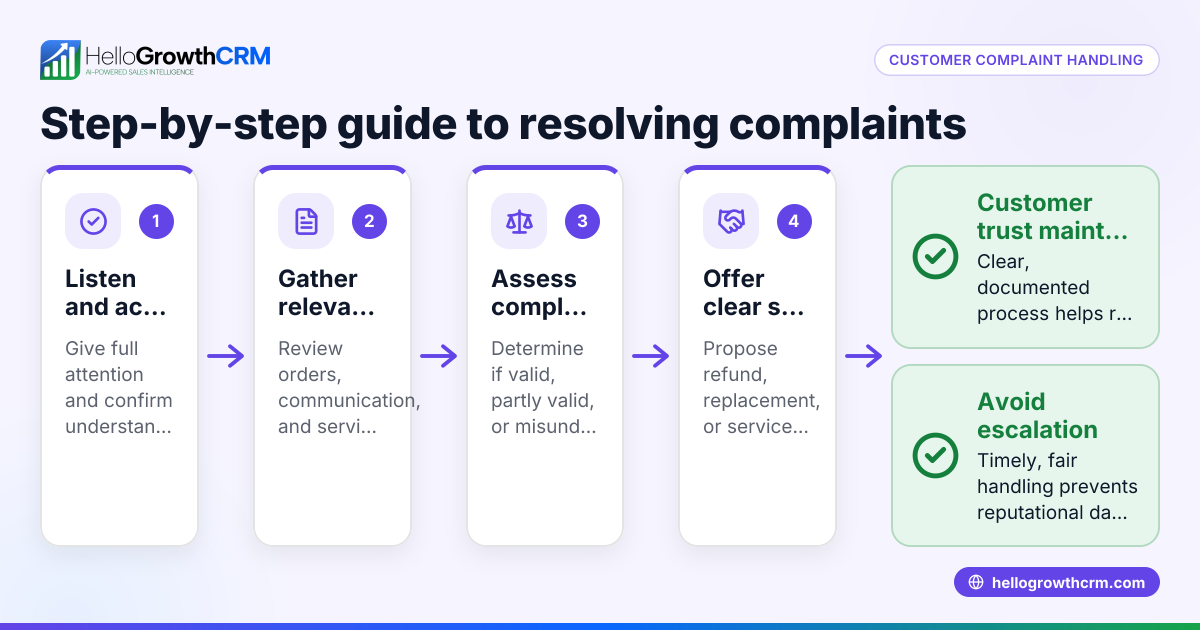
Managing repeat customer complaints effectively is crucial for maintaining your business reputation and customer loyalty. The key is to document complaints clearly, analyse patterns, respond quickly, and resolve issues permanently. This article explains why repeat complaints happen, offers a step-by-step guide to handle them, shows a realistic example from a Singapore business, highlights common mistakes, and introduces how HelloGrowthCRM can support your efforts.
Why this comes up / what goes wrong
Small and mid-sized businesses in Singapore often face repeat customer complaints because complaints are not tracked consistently or resolved thoroughly. For example, a property agency may receive recurring complaints about delayed responses or unclear communication. Without a system to log these complaints and identify trends, the same issues keep happening. Businesses may also fail to follow up with customers after resolving the complaint, leaving dissatisfaction unresolved. Managing complaints manually via WhatsApp, email, or spreadsheets can slow down response times and cause information to be lost.
Step-by-step
- Record each complaint in detail
- Capture customer name, contact, date, complaint description, and product or service involved.
- Check that all complaints are logged in one place for easy tracking.
- Categorise complaints by type and urgency
- Assign categories such as product defect, service delay, or billing error.
- Prioritise urgent complaints that affect customer safety or legal compliance.
- Analyse for repeat patterns weekly or monthly
- Review logged complaints to find recurring issues or customers.
- Check if the same problem or customer accounts for multiple complaints.
- Communicate promptly with the customer
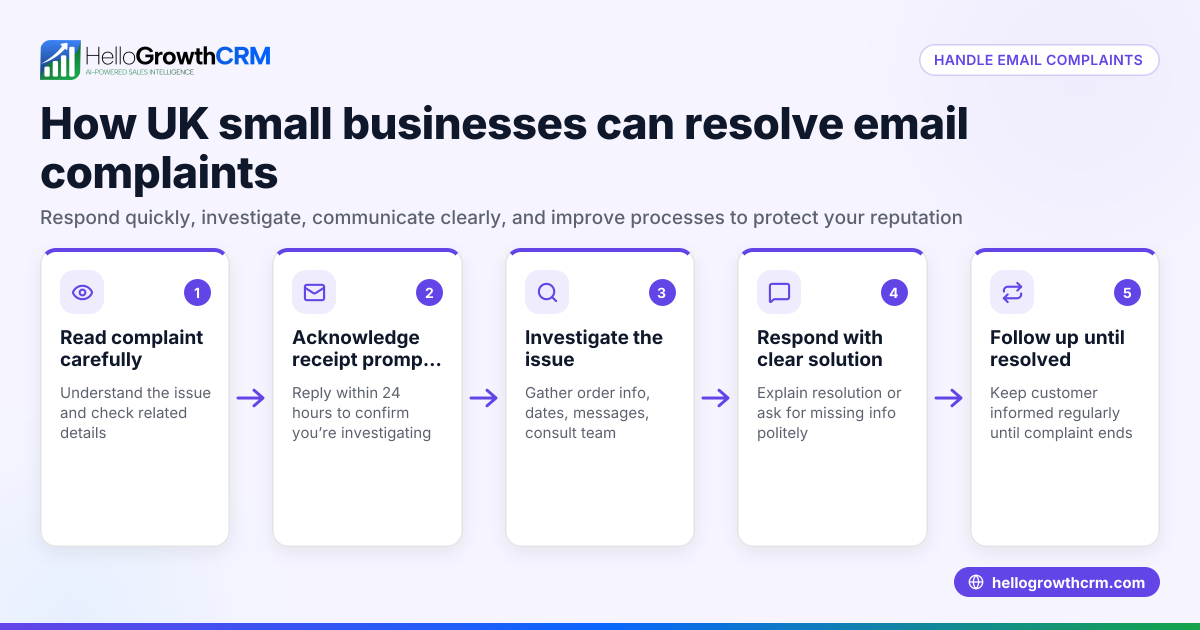
- Acknowledge receipt of the complaint within 24 hours.
- Provide a clear timeline for resolution and next steps.
- Investigate and identify root causes
- Check internal processes, staff actions, or product quality related to the complaint.
- Confirm findings with relevant teams.
- Implement corrective actions
- Fix the root cause to prevent recurrence.
- Update processes or provide staff training if needed.
- Follow up with the customer after resolution
- Confirm the issue is resolved to their satisfaction.
- Invite feedback or offer compensation if appropriate.
- Document the resolution and close the complaint
- Record all actions taken and customer responses.
- Mark the complaint as closed only after confirmation.
- Use complaint data for continuous improvement
- Report trends to management regularly.
- Adjust products, services, or policies based on insights.
- Leverage tools like HelloGrowthCRM
- Use the customer portal, tickets, and knowledge base to centralise complaints and resolutions.
- Keep service requests linked to the customer record for full history.
Example (fictional figures)
A property agency in Novena receives repeat complaints about delayed contract processing. They logged 15 complaints between 01/01/2024 and 31/03/2024. The agency follows these steps:
- Total complaints: 15
- Complaints related to contract delays: 12
- Average delay reported: 5 days
Step 1: Record complaints with dates and customer details.
Step 2: Categorise all 12 as "service delay".
Step 3: Analyse and find that delays stem from manual document handling.
Step 4: Acknowledge complaints within 24 hours via WhatsApp.
Step 5: Investigate and discover bottlenecks in contract approval.
Step 6: Implement digital contract management to reduce delays.
Step 7: Follow up with customers confirming improved processing times.
Step 8: Document resolutions and close complaints.
Step 9: Report to management quarterly and monitor new complaints.
This process helped reduce repeat complaints by improving the root cause.
Common mistakes
- Not logging complaints consistently: Prevent by using a central system to capture every complaint.
- Ignoring the root cause: Prevent by analysing complaint patterns regularly.
- Delayed or no communication with customers: Prevent by setting response time targets.
- Closing complaints without confirmation: Prevent by following up and documenting customer satisfaction.
- Using separate tools causing information loss: Prevent by centralising complaints in one CRM, such as HelloGrowthCRM.
- Failing to train staff on complaint handling: Prevent by providing regular training and updates.
Doing this in HelloGrowthCRM
HelloGrowthCRM offers a customer portal where customers can submit complaints directly. Support tickets and a knowledge base help your team manage and resolve issues efficiently. After the sale, service requests stay on the same customer record as the deal, giving your team full context. This centralisation simplifies tracking repeat complaints and improves response times. Learn more about how HelloGrowthCRM supports customer health score and WhatsApp and SMS CRM features to enhance communication and complaint management customer health score, WhatsApp and SMS CRM, and HelloGrowthCRM for Singapore.
Frequently asked questions
How quickly should I respond to a customer complaint? Respond within 24 hours to acknowledge the complaint and set expectations for resolution. Prompt communication helps reduce customer frustration.
What if a customer keeps complaining about the same issue? Analyse the root cause carefully and implement corrective actions. Use a CRM to track all complaints from the customer to identify patterns and ensure complete resolution.
Can I use WhatsApp to manage complaints? Yes, WhatsApp is widely used in Singapore for customer communication. Using a CRM that integrates WhatsApp and SMS can centralise messages and complaints, improving follow-up and record-keeping.
Why is documenting complaint resolution important? Documentation provides a clear history for future reference, ensures accountability, and helps prevent repeat complaints by showing what actions were taken.
How can I prevent repeat complaints long-term? Regularly review complaint data, improve products or services based on feedback, train staff on complaint handling, and use CRM tools to monitor customer health.
Key takeaways
- Log every complaint with full details in one system.
- Analyse complaints regularly to identify repeat issues.
- Communicate promptly and follow up after resolution.
- Address root causes to prevent recurrence.
- Avoid common mistakes like inconsistent logging and poor communication.
- Use HelloGrowthCRM’s customer portal and ticket system to centralise complaint management.
Managing repeat customer complaints effectively protects your business reputation and builds customer trust. Start managing complaints systematically today with the help of tools like HelloGrowthCRM.
Start on the Free Forever plan (200 leads, no credit card) at HelloGrowthCRM.
Ready to put this into practice?
Set up your pipeline, WhatsApp follow-ups, and AI lead scoring in minutes — free, no credit card.
Try HelloGrowthCRM freeGet CRM tips in your inbox
Join thousands of sales professionals who get weekly insights on CRM strategy, AI automation, and pipeline optimization.

The HelloGrowthCRM team publishes guides on CRM strategy, AI sales tools, and revenue operations for small business sales teams.